Auto-claude-code-research-in-sleep
ARIS ⚔️ (Auto-Research-In-Sleep) — Lightweight Markdown-only skills for autonomous ML research: cross-model review loops, idea discovery, and experiment automation. No framework, no lock-in — works with Claude Code, Codex, OpenClaw, or any LLM agent.
原始仓库简介 · 中文摘要待补充 · ai-research / ai-tools / aris / autonomous-agent / claude / claude-code
README / 项目原文
Auto-claude-code-research-in-sleep (ARIS ⚔️🌙)










🌱 ARIS is a methodology, not a platform. What matters is the research workflow — take it wherever you go.
💡 Use ARIS as a skill-based workflow in Claude Code / Codex CLI / Cursor / Trae / Antigravity / GitHub Copilot CLI / OpenClaw / DeepSeek Harness — enjoy any way you like!
The executor drives, an independent model (Codex MCP by default) reviews. Alternative model combinations, including ModelScope-hosted models, need no Claude or OpenAI API.
📦 Those are the skills installed directly. Want it in one command? ARIS also ships as a standalone CLI and as plugins: 



❗ 
codex mcp-server — the entry point every ARIS reviewer call used. No impact on ARIS: the codex MCP server is now ARIS's own bridge over codex exec (mcp-servers/codex-exec/), same tools, same results, all 82 skills unchanged, ultra and per-thread resume intact. One re-registration is all it takes — already installed? → Quick Start step 2b · new install → step 2 · what changed.
🧩 The ARIS family — same method, other jobs. One line each; the details live in their own repos.



CLAUDE.md / AGENTS.md against the four shapes agents over-defend in (Hashing, Edge cases, Rubrics, Overbuild), bounding what the agent proposes, never what it looks for. Anti-Autoresearch: 61 integrity signals into a deterministic, reviewer-ready report — fabrication forensics, not an AI-text detector.

/method-figure).

cd aris-monitor && ./run.sh. Many windows? Claude Fleet by @tianyilt is the full dashboard.
🔥 ARIS-Code CLI — 独立安装版 · English | ⬇️ Download · 
ARIS_REASONING_EFFORT works on the Anthropic channel, tool calls through {}-placeholder relays fixed, OS proxy honoured. v0.4.27: launching and quitting the REPL leaves no empty session file. v0.4.26: the fable alias and /model now point at Fable 5.1 (default stays Opus 5). v0.4.25: the Codex reviewer works again on codex-cli ≥ 0.154 (built-in codex exec bridge, nothing to register), /since takes you back to your last input, /resume lists sessions by index, Windows multi-line paste fixed (pending confirmation), 83 bundled skills on GPT-6-Astra.
ARIS-Code — screenshot, what's in v0.4.28, per-release details, older versions
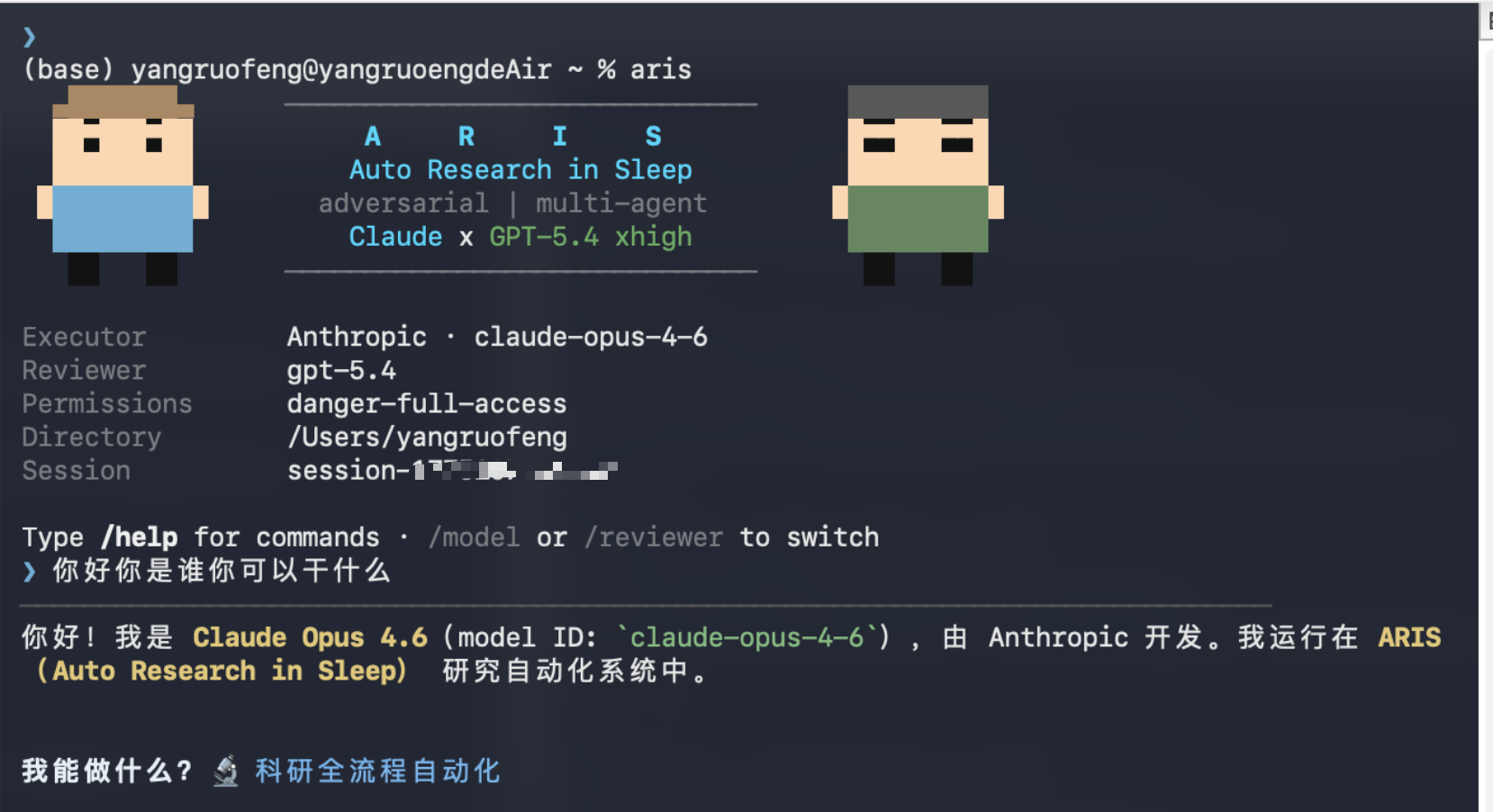
📰 ARIS-Code v0.4.28 (2026-09) — latest: ARIS_REASONING_EFFORT works on the Anthropic channel (#446), tool calls through relays that send a {} placeholder no longer fail (#444), and the OS proxy on Windows / macOS is used without exporting HTTPS_PROXY (#401). v0.4.27: launching and quitting the REPL no longer leaves an empty session file, and /resume lists only sessions with messages (#439 follow-up). v0.4.26 made Fable 5.1 the fable alias and the first /model entry (the default executor stays Opus 5). v0.4.25 is the reviewer-bridge release: codex-cli 0.154 removed codex mcp-server, so every Codex review from ARIS-Code died on an updated codex. The reviewer now runs over a built-in codex exec bridge — no mcpServers.codex entry, old entries migrate in memory, thread records interoperate with ARIS's Python bridge. Also: /since replays everything after your last input (folded like the live display, /since full for complete output), /resume lists sessions with indices and shows where you stopped (#439), Windows multi-line paste no longer submits line by line (#430, pending confirmation), the Windows shim message carries the native installer (#428), and the bundle moves to 83 skills on GPT-6-Astra. Recent headliners: v0.4.24 — Claude 5 model refresh (Opus 5 default, Fable 5 tier, availability chain) and v0.4.23 — output folding. Caps a 24-release run (v0.4.5 → v0.4.28); per-release detail below. Credits: @GetIT-Sunday, @Anduin9527, @GO-player-hhy, @Jxy-yxJ, @screw-44, @StevenUST, @opposj, @ShijunLei-cn, @algojogacor, @YukinoshitaLove, @jinliye-2026, @SajimJC, @JasmineLCY.
Per-release details (v0.4.5 → v0.4.28)
v0.4.28 (2026-09-28) —
ARIS_REASONING_EFFORTnow works on the Anthropic channel (#446):low/medium/high/xhigh/maxfor the main session and subagents; unset, requests are unchanged.ARIS_MAX_TOKENSraises the output cap when a high effort runs into it.autoCompactEnabled: falsein settings turns automatic compaction off. 🐛 #444 tool calls through relays that send a{}placeholder no longer fail withinvalid tool input JSON. 🌐 System proxy on Windows / macOS is used without exportingHTTPS_PROXY(#401, by @JasmineLCY);NO_PROXY=*connects directly as before. Upgrading: if you already exportARIS_REASONING_EFFORT, have an OS proxy, or haveautoCompactEnabled: falsein settings, read the upgrade notes.v0.4.27 (2026-09-19) — launching and quitting the REPL no longer leaves an empty session file;
/resumelists only sessions with messages (#439 follow-up).v0.4.26 (2026-09-16) — Fable 5.1: the
fablealias now resolves toclaude-fable-5-1,/modellists Fable 5.1 first (Fable 5 stays selectable) and the system-prompt identity names it; the default executor remainsclaude-opus-5(the Mythos tier is $10/$50 vs Opus 5's $5/$25, so the default does not move). Savedexecutor_modelvalues are ids, not aliases, and are untouched. Pricing already matched onfable; a test pins 5.1. Tests unchanged (aris-cli 225 + 4 e2e / runtime 252 / tools 71 / commands 6). Codex MCP (gpt-6-astra xhigh) gate: GO.v0.4.25 (2026-09-16) — the reviewer-bridge release. codex-cli 0.154 removed
codex mcp-server, the entry point ARIS-Code'saris setuphad written into settings.json for every Codex review; on an updated codex every review call died. Built-incodex execbridge:mcp__codex__codex/codex-replyrun ascodex exec --jsonwith nothing to register — no settings entry, a legacycodex mcp-serverentry is migrated in memory (env,-cdefaults,requestTimeoutSecs, trust kept), an explicit Python-bridge entry is used as configured, thread records share~/.codex/state/codex-exec/threads/with the Python bridge, 1800 s budget forultraaudits,ARIS_CODEX_BRIDGE=0restores the old path;aris doctorprints the effective backend. Found on the way: the model never received a Codex result'sthreadId(it lives only instructuredContent), socodex-replycould not continue a thread — results now start with athreadId:line./since [full]replays the user's last input and everything after it with the live formatters (display only; after/resumeand in--resumebatch mode too); a dim hint after turns with ≥ 8 tool calls (ARIS_TURN_SUMMARY=0). #430 Windows consoles deliver no paste event, so each pasted line became its own Enter — lines are now merged into the input and never auto-submitted, Ctrl+C discards the rest (ARIS_PASTE_BURST=0; inferred from crossterm's source, pending confirmation on a Windows machine). #439/resumelists sessions with[n]indices and ages and accepts an index, a unique id prefix or a path; the last turn is replayed after loading. #428 the.cmd-shim message carries the official native installer one-liner. Bundle 81→83 (pin 3e49e63 → 4734364):/proof-orchestrator,/research-implement-feature, 32 helpers (+review_gate.py,copilot_native_evidence.py,idea_discovery_gate.py), repo-roottemplates/bundled; reviewer doctrine and system prompt on gpt-6-astra (fallback gpt-5.6-sol → gpt-5.5), explicit— reviewer:directives win,LlmReviewresults carryreviewer_model:so HTTP rounds report toreview_gate.pytruthfully; gpt-6-astra pricing tier $10/$50 (cache write $12.50, read $1). Tests: api 35+6 / aris-cli 225 + 4 e2e / runtime 252 / tools 71 / commands 6, all green; livecodex execfresh + resume roundtrip on codex-cli 0.154.0. Codex MCP (gpt-6-astra): ultra design gate (2 rounds), xhigh implementation gate per step (5/2/2/2 rounds), final whole-diff gate (2 rounds) → GO.v0.4.24 (2026-08-09) — the Claude 5 model refresh (#392, requested by @YukinoshitaLove). Explicit
--model claude-opus-5/claude-fable-5already passed through on every platform — this release makes them first-class. Default →claude-opus-5(main session, subagents,aris setup; same $5/$25 tier as Opus 4.8); the v0.4.18 availability fallback becomes an ordered chain walk (Opus 5 → Opus 4.8 → Opus 4.7, one step per precise404 not_found_error, explicit choices never silently change) — the naive constant swap would have stranded 4.7-only accounts and configs saved by v0.4.23's setup, a regression the cross-model review caught and an end-to-end mock-404 chain test now locks./modelpicker adds Fable 5 / Opus 5 / Sonnet 5; newfablealias. New Mythos-class pricing tier (fable/mythos= $10/$50, cache write $12.50 / read $1, verified 2026-08 — previously fell to the conservative $15/$75 unknown-model tier, a 1.5× over-estimate); Opus 5 / Sonnet 5 pinned on their existing branches. Tests: api 41 / aris-cli 213 + 4 e2e / runtime 226 / tools 70 / commands 5, all green; live smoke on claude-opus-5, claude-fable-5 and the fable alias. Codex MCP (gpt-6-astra xhigh) implementation gate: NO-GO → NO-GO → GO.v0.4.23 (2026-08-02) — the output-folding release (top real-user complaint: "aris dumps thinking and the full content of documents it reads onto the screen"). 🧹 Tool-output folding, display layer ONLY: the disk-verified culprits were format_read_result appending the ENTIRE read payload, bash pushing full stdout/stderr, grep dumping its full content blob, and the edit preview capping line counts but not line LENGTH. Now Read/Grep show the first 6 lines, Bash shows first 4 + last 4 per stream (stderr keeps its red), each kept line capped at 240 chars (the minified-single-line case), then one dim "… (+N more lines — set ARIS_TOOL_OUTPUT_LINES=0 for full output)" hint. ONE env knob: unset = defaults, a positive integer overrides every tool, 0 = the exact old display; the session, model context,
--output-format jsonand/exportare untouched and always complete. Thinking was verified to never print (Anthropic deltas only accumulate; Kimi reasoning_content only feeds the replay cache — the "thinking dump" perception came from the document dumps); two end-to-end sentinel tests (real binary vs mock SSE server) lock that thinking/reasoning never reaches the terminal. Interactive expand/collapse was deliberately rejected as over-engineering. 🐛 Bash timeout now kills the command: a timed-out call reportedinterrupted: truewhile the dropped tokio future left the child RUNNING — side effects landed after the report; now kill_on_drop (escape hatchARIS_BASH_KILL_ON_TIMEOUT=0; background tasks untouched; locked by a real behavioral test — a timed-out "sleep 1 && touch marker" must not create the marker). 📦 Bundle 79→81 (pin 7182624 → 3e49e63):/integrity-forensics— the Anti-Autoresearch SHA-pinned thin launcher (span-anchored evidence ledger → GPT auditors propose → deterministic rules-only adjudicator decides → typed BLOCK/WARN gate + obligations ledger) — and/web-debug-search, +tools/forensics_gate.py (29 helpers, 104 embedded resources). 🎁 Also: grep's content mode no longer shows a false "0 matches" above real results (the gate caught that"numMatches": nullserializes with the key present, defeating a naive presence check); all four crates' local-mock-server tests are now proxy-immune (a shell with http(s)_proxy set used to turn 15 tests red on a released tag — 127.0.0.1 was routed through the proxy). The rest of the runtime-state package (compaction re-arm, failed-turn cleanup, /cost dollars, SSE tail) ships as v0.4.24 — the cached-token cost fix is deliberately held back because it changes what the compaction trigger measures. Tests: api 41 / aris-cli 212 + 3 e2e / runtime 225 / tools 69 / commands 5 (+13), all green under a live proxy; new-code clippy delta zero. Codex MCP (gpt-6-astra): ultra scope+design adjudication, then a 3-round implementation gate (round 1 caught the null-serialization defeat and a non-hermetic behavioral test; round 3 GO).v0.4.22 (2026-07-12) — the skills-resync + GPT-6-Astra release. 📦 Bundle resync (pin 7e3ab67 → 7182624, 93 commits): 79 bundled skills (+
meta-apply, +paper-poster-html;paper-posterretired to a redirect stub), 28 tools helpers (8 new: capture_filter, evidence_check, iteration_log, provenance, run_state, threat_scan, meta_opt/trigger_eval + sample evals), 11 new shared-references docs (fan-out-pattern, acceptance-gate, external-cadence, skill-governance, compute-env-contract, resumable-runs, evidence-precheck, injection-hygiene, capture-antipatterns, output-composition, taste-calibration); sync hardening —ARIS_SYNC_EXPECT_SHAguard (aborts before touching assets if main moved; it caught a real move on first use) + exact-inventory drift tests + the vendored posterly MIT license text now ships. 🎛 GPT-6-Astra two-tier reviewer alignment: the CLI's system-prompt nudge now passes the skills' explicitmodel: gpt-6-astra+ per-call effort pins through (the v0.4.17 blanket "never pass a model" rule would have silently stripped deep audits from ultra to xhigh), carries the canonical capability-only fallback chain (effort-unsupported → same model xhigh, deep tier only; model-unknown → explicit gpt-5.5+xhigh; never degrade on transport-class errors; an explicit call-level override disables the chain), pinsapproval-policy: "never"+ explicitsandboxon every fresh codex call, and makes the HTTP fallback pre-dispatch-only with parameter stripping; the HTTP LlmReview default deliberately stays gpt-5.5 pending a real smoke; gpt-5.6 family pricing (sol $5/$30, terra $2.50/$15, luna $1/$6) verified against the official page; banner/Reviewer display//reviewerare honest about primary-vs-fallback (pure-Codex setups get status + guidance instead of a fake picker). 🐛 8 verified fixes: explicit--modelwas silently overridden by the saved executor model (model provenance now tracked end-to-end; the 4.8→4.7 availability fallback respects explicit choices;/modeland/setupre-arm it); saved models no longer leak across provider transports (blank saved models count as absent; OpenAI transport with no model source fails fast; the first-run wizard's config now actually feeds startup model resolution);--output-format jsonnever prompts (locked by a real end-to-end binary test against a mock SSE server); Windowsaris loginfixed (PKCE randomness read /dev/urandom → getrandom); Windows command probing fixed (the PowerShell tool probed itself throughsh; now where.exe); codex.cmdshims classified honestly (three-state probe; setup requires explicit confirmation before writing a config the MCP client can't spawn); nested config.json warns instead of silently parsing to all-defaults; NotebookEdit mints collision-free cell ids. 🖥 New windows-latest CI job (workspace compile gate + three targeted test groups, each guarded against silent 0-test green). Tests: api 41 / aris-cli 204 + 1 e2e / runtime 223 / tools 69 / commands 5 (+54), all green; new-code clippy delta zero. Codex MCP (gpt-6-astra): ultra design gate — 5 rounds, NO-GO ×4 → GO — then a 3-round implementation gate whose round 2 caught a first-run config-wiring blocker before it shipped; 4 implementation subagents, every report disk-verified.v0.4.21 (2026-06-28) — bug-fix patch: 5 new user-facing bugs from a Codex adversarial hunt (all disk-verified, distinct from v0.4.20), each cross-model reviewed at a design gate and an implementation gate (gpt-5.5 xhigh; both started NO-GO — the reviewer caught an off-by-one in the grep line-mapping and a missing stream-level test before GO). 🐛 Headline: OpenAI-compatible streaming corrupted multi-byte UTF-8 (CJK / emoji) split across network chunks into
�— each HTTP body chunk wasfrom_utf8_lossy'd independently, so a 3-byte Chinese character or 4-byte emoji straddling a chunk boundary broke on both sides (a frequent hit for Chinese users on domestic OpenAI-compatible providers — Kimi/GLM/MiniMax/DeepSeek/Qwen/Doubao — streaming Chinese text); the stream buffer is now raw bytes, decoding only complete SSE lines. A saved OpenAI/custom executor config no longer overrides a shell-setEXECUTOR_PROVIDER— the startup "shell-provided vars win" path had one ungated write that re-pointedEXECUTOR_PROVIDER=anthropic … aris …to OpenAI (wrong executor / model-not-found). An Anthropic stream truncated after content but before a terminal signal now hard-errors (premature_eof) instead of saving a half-finished answer to history as a complete turn (symmetric to the OpenAI#249guard; thestop_reason-only compat path is preserved, andARIS_ALLOW_EOF_WITHOUT_STOP=1opts a terminal-signal-less proxy back into the old behavior).grep_searchwithmultiline: truenow matches across lines in content mode (was silently empty —countmode already worked). MCP tool results carried only instructuredContent(emptycontent) are no longer dropped — the model gets the JSON structured payload. Tests (CI mode): api 32→35 / runtime 205→212 / tools 67 / aris-cli 172→181 / commands 5 (+21, incl. 2 stream-level integration tests), all green. Codex MCP (gpt-5.5 xhigh): design gate (NO-GO → GO after fixing the off-by-one) → implementation gate (NO-GO → GO after adding the stream-level integration tests); the Anthropic streaming spec (every stream ends withmessage_stop) was WebFetch-verified. Two latent-only candidates (Anthropic block-indexrouting, OpenAI multi-line SSE) remain deferred.v0.4.20 (2026-06-19) — bug-fix patch: 7 user-facing bugs surfaced by a Codex adversarial hunt, each reviewed across 3 rounds (the reviewer caught a redraw gap, a trailing-blank, a spinner tail, and a blank-line edge before GO). 🐛 Headline (#299): short REPL replies showed only "✔ Done" — the spinner draws "⠋ Thinking…" with Save/RestorePosition so streamed output overwrites it on the same line, but
finishthen cleared that whole line, erasing a short single-line reply. The REPL now finishes without clearing when the turn printed visible text (Clear(UntilNewLine)wipes only the spinner tail after the reply). Streamed multi-paragraph replies rendered glued ("para1para2") — each chunk's paragraph separator was trimmed at the stream boundary; the markdown streamer now preserves separators via a held-separator so streamed output equals a single full render (no dangling blank line). Markdown tables with CJK/fullwidth content misaligned — width now counts display cells (CJK = 2), not chars.aris "prompt"/aris setup(REPL-only before) — a configured OpenAI/custom executor got the Anthropic default sent to its endpoint; the one-shot and REPL paths now share one resolver. Esc now actually closes the completion dropdown (it was recomputed right back).glob_searchreports the total matched count when truncated (not the capped 100, which made the model think a 1000-match glob had 100 files)./model's custom menu reads the effective env the executor uses, not stale on-disk config. Tests (CI mode): api 32 / runtime 205 / tools 67 / aris-cli 172 / commands 5, all green; +7 new; real-machine verified (short reply renders + "✔ Done"; paragraphs keep their blank lines). Codex MCP (gpt-5.5 xhigh): hunt → 3 review rounds (NO-GO → NO-GO → GO). Two latent-only candidates (Anthropic block-indexrouting, OpenAI multi-line SSE) deferred to a hardening pass.v0.4.19 (2026-06-14) — honesty / guardrails patch (theme from a Codex fresh-eyes audit; no behavior change for healthy setups). 🔴 MCP protocol-version negotiation guard — the stdio handshake requested
2025-03-26but never read the version the server negotiated back (a parsed-but-dead field), so a server agreeing on a version ARIS can't speak was silently accepted and latertools/list/tools/callran on an incompatible protocol with opaque failures. ARIS now validates the negotiated version against a supported set (2025-11-25/2025-06-18/2025-03-26/2024-11-05— stdio framing is identical across these) and, on an unsupported one, terminates the child + clears the slot + surfaces a clear per-server error (aris doctorshows it) — the "terminate when versions can't be agreed" behavior the MCP lifecycle spec requires. The request stays2025-03-26(proven againstcodex mcp-server), so healthy servers are unaffected — verified end-to-end: the real Codex MCP server still spawns + initializes + advertises its tools under the guard. 🧹 Papercuts: the OpenAI-family subagent fail-loud message dropped its stale "lands in v0.4.18" marker (now version-agnostic + actionable, still credential-free); OpenAI upstream error bodies are now truncated (500 chars) + credential-redacted (sk-…keys andBearer …tokens, via a substring scanner that catches the compact-JSON shape{"api_key":"sk-…"}a misconfigured proxy can reflect back) instead of splatted verbatim; the system-prompt hook-events summary now counts only the hooks the runtime actually executes (acommandhook with acommandstring), matching the parser. Tests (CI mode): api 32 / runtime 204 / tools 67 / aris-cli 167 / commands 5, all green; live smoke confirms the real Codex MCP server still initializes under the guard. Reviewed by Codex MCP (gpt-5.5 xhigh): design GO → impl NO-GO (compact-secret miss + command-string strictness) → GO after fixes.v0.4.18 (2026-06-14) — default model → Claude Opus 4.8, with corrected pricing and a safety net. The bump moves
DEFAULT_MODEL, theopusalias, the model picker,aris setup, and the subagent default toclaude-opus-4-8— with an availability fallback: if the account lacks 4.8 (the API returns404 not_found_error), ARIS auto-falls-back toclaude-opus-4-7for the session, rebuilds the system-prompt model identity so it stays coherent (the model is never told it's 4.8 while served 4.7), warns once, and retries — for the main session (text + JSON) and subagents. It fires only on that precise 404 (never 400/rate-limit/auth), latches against loops, and the text path rebuilds from a pre-turn snapshot so a retry never double-appends the user message; accounts with 4.8 are byte-identical to a plain bump. 💰 Pricing corrected (verified against Anthropic's published schedule; had been a 3–5× over-estimate): current Opus 4.5–4.8 =$5/$25(deprecated Opus 4/4.1 keep$15/$75, split by word-boundary so a futureopus-4-10isn't mis-tiered); Sonnet 4.x =$3/$15(decoupled from the generic unknown-model fallback, which stays$15/$75); Haiku was already correct. 🧹 Backlog:aris setupoption 10 pins the Codex MCP reviewer tomodel_reasoning_effort="xhigh"(deterministic for new setups, independent of~/.codex/config.toml; idempotent merge never clobbers an existing entry); a startup +aris doctormisconfig hint (#259) for a silently-ignored/misplaced config (malformed JSON, or a stray~/.aris/config.yaml— stderr-only soSessionStart/SessionEnd/… — deferred to a separate issue). Tests (CI mode): api 32 / runtime 202 / tools 67 / aris-cli 166 / commands 5, all green; a live one-shot smoke returnsmodel=claude-opus-4-8end-to-end. Reviewed by Codex MCP (gpt-5.5 xhigh) across the design + both implementation batches (design REWORK→GO, impl NO-GO→GO, batch-2 GO).v0.4.17 (2026-06-13) — the MCP release. Before v0.4.17,
mcpServersinsettings.jsonparsed, showed inaris doctor, and did nothing; now ARIS spawns each configured stdio server, runs the MCP handshake, discovers tools, and advertises them asmcp__<server>__<tool>on both provider paths (Anthropic + OpenAI-family), with end-to-end dispatch, soft per-server degradation, and an approval gate for untrusted MCP tools (external processes the sandbox can't cover;--allowedToolsnow acceptsmcp__names). 🆕 zero-API-key cross-model reviewer:aris setup→ option 10 (Codex MCP, ChatGPT subscription, no API key) writes an idempotentmcpServers.codexentry into the settings file the runtime actually reads (atomic write + backup, explicit consent beforetrust: true), with an optional API reviewer as fallback (ARIS_REVIEWER_PROVIDER=codex-mcp+ARIS_REVIEWER_FALLBACK_PROVIDER);/setupin-REPL rebuilds the system prompt + runtime so reviewer changes take effect without quitting. 🔴 Protocol fix the fakes couldn't catch: real-machine e2e againstcodex mcp-serverexposed that our stdio transport spoke LSP-styleContent-Length:framing while the MCP spec (and codex) use newline-delimited JSON-RPC — every fake-server test passed because the fakes spoke the same wrong dialect; writes are now NDJSON, reads auto-detect both, and the spec-mandatednotifications/initializedis sent afterinitialize(a select-based round-trip also closes the #286 large-request deadlock). Hooks: object-style Claude Code hooks preservematcher/timeout/async(anchored-regex matcher filtering; per-hook timeout, default 30 s kill = warning not deny). Long tail:ARIS_DISABLE_KEYCHAINgate, Anthropicstop_reasonclean-EOF symmetry (CL2), OpenAI tool-callindex-missing merge-by-id (OE6), slash commands enter history. Real-machine push-gate hardening (the zero-key reviewer's first run): codexcodex/eventnotification spam silenced by default (gated behindARIS_MCP_STDERR=inherit), the system prompt now tells the model not to pass amodelparameter to Codex (account default = gpt-5.5 + xhigh; arbitrary names are rejected by a ChatGPT account), and a Codex-MCP-primary-with-no-fallbackLlmReviewcall returns a clear "usemcp__codex__codex" message instead of a misleadingOPENAI_API_KEY/gpt-5.5error. Built with the v0.4.16 zero-regression methodology (24 new characterization tests; every deliberate flip annotated in-place). Tests (CI mode): runtime 199 / aris-cli 165 / tools 67 / api 30 / commands 5, all green. Reviewed phase-by-phase by Codex MCP (gpt-5.5 xhigh) across 17 rounds (7 NO-GOs all resolved). Subagent MCP routing (P8) + MCPprotocolVersionbump + hookasyncexecution deferred to v0.4.18.v0.4.16 (2026-05-30) — REPL UX + provider hardening, shipped under a zero-regression discipline: 64 characterization ("golden") tests locked the current provider-routing / pricing / reviewer / subagent / REPL behavior first, then stayed green through every change. Closes #274: command history now persists to
~/.config/aris/history(0600) and reloads on startup, with anARIS_NO_HISTORYkill-switch and a disk-only secret-skip (credential-looking lines stay in in-session history but never touch disk); bash-style Ctrl+R reverse incremental search (CJK display-width-aware single-line render; no existing key binding changed; no new dependency). Security: an OpenAI-family main session (Kimi / GLM / MiniMax / …) spawning a subagent previously silently billed the user's Anthropic OAuth/Keychain credential — it now fails loud with a clear, credential-free error; full OpenAI-family subagent routing is a cross-crate change deferred to v0.4.17. Groundwork (no behavior change): the 3 byte-identical word-boundary matchers consolidate into one canonicalruntime::word_match; new pureProviderFamilyclassifier (unwired). Tests (CI mode): runtime 164 / aris-cli 128 / tools 49 / commands 5, all green. Codex MCP (gpt-5.5 xhigh) reviewed each phase + a final integration pass.v0.4.15 (2026-05-29) — OpenAI-compatible streaming robustness hotfix. Closes #249: MiniMax (and other OpenAI-compatible providers / proxies) were effectively unusable because the clean-EOF completion check treated the
data: [DONE]SSE sentinel as the only authoritative signal. A non-emptychoices[].finish_reasonis the Chat Completions spec's terminal-chunk marker;[DONE]is a transport convention some compatible providers never emit (MiniMax sendsfinish_reason: "stop"then closes without[DONE]). The clean-EOF decision is now a pure, unit-testedstream_eof_action(...)that completes on EITHER[DONE]OR a non-emptyfinish_reason; reads are NOT stopped early at finish_reason (a trailinginclude_usageusage-only chunk is still consumed), genuine truncation still hard-errors, and a pre-output proxy abort still restarts. Coupled fixes: OE7 reads finish_reason before thedeltaguard (delta-less terminal choice); OE2 flushes pending tool calls on any non-empty finish_reason; OE4 surfaces a mid-stream error envelope as a hard error instead of silently dropping it; OE3 toleratesdata:{...}without the space after the colon. +5 unit tests (77→82) extract the previously-untested SSE completion logic into pure helpers. Anthropic SSE path untouched. Codex MCP (gpt-5.5 xhigh) 3 rounds (GO-WITH-NITS → GO-WITH-NITS → GO).v0.4.14 (2026-05-25) — Security-hygiene release closing the top items from the v0.4.13 codex audit (gpt-5.5 xhigh, 6/10 NEEDS-REWORK verdict). 🔴 S9 (P0) system-prompt config redaction — before v0.4.14,
render_config_section()dumped the mergedsettings.jsonverbatim into the system prompt sent to the LLM provider, leakingenv,mcpServers.<name>.headers.AuthorizationBearer tokens, hook command env, signed-URL query params, andapiKeyfields. New renderer whitelists top-level fields (model/permissionMode/theme/outputStyle/permissions/sandboxwith recursive redaction inside), redacts sensitive keys (apikey/token/secret/password/authorization/headers/env/_KEY/_SECRET/_TOKEN), replaces MCPcommandwith<configured>placeholder, reduces MCPurlto strict<scheme://host[:port]>origin (scheme allow-listhttp/https/ws/wss, ASCII host, digit-only port, IPv6 brackets), and drops hook command strings entirely. Regression test exercises 9 distinct leak surfaces; URL parser has its own targeted test for 7 smuggling attempts including port-position secret injection (codex round-3 catch). 🟡 P9 (P1): DeepSeekaris --helpnow points ataris setupoption 7 instead of an env-var path the resolver never honored. 🟡 M1/M2 (P1) doc:aris doctor+ README/README_CN gain experimental warning whenevermcpServers.len() > 0(full MCP tool dispatch lands v0.4.16). 🟢 C11 (P2) stream idle timeout — both AnthropicMessageStreamand the OpenAI SSE loop wrapresponse.chunk().awaitintokio::time::timeout(envARIS_STREAM_IDLE_TIMEOUT_SECS, default 120, clamp[10, 1800], 0/negative disables); closes the "aris hangs forever with no output" symptom when an upstream HTTPS proxy holds a connection without keepalives. Bundle: 77 skills (+1/wiki-enrichvia late same-day sync to main7e3ab67which also picks up upstreamcheck_ready.shawk + grep-c null-match fix), 54 helpers. Codex MCP 6 rounds (NO-GO + 4 → GO-WITH-NITS + 3 → NO-GO + port smuggling → GO → release metadata GO → sync GO).v0.4.13 (2026-05-25) — Residue-cleanup release closing every codex audit P1 carried since v0.4.10–v0.4.12, plus the long-tail regression tests. 🟡 v0.4.10 P1.D per-server MCP timeout —
mcpServers.<name>.requestTimeoutSecsoverride >MCP_REQUEST_TIMEOUT_SECSenv > 300s default (clamped 1..=1800), so one Codex MCP agent can run 5 min while filesystem MCP errors in 5 s. 🟡 v0.4.10 known limitation closed —McpStdioProcess::request()skips JSON-RPC notifications (id absent/null) and keeps reading until the correlated response. 🟢 meta_opt hook deploy viaaris init—tools/meta_opt/{log_event,check_ready}.shbundle into the binary;aris initwrites ARIS-namespacedaris-meta-opt-log-event.sh/aris-meta-opt-check-ready.shto~/.claude/hooks/(codex round-1 #1: never clobbers user hooks); settings.json merge idempotent, backups hard-fail, final rewrite atomic via tempfile + rename. 🧪 9 v0.4.12 targeted regression tests for sandbox.strictMode (3) + parse strictMode + provider_match pricing + has_word o-series + stream_options 400 + meaningful-content classification + premature-EOF retry truth table (codex round-1 #3 —should_retry_on_premature_eof()extracted to pure fn, 7-row test). Bundle: 76 skills, 54 helpers (+2 meta_opt scripts vs v0.4.12). Codex 3 rounds (NO-GO + 3 → NO-GO + metadata → GO).v0.4.12 (2026-05-22) — Bug-fix + small-feature release. #238
sandbox.strictModeopt-in config key; when set,SandboxConfig::resolve_request()ignores all five LLM-supplied overrides (dangerouslyDisableSandbox,namespaceRestrictions,isolateNetwork,filesystemMode,allowedMounts) — closes the gap where a tool call could silently bypass user sandbox policy.aris doctoradds a "Sandbox:" row; bash tool schema documents the strictMode semantics. #232auto-review-loop-llmupdated from legacydeepseek-chat/deepseek-reasoner(deprecate 2026-07-24; reasoner rejectstool_choice) todeepseek-v4-flash/deepseek-v4-pro. v0.4.10 audit P1 follow-ups: P1.A Anthropic stream retry gates onhas_emitted_meaningful_content(a stream that only sentMessageStartbefore EOF is retry-eligible); P1.Bsupports_reasoning_effort+ reviewer mirror use word-boundary match soopenai/o3-mini/proxy:o4route correctly; P1.Cstream_options.include_usage:trueproxy fallback retries once without on real 400 unknown-field errors; P2 pricing match precision viaprovider_match()soqwen3.6-plus/kimi-k2.5route correctly whilemy-kimi-clonedoes not. Skills sync (76 skills, 52 helpers):/interview-cheatsheet+/render-htmlnewly bundled;build.rsALLOWED_EXTSgainshtmlfor render-html templates;EXCLUDED_SKILL_PREFIXES→starts_with("skills-codex"). CI fetch-depth: 0 + origin/main fetch so drift-test ancestor check runs. Cross-reviewed by Codex MCP (gpt-5.5 xhigh) over 4 rounds.v0.4.11 (2026-05-18) — Skills bundle refresh + sync infrastructure. The embedded skills set in the v0.4.10 binary had fallen behind main (~6 of 56 main
skills/commits had been cherry-picked); v0.4.11 syncs the full set and ships sync infrastructure so the gap can't silently reopen. Bundle: 65→74 user-facing skills, 34→49 helper resources. 10 new skills bundled:/citation-audit(fourth-layer bibliography audit),/experiment-queue(SSH multi-seed job queue with OOM retry),/kill-argument(two-thread adversarial review for theory papers),/resubmit-pipeline(W5: text-only port to a new venue),/paper-talk(end-to-end conference talk pipeline),/slides-polish(per-page Codex layout review),/overleaf-sync(two-way Overleaf Git-bridge),/gemini-search+/openalex(broader literature sources),/qzcli(Qizhi GPU jobs). 46 existing SKILL.md refreshed — most critically the canonical resolver chain rollout (closes real user incident where/research-wikiwas empty for a week from hardcodedtools/research_wiki.py), submission assurance gate + external verifier (/paper-writingPhase 6 now functions). tools/ goes 9→18: 9 baseline helpers refreshed (research_wiki.py315→767 lines with canonicalingest_paperAPI), 9 new helpers (extract_paper_style.py,figure_renderer.py,paper_illustration_image2.py,overleaf_{setup,audit}.sh,verify_wiki_coverage.sh,watchdog.py,experiment_queue/{build_manifest,queue_manager}.py). Newtools/sync_main_skills.shautomates main → bundle rsync with symlink pre-flight + codex-mirror prune +SKILLS_SOURCE_COMMITpinning. 3 new CI drift tests incrates/runtime/src/cache.rscover all 4 resolver layer patterns. Gemini MCP calls in/research-litand/gemini-searchnow passmodel: 'auto-gemini-3'(avoids silent downgrade to 2.5-pro on OAuth-personal capacity exhaustion). CLI runtime unchanged — codex-audit P1 follow-ups remain on v0.4.12 backlog. Cross-reviewed by Codex MCP (gpt-5.5 xhigh) across 5 rounds (REQUEST CHANGES → APPROVE WITH NITS → NO-GO → GO → final GO).v0.4.10 (2026-05-17) — Stream + MCP reliability + multi-provider pricing. C6 whole-stream restart in Anthropic
MessageStream+ OpenAI SSE loop on chunk decode failure / premature EOF (ARIS_STREAM_RETRY, default 2, clamp 0..=5, fires only when nothing emitted yet — closes #228-style "error decoding response body" loop). M3 MCP stdio gains 300s defaulttokio::time::timeoutover send+read (overrideMCP_REQUEST_TIMEOUT_SECS, clamp 1..=1800);response.id ↔ request.idcorrelation;ensure_server_ready()try_wait()dead-process respawn;kill().awaiton all failure paths so the next call starts clean (closes #151 / #172 "Calling codex..." stalls). C8/P4 OpenAI streaming requests now sendstream_options.include_usage:true+ parsecached_tokens; Anthropic streaming mergesMessageStart.usage(input/cache) withMessageDelta.usage(output). C9 multi-provider pricing registry (15+ models, OpenAI cache_read = input × 0.1 corrects 5× generic overstatement, DeepSeek cache_hit/cache_miss tiers,has_word()boundary matcher forprovider/<model>slugs). 9 dead-code warnings cleared;aris setuphelp text synced with actual behaviour.v0.4.9 (2026-05-17) — Closes Codex v0.4.7 audit residuals (L1 TLS double-stack, L3 reasoning_cache compaction misalign, L4 reasoning replay unbounded). 2 new skills bundled (
/figure-spec+/paper-illustration-image2withscripts/subdirs, new Layer 0b =$ARIS_CACHE_DIR/skills/<name>/scripts/);research_wiki.pypromoted to sharedtools/(9+ callers); 5 more SKILL.md migrated to fallback chain.v0.4.8 (2026-05-17) — Skill helper subsystem rewrite. Bundled helpers extract to
~/.config/aris/cache/<version>/at startup; every Skill invocation surfaceshelperReportJSON + 4-layer resolver preamble;/skills exportcopies helpers; newintegration-contract.mdwith 6 failure policies; 8 shared helpers (arxiv/deepxiv/exa/S2/openalex/save_trace/verify_papers/verify_paper_audits) bundled;/research-lit+/deepxivmigrated. Plus 4 bug fixes: gpt-5.5+tools 400 on OpenAI; Custom reviewer reset; missingsignaturefield (#228);--versionBuild date hardcoded.v0.4.7 (2026-05-16) — DashScope Coding Plan 405 fixed (#159) via
native-tlsswitch (#225);reasoning_contentreplay for all reasoning models (OpenAI o1/o3/o4 / DeepSeek-R1 etc.), not just Kimi (#226); 600+ lines dead code cleanup +rustylinedep removed + "Claw Code" → "ARIS-Code" rebrand.v0.4.6 (2026-05-14) — 🚨 Two long-standing silent bugs fixed:
PermissionMode::Promptsilently allowed every tool (derived-Ordbug); system prompt hardcodedcurrent_date = "2026-03-31"made models reject post-cutoff data as future/prompt-injection. Plus Custom OpenAI-compatible provider (/setupoption 11) with dynamic/modelsdiscovery (@Anduin9527 #221 + #222).v0.4.5 (2026-05-13) — First-class reasoning-model support: thinking content blocks end-to-end (fixes #161) +
reasoning_effort='xhigh'for GPT-5.5 / o1 / o3 / o4 / DeepSeek-thinking. DeepSeek V4 Pro + Xiaomi MiMo + Qwen 3.6 + Doubao in/setup(options 7-10). Object-style hooks parser. Default model bumped to Claude Opus 4.7 + GPT-5.5. REPL input hardening (multi-line wrap / Cmd+V paste / CJK boundary). GitHub Actions CI. Credits: @GO-player-hhy (#186), @Jxy-yxJ (#171), @GetIT-Sunday (#216 partial).Older versions
v0.4.4 (2026-04-20) — Setup UX + reviewer routing fixes (resolves #158, #162) |
/setupno longer forces Bearer for Anthropic + custom URL | Provider-aware proxy URL hints | Stale state no longer leaks across provider switches | LlmReview smart fallbackv0.4.3 (2026-04-17) — Third-party Anthropic-compat proxy support (Bedrock etc.) | Skip beta flags that proxies reject | Propagate custom base URL for
anthropicprovider | Credit @screw-44v0.4.2 (2026-04-17) — Auto-compaction corruption fix | Compaction summary preserved on OpenAI-compat executors | Shell-provided API keys no longer erased on launch
v0.4.1 (2026-04-15) — Plan mode (
/plan) | Cooperative Ctrl+C interrupt | Auto-retry (429/5xx/network) | Research Wiki 📚 (persistent knowledge base) | Self-Evolution 🧬 (/meta-optimize) | Local models (LM Studio/Ollama) | 62 skills syncedv0.3.11 (2026-04-13) — Reviewer Anthropic-compatible mode (Claude via proxy)
v0.3.9 (2026-04-11) — Proxy/custom base URL (CCSwitch) | Local models (LM Studio/Ollama) | Windows (experimental)
v0.3.5 (2026-04-08) — Research Wiki (persistent papers/ideas/experiments/claims + relationship graph) | Meta-Optimize self-evolution (analyze logs → propose SKILL.md patches)
v0.3.0 (2026-04-03) — Multi-file memory index | Rich task system (TodoWrite) |
/plan| Security hardeningv0.2.2 (2026-04-03) —
/planstep-by-step planning |/taskspersistent trackingv0.2.1 (2026-04-03) — Persistent Memory | Kimi K2.5 multi-turn fix | CJK cursor fix
v0.2.0 (2026-04-02) — Open source | Kimi + MiniMax + GLM support | Smart LlmReview routing | CI/CD
v0.1.0 (2026-04-02) — Initial release | Multi-executor & reviewer | 42 bundled skills


中文版 README | English
🌙 Let Claude Code do research while you sleep. Wake up to find your paper scored, weaknesses identified, experiments run, and narrative rewritten — autonomously.
🪶 Radically lightweight — no infrastructure, zero lock-in. The entire skill layer is plain Markdown files. No framework to learn, no database to maintain, no Docker to configure, no daemon to babysit. Every skill is a single
SKILL.mdreadable by any LLM — swap Claude Code for Codex CLI, OpenClaw, Cursor, Trae, Antigravity, Copilot CLI, Windsurf, or your own agent and the workflows still work. Fork it, rewrite it, adapt it to your stack.
💭 Why not self-play with a single model? Using Claude Code subagents or agent teams for both execution and review is technically possible, but tends to fall into local minima — the same model reviewing its own patterns creates blind spots.
Think of it like adversarial vs. stochastic bandits: a single model self-reviewing is the stochastic case (predictable reward noise), while cross-model review is adversarial (the reviewer actively probes weaknesses the executor didn't anticipate) — and adversarial bandits are fundamentally harder to game.
💭 Why two models, not more? Two is the minimum needed to break self-play blind spots, and 2-player games converge to Nash equilibrium far more efficiently than n-player ones. Adding more reviewers increases API cost and coordination overhead with diminishing returns — the biggest gain is going from 1→2, not 2→4.
Claude Code's strength is fast, fluid execution; Codex (GPT-6-Astra xhigh) is slower but more deliberate and rigorous in critique. These complementary styles — speed × rigor — produce better outcomes than either model talking to itself.
🧿 Want the strongest possible reviewer? Add
— reviewer: oracle-proto any skill to route reviews through GPT-5.5 Pro via Oracle MCP. Pro-level reasoning for proof verification, experiment auditing, and final stress tests. Works with API key or free browser mode. Setup →
Contents
- More Than Just a Prompt
- What's New · changelog
- Quick Start · install + first run
- Features
- Score Progression (Real Run)
- Community Showcase — Papers Built with ARIS
- Awesome Community Skills & Extensions
- Workflows · 13 named pipelines (W1 / W1.5 / W2 / W3 / W4 / W5 / W6 / Wiki / WM + Effort / Assurance / Oracle)
- Setup · prerequisites / install / update / usage / GPU server config
- Customization · per-skill config knobs
- Alternative Model Combinations · GLM / MiniMax / Kimi / etc.
- Community
- Citation
- Star History
- Acknowledgements
- License
1. 🎯 More Than Just a Prompt
These are full pipelines — you can also use each workflow independently. Already have an idea? Skip to Workflow 1.5. Have results? Jump to Workflow 3. Got reviews? Jump to Workflow 4. Want persistent memory? Enable Research Wiki. See Quick Start for all commands and Workflows for the full breakdown.
Basic mode — give ARIS a research direction, it handles everything:
/research-pipeline "factorized gap in discrete diffusion LMs"
🔥 Targeted mode — got a paper you want to improve? Give ARIS the paper + the code:
/research-pipeline "improve method X" — ref paper: https://arxiv.org/abs/2406.04329, base repo: https://github.com/org/project
ARIS reads the paper → finds its weaknesses → clones the codebase → generates ideas that specifically fix those weaknesses with that code → runs experiments → writes your paper. Like telling a research assistant: "read this paper, use this repo, find what's missing, and fix it."
Mix and match:
ref paperonly = "what can be improved?",base repoonly = "what can I build with this code?", both = "improve this paper using this code."
🛠️ Build a feature — already know what to build?
/research-implement-feature "add KV-cache reuse to the decoder" — base repo: https://github.com/org/project
Spine first, then one feature at a time, each with a runnable check. Every choice the request left open is written to an assumption ledger before the code that depends on it, and a different model family then reads the raw diff for the ones that went undeclared. It reports "the checks passed", never "the method works". Contributed by @heroarmor.
🔥 Rebuttal mode — reviews just dropped? Don't panic. ARIS reads every concern, builds a strategy, and drafts a rebuttal that's grounded, structured, and under the character limit:
/rebuttal "paper/ + reviews" — venue: ICML, character limit: 5000
Three safety gates — rebuttal will NOT finalize if any fails:
- 🔒 No fabrication — every claim maps to paper/review/user-confirmed result
- 🔒 No overpromise — every promise is user-approved
- 🔒 Full coverage — every reviewer concern is tracked
Two outputs: PASTE_READY.txt (exact char count, paste to venue) + REBUTTAL_DRAFT_rich.md (extended version for manual editing).
Show rebuttal parameters — venue, character limit (required), quick mode, auto experiment, stress test rounds, followup rounds
| Parameter | Default | What it does |
|---|---|---|
venue |
ICML |
Target venue (ICML/NeurIPS/ICLR/CVPR/ACL/AAAI/ACM) |
character limit |
— | Required. Hard character limit for rebuttal text |
quick mode |
false |
Stop after parsing + strategy (Phase 0-3). See what reviewers want before drafting |
auto experiment |
false |
Auto-run supplementary experiments via /experiment-bridge when reviewers ask for new evidence |
max stress test rounds |
1 |
How many times GPT-6-Astra xhigh stress-tests the draft |
max followup rounds |
3 |
Per-reviewer follow-up round limit |
After acceptance — your paper is in, now prepare the presentation:
/paper-slides "paper/"     # → Beamer PDF + PPTX + speaker notes + Q&A prep
/paper-poster-html "paper/" # → measurement-gated HTML/CSS poster → print-ready PDF
💡 From idea to paper to podium — one toolchain. 🌱
2. 📢 What's New
⚠️ Any entry that touches skills:
bash tools/smart_update.sh --applypulls it.
- 2026-10-19 — 🔀 Choose reviewers inside the complete Claude Code and Codex skill packs — use
— reviewer:or project configuration to select Codex, Gemini/Antigravity, Grok, or Claude Code through your configured reviewer tools. See the routing guide and Codex guide. The Claude Code MCP bridge now respects the requested working directory and records the CLI-reported model, including configured providers such as DeepSeek. Same-family reviews remain provisional. (#473, #472) - 2026-10-19 — 📚 Catch bibliography field errors with
/citation-crosscheck— compare local.bibentries with records freshly fetched from paper sources, then export a side-by-side spreadsheet of author, year, venue, DOI, and arXiv ID discrepancies. Available for Claude Code and Codex, alongside the existing citation audit. (#371; thanks @dty0606) - 2026-10-19 — 🔬 Bounded parallel work for research workflows — idea generation, literature extraction, and proof checking now share fan-out rules: capped worker batches, coverage records, and sequential fallback when parallel execution is unavailable. Workers collect candidates and evidence; designated reviewers retain final judgments. (#372; thanks @Dennis-Huangm)
- 2026-10-07 — 🧮 From a mathematical statement to a checked Lean proof — new
/lean-formalizefor Claude Code and Codex. Develop proof routes, connect intermediate lemmas to the original theorem, and deliver reproducible Lean sources with statement and axiom checks. Cross-family reviews target the statement, key arguments, and final assembly. Integrated into five proof/research skills; use it when requested or a concrete proof obligation benefits from formal verification. (#461) - 2026-10-05 — 🔌 New Grok and Gemini / Antigravity MCP bridges — use your existing CLI login to read files and resume conversations from Claude Code or Codex. (#454)
Earlier updates (2026-03-12 — 2026-09-28, 98 entries)
2026-09-28 —
📚 Real papers stop being reported as hallucinated citations (#445, #447, #450; thanks @ilya-pershin and @AfonsoZhang). arXiv sometimes refuses Python's HTTP client with a 406 for minutes while
curlgets through;verify_papers.pyread that refusal as "paper not found" and one user saw a 47% hallucination rate on 38 real papers. A 406 now goes throughcurl, and a refusal (406 / 401 / 403) isverify_pending, neverunverified. SetSEMANTIC_SCHOLAR_API_KEYand title checks use it. Seen a suspicious hallucination rate recently? Re-run with--no-cacheonce. Also in this round: five skills can now actually invoke the sub-skills their text tells them to (#440, @Jeremy-xuan); concurrent watchdog registrations no longer overwrite each other (#443, @hiro-nikaitou);xhighis described as the regular reviewer tier it is (#442, @dreamworld2023).2026-09-16 —
🧩 ARIS is a Claude Code plugin now (#437, thanks @white-drizzle).
claude plugin marketplace add wanshuiyin/Auto-claude-code-research-in-sleep→claude plugin install aris@aris→/aris:setuponce → restart. Setup registers the Codex reviewer bridge that ships inside the plugin, so the reviewer works on codex-cli 0.154+ out of the box. Plugin skills are typed with the prefix (/aris:idea-discovery); they call each other by short name internally. Codex CLI reads the same repo as a plugin too (codex plugin marketplace add …→codex plugin add aris@aris) and gets the Codex-native mirror. Cursor, Trae and DeepSeek Harness keep their own routes.2026-09-10 —
codex mcp-server— re-register thecodexMCP server. Every ARIS reviewer call went through that entry point; on 0.154+ it now opens the interactive TUI and the MCP handshake fails. ARIS ships its own stand-in,mcp-servers/codex-exec/server.py, same tool names and result shape, drivingcodex execunderneath — skills unchanged. Run once:git pullin your ARIS clone (older clones do not have the file), thenclaude mcp remove codex -s user && claude mcp add codex -s user -- python3 "$HOME/aris_repo/mcp-servers/codex-exec/server.py"(absolute path of your clone), then restart Claude Code. Step-by-step for new and existing installs in Quick Start. Works on 0.153 too, so do it before you update. OpenAI's own replacement, the Claude Code plugin, has noultraeffort and no per-thread resume, which the deep-audit skills need. Cursor / Trae / Antigravity / Copilot CLI configs: same key,python3+ that path — see the adaptation docs.2026-09-07 —
gpt-6-astra. Every reviewer call that pinnedgpt-5.6-solnow pinsgpt-6-astra; the two effort tiers (ultra for the seven deep audits, xhigh everywhere else) are unchanged, and so is the executor — whatever agent you run ARIS in. No access to the model yet? The capability fallback triesgpt-5.6-sol, thengpt-5.5, both at xhigh — nothing to configure.2026-09-06 —
.github/agents/whether or not anything used them — dead files for Claude Code and Codex users, broken links if you committed them. Now they are deployed only whileauto-review-loopis installed;--no-agent-profilesswitches them off for good (undo with--agent-profiles). Your next re-run removes the links the installer created earlier; files you wrote yourself are never touched.2026-09-03 —
/auto-paper-improvement-loopflags the same defects. Indexed under Awesome Community Skills.2026-08-26 —
/research-review— the one reviewer prompt that never got the scope-limits block — now carries it, and its brief ends with "if the work holds up, say so clearly" instead of bare brutality; the adversarial stance itself is untouched./research-pipelineno longer dies overnight on a missingVENUE: ideas, experiments, analysis and the narrative report are venue-independent and run to completion — only paper formatting defers, stamped clearly for a later resume. It had also been declaringVENUE = ICLRwhile forbidding silent defaults; the default is gone.2026-08-26 —
2026-08-26 —
2026-08-21 —
2026-08-21 —
AUTO_PROCEED=truenow actually continues on its own; the idea-discovery gate demands a real reviewer receipt, not a checkbox; cached wiki context is scanned right before/idea-creatorreads it; Codex users with Claude as reviewer get their three paper skills back.2026-08-09 —
/auto-review-loopto its native rubber-duck reviewer (#360, closes #258). Active only inside Copilot CLI sessions; review evidence is revalidated from host events, and same/unknown-family fails closed. The standard Claude Code + Codex setup is untouched.2026-08-09 —
/idea-discoverycan no longer silently skip a stage (#383, closes #285; by @3mom3). Each of the five stages needs recorded evidence, or the report saysBLOCKEDinstead of looking complete.2026-08-05 —
<year>_untitledand got deduped away. Existing UTF-8 wikis unaffected.2026-08-04 —
/paper-poster-html— shipped a major design upgrade (MIT, by @Chenruishuo; ~50 posters at this year's ICML). GitHub · Blog.2026-08-03 —
/proof-orchestrator— Workflow 7: proof campaigns with a memory (#381; by @shenmuxing, from their EtaSkill). Stateful local-first proof runs that continue across sessions, with a ready-to-paste GPT Pro handoff when a proof stalls./proof-checkerremains the submission gate.2026-07-15 —
/citation-crosscheck: two agents work blind — one reads each cited entry from the local.bib, one re-fetches it from the web — and a deterministic gate diffs them field by field (author set+order, year, venue, arXiv-id/DOI), emitting a side-by-side.xlsxwithMATCH/MINOR/MISMATCH. Complements/citation-audit(context-fit); this owns field accuracy.2026-07-14 —
/web-debug-search(Issue #211). Adds a focused debugging/discovery workflow for GitHub Issues and Discussions: exact and normalized error-string matching, version compatibility tracking, and explicit failure handling. Results are labeled for debugging only and are not paper-citation evidence.2026-07-14 —
--list-groups,--groups X,Y,--skills X,--exclude Y, or a bare-TTY checkbox picker), with hard pipeline deps auto-included. Updates now confirm each NEW upstream skill individually (--add-new/--skip-newfor scripting; declines are remembered and never re-asked). Also fixes copy installs (~/.claude/skills) losing helper-script resolution, via a new~/.aris/repopointer file. ⚠️ Backward compatible —--quietfresh installs still install everything; run any installer/updater once to pick up the pointer file. Selective install →2026-07-12 —
/integrity-forensicsskill: a SHA-pinned thin launcher runs Anti-Autoresearch's hostile-reviewer sweep (evidence ledger, nine auditor dimensions, numeric core, rules-only adjudicator) on your paper first. The verdict feeds a typed gate — flags can block a submission, a clean sweep is recorded as "no new blocker" (never an acquittal) — and findings close only with typed, hashed evidence or a recorded human waiver (rewording the flagged sentence doesn't count; the ledger notices)./paper-writingruns it by default at submission assurance (— self_forensics: falseopts out; the Codex mirror is opt-in and limited to upstream's deterministic slice, which can flag but never say CLEAN). ⚠️ First run clones and validates the pinned upstream (needs network); runbash tools/smart_update.sh --apply.2026-07-10 —
ultralevel (#354). codex-cli 0.144.1 addedmax/ultrareasoning abovexhigh; ARIS reviews now default togpt-5.6-sol, with the seven heavyweight verdicts (/proof-checker,/kill-argument,/research-review,/experiment-audit,/paper-claim-audit,/result-to-claim,/meta-apply) atultraand everything else atxhigh. Older codex-cli or no model access steps down automatically (5.6-sol → 5.5, bothxhigh) — never belowxhigh, never on a mere timeout. Also fixed:/result-to-claimnow stops honestly instead of judging its own results when the reviewer is unreachable. ⚠️ Upgrade codex-cli to ≥ 0.144.1, restart the session (MCP reloads only then), and runbash tools/smart_update.sh --apply.2026-07-03 —
bash tools/smart_update.sh --applyto pull.2026-07-02 —
/meta-optimizeasks what can be removed, and/paper-writingagrees on a clear "done" checklist before drafting starts. ⚠️ Runbash tools/smart_update.sh --applyto pull.2026-06-20 —
/idea-creatorrun vanished on re-generation — because wiki pages were written freehand, a prose step the model skips on a re-prompt. Each layer now has a dedicatedresearch_wiki.pywriter joiningingest_paper:add_claim(claims born at/proof-checker),upsert_idea(/idea-creator),add_experiment(/result-to-claim) — each guarded by a drift-check so it can't silently regress to dead code. A claim'sstatusis now a strict proof axis (verified/refuted/unproven/…) while experiment support is carried bysupports/invalidatesedges (closing a latent contradiction the shared validator rejected), and the Codex-CLI skill mirror is synced to match. Zero behavior change when noresearch-wiki/is present.2026-06-19 —
2026-06-07 —
/paper-poster-htmlis now the default poster pipeline; the old LaTeX/paper-posteris retired. It builds the poster as one HTML/CSS file at the venue's real print size, then runs measured layout and asset checks before a content reviewer sees it, so review time goes to the science instead of crooked columns. It also ships templates, reusable poster components, and venue token packs; the core gate machinery was adapted from posterly (MIT, by @Chenruishuo). ⚠️/paper-posternow redirects to/paper-poster-html; the LaTeX pipeline lives only in git history.2026-05-31 —
2026-05-31 —
— reviewer: agyroutes review through the Antigravity CLI for users without Codex MCP / Oracle — fail-closed on the cross-model invariant (recovers + verifies the real Gemini-family model, refuses non-Gemini, binds the recovered transcript to the call via a user-event nonce). Wired intoreviewer-routing.md.2026-05-29 —
shared-referencesdocs decouple breadth from verdict:fan-out-pattern.md(skills generate candidates across same-family Claude subagents — Tier-1 Workflow / Tier-2 Agent / Tier-3 sequential — all ending in the identical cross-model jury),acceptance-gate.md("a loop can DRIVE, it cannot ACQUIT" — self-judge execution-completeness, never quality/correctness), andexternal-cadence.md(/loop&CronCreateare fire-control, never a jury). Wired into/idea-creator,/research-lit,/proof-checker,/kill-argument(fan-out) plus 16 skills (cadence fence/affordance). Also stripped 48 vestigialAgentgrants (least-privilege + a drift-check guard), fixed/idea-creator's same-family idea pre-filter, and reconciled an/auto-review-loopOR→ANDstop-condition inconsistency. Non-ultracode users benefit immediately — fan-out degrades to sequential with the same final jury.2026-05-28 —
/render-htmltoolchain can produce.2026-05-26 —
/idea-discovery,/auto-review-loop,/research-pipeline,/kill-argument,/proof-checker,/paper-claim-audit,/citation-audit,/rebuttalnow auto-render their primary MD artifact to a single-file HTML view via/render-html. Cost-tiered: interim views use--no-review, audit-class / reviewer-facing deliverables keep the full Codex render-fidelity gate. Default on (RENDER_HTML = true); per-skill opt-out. Failures non-blocking — source MD stays canonical.2026-05-26 —
/wiki-enrich(#247 by @hungchun0201) fills paper TODOsingest_paperleaves as scaffolds — Karpathy LLM-wiki principle, fetch chain alphaxiv→deepxiv→arXiv. Mirror drift checker + CI (#241 by @VeraPyuyi) keeps main↔mirror in sync./research-pipelineStage 2/3 unified into/experiment-bridgedelegation (#243 by @ZBigFish) — old inline was a strict subset of the bridge. Windows PowerShell installer parity with reparse-chain inside-repo guard +-FromOldlegacy migration + Windows CI matrix (#242 by @VeraPyuyi). Plusmanual-reviewMCP (#246 by @ZBigFish) — third reviewer backend— reviewer: manualfor zero-cost cross-model review (paste prompt to any non-Claude model: DeepSeek / Kimi / ChatGPT / Gemini / local llama); cross-model invariant guarded by bilingual UI banner + per-session token auth + fail-closed when MCP unavailable.2026-05-17 —
SKILL.md+ MCP support, no skill mirror needed. Installer (install_aris_copilot.sh) + smart-updater + 13-test suite. Community contribution by @EarendelH (#229, closes #214 / #227 / #203).2026-05-17 —
🛠 Tools-stability roadmap (Phase 1+2+3) complete (closes #176 / #177 / #178). Community reported that helper scripts weren't propagating into user projects after
install_aris.sh. Phase 1 — every SKILL.md caller of the 10 canonical helpers now resolves via the strict-safe 3-layer chain.aris/tools/→tools/→$ARIS_REPO/tools/documented inintegration-contract.md§2 (which also defines 5 failure policies A/B/C/D1/D2/E). Phase 2 — new advisory CI lint catches hardcodedpython3 tools/foo.pypatterns in PR-modified SKILL.md (advisory only, never fails CI). Phase 3 — three single-owner helpers (figure-spec,paper-illustration-image2,experiment-queue) moved into their SKILL'sscripts/subdirectory; owner SKILLs use Layer 0${CLAUDE_SKILL_DIR}/scripts/ahead of the canonical chain; legacytools/paths retained asos.execvPython forwarding shims. ⚠️ Existing users: no action needed — legacytools/entries are now shims. If you haven't runinstall_aris.shsince 2026-04-30, one idempotent rerun catches everything up.2026-05-14 —
/paper-plan+/paper-writelearnGAP_REPORT.md+<!-- DATA_NEEDED -->discipline (#217). When— style-ref:is set and the user's project has structural assets (figures/,results/,NARRATIVE_REPORT.md, etc.),/paper-planemits a Gap Report mapping the exemplar's section topology + density (fromstyle_profile.md) against your actual assets — surfacing slots you have no evidence to fill (e.g., "exemplar has 3×4 ablation table, you have no ablation data"). Then/paper-writewrites<!-- DATA_NEEDED: <Slot ID> — <description> -->HTML comments instead of fabricating content at missing slots — invisible in the compiled PDF,grep-friendly for human triage //experiment-bridgefollow-up. Narrow carve-out from the "no placeholders" rule, scoped to GAP_REPORT-listed slots only. Original idea by @zhangpelf.2026-05-14 —
⚙️ Default reviewer model:
gpt-5.4→gpt-5.5across ~30 SKILL.mdREVIEWER_MODELdefaults. Codex MCP has routedgpt-5.5as the default since 2026-04-24; this catches the docs up to runtime. ⚠️ Behavior changes: (a).aris/traces/*JSONs from prior runs are not reproducible — re-runs on 5.5 may emit differentWARN/FAILverdicts on borderline cases (reviewer-quality lift, not regression). (b) ChatGPT Plus/Pro monthly quotas drain faster under heavy use. Fallback: pass— reviewer-model: gpt-5.4per invocation, or pinREVIEWER_MODEL = gpt-5.4per skill. Oracle Pro tier (routed via— reviewer: oracle-pro) is a separate path and unaffected.2026-05-13 —
tools/verify_papers.py+ Pre-Search Verification Protocol — anti-hallucination filter for literature-facing skills. New helper does 3-layer fallback verification (arXiv batch API up to 40 IDs/request → CrossRef DOI lookup → Semantic Scholar fuzzy title match, default 0.6 word-overlap) and emits 4-state per-paper status (verified/unverified/verify_pending/error) plus a top-level verdict aligning withassurance-contract.md(PASS/WARN/BLOCKED/ERROR). Transient failures (5xx, timeouts, 429) are taggedverify_pendingand excluded from the hallucination rate so network blips don't get conflated with fabricated references. Per-project cache at<project>/.aris/cache/verify_papers.jsonwith 30-day TTL; canonical key priorityarxiv:{id_without_version}→doi:{lowercase}→title:{sha1[:16]}. NewPre-Search Verification Protocolsubsection inshared-references/citation-discipline.mdmakes the split explicit: this protocol is the fast filter between SEARCH (Step 1) and full VERIFY (Step 2);/citation-auditand/paper-claim-auditremain the submission-time audit gates and are not replaced./research-litgets a mandatoryStep 1.5: Verify Candidate Paperscalling the helper;/idea-creatorand/novelty-checkadd a Key Rule reference for cited Closest Prior Work / landscape entries. Unverified papers are retained in output tagged[UNVERIFIED](retention-over-silent-removal) so search-quality issues stay visible. SetARIS_VERIFY_EMAILin your shell to lift CrossRef to the polite-pool rate. Original signal from @YiwenZhu77 in #120 — landed via clean reimplementation rather than direct merge (PR was 5 weeks old + scope creep into figure-style).2026-05-06 —
/paper-talkworkflow +/slides-polishskill — end-to-end conference talk pipeline./paper-talkorchestrates paper → slide outline → Beamer + PPTX → per-page polish → assurance audits → final report (sister to/paper-writing,/paper-poster); composes/paper-slides,/slides-polish, plus/paper-claim-audit+/citation-auditwhenassurance: conference-ready./slides-polishis the post-generation visual pass: per-page Codex review against a reference PDF + a fix-pattern catalog (PPTX font scaling 1.5-1.8× for projector-readable size, text-frame resize after font bump, banner-as-tcolorbox, italic style leak guard, em-dash spacing, Chinese EA font hint via PingFang SC, anonymity placeholder discipline). Assurance ladderdraft / polished (default) / conference-readyis independent from the effort axis;effort: lite, assurance: conference-readyis legal and means "fast pipeline, every audit must emit verdict before final". Phase 4 staging adapter materializes slide text + speaker notes + talk script as a synthetic paper directory (.aris/paper-talk/audit-input/sections/*.tex+ symlinked.bib/results//figures/) so the existing audits run with their paper-shaped contracts and emit 6-state JSON verdicts pershared-references/assurance-contract.md.2026-05-05 —
/resubmit-pipeline— Workflow 5: text-only resubmit across venues (#208). Port a polished paper from one venue to another under hard constraints (no new experiments, no bib edits, no framework changes, never overwrite prior submissions). 5 phases: physical isolation → 5-layer anonymity check → audits (proof / claim / citation--soft-only) → microedits via/auto-paper-improvement-loop --edit-whitelistwith per-round diff gate → adversarial gate via/kill-argument→ final compile + Overleaf push via/overleaf-sync. Two prerequisite SKILL upgrades shipped in the same PR:/auto-paper-improvement-loop --edit-whitelist <path>(YAML schema with allowed/forbidden paths +forbidden_operationslikenew_cite/new_theorem_env/numerical_claim,forbidden_deletions,requires_user_approval_for,max_edits_per_round) and/citation-audit --soft-only(translates KEEP/FIX/REPLACE/REMOVE verdicts to text-rewrite proposals when bib is frozen; hallucinated citations getdrop_cite_in_body_onlyaction). MasterRESUBMIT_REPORT.jsonledger pershared-references/assurance-contract.md; 7-verdict failure mode table includingUSER_DECISIONruntime state.2026-05-05 —
/kill-argument— adversarial Attack-Adjudication review for theory papers (#206). Two fresh codex 5.5 + xhigh threads: Thread 1 writes the strongest 200-word rejection memo a senior area chair would produce; Thread 2 (independent adjudicator, NOT defender) reads the current paper and classifies each rejection point asanswered_by_current_text/partially_answered/still_unresolvedwith file:line evidence. Output:KILL_ARGUMENT.{md,json}, detect-only. Integrated as Phase 5.6 of/paper-writing(between claim-audit and citation-audit) and as the canonical implementation called from/auto-paper-improvement-loopStep 5.5 — replaces inline prompt in both places. Mandatory atassurance: submissionfor theory-heavy / scope-heavy papers; emitsNOT_APPLICABLEfor empirical papers without scope claims. Audit JSON isverify_paper_audits.sh-compatible (full schema pershared-references/assurance-contract.md, 6-state verdict). Catches the failure mode score-based reviews miss: when every local component is correct (numbers match, cites resolve, theorems prove) but the paper still oversells what it actually establishes.2026-05-04 —
/research-wikiand 8 caller skills now resolve helper via fallback chain (#204). Bug: afterbash tools/install_aris.shthe helper lives at.aris/tools/research_wiki.py(symlink), but skills hard-codedtools/research_wiki.pyand silently failed when invoked —research-wiki/stayed empty across full W1 runs. Fix: 3-layer chain (.aris/tools/→tools/→$ARIS_REPO/tools/) codified inshared-references/wiki-helper-resolution.md. The manual-copy workaround at<project>/tools/research_wiki.pyis layer 2, so users whocp-installed the helper as a temporary fix continue to work. ⚠️ Existing users: rerunbash tools/install_aris.shonce — also picks up a separate Python 3.9ImportErrorfix in the helper.2026-05-03 —
— style-ref: <source>for writer-side skills (#202)./paper-{plan,write,writing,illustration,poster,slides},/grant-proposal, and/auto-paper-improvement-loopaccept an optional— style-ref: <source>argument that mimics a reference paper's structural style (section ordering, theorem/figure density, sentence cadence, citation style) without copying its prose, claims, or terminology. Sources: local.texdir/file, local PDF, arXiv id (2501.12345orarxiv:2501.12345), HTTP/HTTPS URL. Overleaf URLs/IDs are rejected — clone via/overleaf-sync setup <id>first. Default OFF; existing behavior unchanged when the flag is absent. Reviewer / auditor sub-skills (/proof-checker,/paper-claim-audit,/citation-audit, the improvement-loop reviewer) never see the style ref — cross-model review independence preserved. ⚠️ Existing ARIS users: the helper ships attools/extract_paper_style.py, distributed via the.aris/toolssymlink (install_aris.shPhase 0, added in #192). Re-runbash tools/install_aris.shonce to refresh the symlink and pick up the helper. Manual fallback:cp <ARIS-repo>/tools/extract_paper_style.py <your-project>/tools/. Without either, the writer skill aborts with a clear error pointing here.2026-05-02 —
gpt-5.5-pro/ DeepResearch from Node, via Chrome CDP Fetch interception + WebSocket second-leg streaming; ships an MCP server for Claude Code / Codex / Cline. Alternative implementation path to Oracle MCP for ARIS users invoking— reviewer: oracle-pro— same target capability (Pro-tier reviewer), different mechanics. Indexed under Awesome Community Skills & Extensions. 🌟 if you're using it!2026-05-02 —
/gemini-searchdefault bumped togemini-3-pro-preview(strongest Gemini, out-of-box). ⚠️ Action required: requiresgemini-cliv0.40+ (rungemini --version; upgrade withnpm i -g @google/gemini-cliif older). Legacy override:/gemini-search "topic" — model: gemini-2.5-pro. Other overrides:gemini-3-flash-preview(faster),auto-gemini-3(load-routed). (b)/idea-discoveryPhase 1 now includes Gemini in its literature survey by default (#199) — auto-injects— sources: all, geminiinto/research-litunless the user passed an explicit— sources:; graceful skip ifgemini-clinot installed. (c) Oracle MCP upstream PR queue (steipete/oracle/pulls) is the first triage stop when invoking— reviewer: oracle-pro(especiallyo3-deep-research/gpt-5.5-pro) — ARIS does not vendor Oracle MCP; check upstream first if behavior surprises you (reviewer-routing.md)2026-05-02 —
install_aris.shcreates optional.aris/toolssymlink (#192, closes #174) — Phase 0 of the 4-step tools-stability plan (#174 → #176 → #177 → #178); idempotent, zero impact until rerun. (b)/experiment-queueorchestration paths repaired (#193) — first real user of the symlink; 7 cascading bugs fixed via 3 rounds of Codex MCPgpt-5.5xhigh audit. Pure prose + docstring;queue_manager.pylogic untouched. Windowsinstall_aris.ps1parallel update tracked as follow-up2026-05-02 —
/citation-audit --uncitedsurfaces bib entries with no\cite{}reference (detect-only)./proof-checker --deep-fixadds a repair-grade plan to the Phase 1 reviewer prompt (corrected statement / patch plan / closure tests + Schur/quadratic-form algebra sanity)./proof-checker --restatement-checkadds Phase 3.6 cross-location theorem drift detection (6 drift signatures). Zero behavior change when flags unset. Plus doc PRs #190 (thread-policy) + #191 (auto-loop xref). Delegated-agent + maintainer-fixup pattern; Codex MCPgpt-5.5xhigh review caught 6+ blockers2026-05-01 —
/research-lit(#175, community contribution by @stdAri). Two opt-in sources:/gemini-search(AI-driven discovery viajamubc/gemini-mcp-toolMCP) and/openalex(250M+ work open citation graph, no API key). Triggered via— sources: geminior— sources: openalex; zero behavior change when defaultall(both excluded). Maintainer fixups: corrected@google/gemini-clinpm name; addedtry/except ImportError+ bash preflight for graceful OpenAlex skip whenrequestsmissing2026-04-30 —
/rebuttalper-reviewer thread mode + transferable patterns (SKILL.md). AddsVENUE_MODE(single_document|per_reviewer_thread) for OpenReview-style venues,reviewer_priority: pivotalrouting,structural_distinctionresponse mode, 5 reviewer-defensive heuristics, 2 Phase 5 lints, and severity-scaled stress rounds. DefaultVENUE_MODE = single_documentkeeps ICML-style behavior — zero change for existing users. Three rounds of cross-model review before/after merge2026-04-30 —
skills/skills-codex/now mirrors all 67 mainline skills; replacesmcp__codex__codexreviewer path with Codex-nativespawn_agent+send_input. Newtools/install_aris_codex.sh+tools/smart_update_codex.shhandle project-local symlinks with manifest tracking. Anti-drift:tests/test_codex_skill_mirror.py+tests/test_codex_install_update.py(26 failure paths). Open discussion in #1842026-04-24 —
/paper-illustration-image2— Codex-native image generation as Phase 2b illustration backend (#166, community contribution by @kbr19-thu 清华). Uses ChatGPT Plus/Pro quota via local Codex app-server MCP bridge — noGEMINI_API_KEYrequired. Triggered by/paper-writing — illustration: codex-image2; default staysfigurespec(zero behavior change). Async-only API, sandboxed writes tofigures/ai_generated/, integration-contract-compliant helper. Marked experimental (Codex debug app-server is unstable upstream)2026-04-21 —
research_wiki.py,/research-wiki). Fixes user-reported bug where/research-wiki initleftpapers/empty forever (ingestsubcommand had no implementation; paper-reading skills had no wiki hook). New canonicalpython3 tools/research_wiki.py ingest_paperhelper owns slugging / metadata fetch / dedup / page render; all 6 paper-reading skills wired to it. Manual backfill viasync --arxiv-idsorsync --from-file. Ships withintegration-contract.mdformalizing the six-component pattern every cross-skill integration must follow2026-04-21 —
— effort: beast | maxnow really runs mandatory audits (assurance-contract.md,tools/verify_paper_audits.sh). Fixes silent-skip of/proof-checker//paper-claim-audit//citation-auditat high effort. Newassuranceaxis (draft|submission) independent fromeffort:lite/balanced→draft(zero behavior change),max/beast→submission. At submission the 3 audits emit a JSON artifact with 6-state verdict;paper-writingPhase 6 runs the external verifier as source of truth (non-zero exit blocks Final Report). SHA256 input hashing catches stale audits. Escape hatch:— effort: beast, assurance: draft2026-04-20 — 🩹 Project install: flat layout + manifest tracking — fixes a real bug where the previous nested install (
.claude/skills/aris/) hid skills from Claude Code's slash-command discovery (CC only scans one directory level). Anyone who raninstall_aris.shbefore this date was silently affected. Newinstall_aris.shcreates one symlink per skill at.claude/skills/<name>, writes a versioned manifest to.aris/installed-skills.txt, and is re-runnable to reconcile new/removed upstream skills. Defense-in-depth: 13 safety rules (no-symlinked-parents, exact-target revalidation, slug regex, atomic same-dir manifest rename, no-overwrite-real-files, mkdir-based portable lock, ADOPT for crash recovery, …). Granular--adopt-existing/--replace-linkflags replace the all-or-nothing--force. Migration paths:--from-oldfor legacy nested symlink,--migrate-copy keep-user|prefer-upstreamfor legacy nested copy.smart_update.sh --target-subdir .claude/skills/arisis now deprecated with a redirect toinstall_aris.sh. Stale-file bug incp -roverlay also fixed (nowrm -rf && cp -rfor safe-update path)2026-04-19 — 🔗
/overleaf-sync— two-way bridge between local ARIS paper directory and an Overleaf project via the official Overleaf Git bridge (Premium). Lets collaborators keep editing in the Overleaf web UI while ARIS audit/edit pipelines (/paper-claim-audit,/citation-audit,/auto-paper-improvement-loop) keep running locally. Sub-commands:setup(one-time, user-driven so the agent never sees the token) /pull(with diff-protocol — flags half-sentences, typos, claim/cite changes that should re-trigger audits) /push(with confirmation gate before writing to shared Overleaf state) /status(3-way divergence check). Token never touches the agent or any file — primed once into macOS Keychain via the user's terminal, then auth-free for all subsequent agent operations2026-04-19 — 📚
/citation-audit— fourth and final layer of the evidence-and-claim assurance stack (experiment-audit→result-to-claim→paper-claim-audit→citation-audit). Fresh cross-family reviewer (gpt-5.4 via Codex MCP) with web/DBLP/arXiv lookup verifies every\cite{...}along three independent axes: existence (paper resolves at claimed arXiv ID/DOI/venue), metadata correctness (authors/year/venue/title match canonical sources), and context appropriateness (the cited paper actually establishes the claim it supports — the most diagnostic check). Per-entry verdicts: KEEP / FIX / REPLACE / REMOVE. Auto-integrated into Workflow 3 Phase 5.8 as the pre-submission bibliography gate. Empirical motivation: in a real submission run, several real papers were cited in contexts they did not actually support, and at least one entry shipped withauthor = "Anonymous"— none caught by metadata-only checks2026-04-17 — 🔀
/experiment-queueintegrated into Workflow 1.5 + research-pipeline —experiment-bridgePhase 4 Deploy now auto-routes by milestone job count: ≤5 jobs →/run-experiment, ≥10 jobs or phase dependencies →/experiment-queue(with OOM retry, stale-screen cleanup, wave-transition gating, crash-safe state). New--- batch: queueoverride for global force-queue mode. Large multi-seed sweeps fromEXPERIMENT_PLAN.md(e.g., 36-cellN × seed × n_traingrids) now get proper orchestration without manual queue invocation2026-04-17 — 🔗 Project-local symlink install (resolves #118) — new recommended default install.
bash tools/install_aris.shauto-detects platform (Claude Code / Codex CLI), creates.claude/skills/arisor.agents/skills/arissymlink to the ARIS repo, adds a managed<!-- ARIS:BEGIN -->block toCLAUDE.md/AGENTS.mdtelling the agent to use only project-local skills, and records install metadata in.aris/skill-source.txt. Solves the skill collision problem when ARIS is mixed with Superpowers / OpenHands / other community packs in the same global skill directory. PowerShell version (install_aris.ps1) ships with junction support for Windows.smart_update.sh --target-subdirflag added for.agents/skills/aris(Codex) project-copy installs; symlinked installs now correctly refusesmart_updateand direct users togit pull. Global install remains supported for power users2026-04-16 — 🎨
/figure-spec— deterministic JSON→SVG renderer packaged as a first-class skill. Preferred default for architecture/workflow/pipeline/audit-cascade figures in papers. Shape-aware edge clipping (rect/circle/ellipse/diamond), self-loops, curved edges, multi-line labels with CJK width estimation. Editable vector output, reproducible (same spec → same SVG), no external API. Phase 2b in Workflow 3 restored:illustration: figurespec(new default) /gemini/mermaid/false— 4-way illustration selector with complementary strengths2026-04-16 — ⚙️
/experiment-queue— SSH job queue for multi-seed/multi-config ML experiments. Designed from real 36-cell NeurIPS sweep pain points: OOM-aware retry with backoff, stale-screen cleanup, wave-transition race prevention, teacher→student phase dependencies, crash-safe scheduler that resumes from JSON state. Declarative grid specs expand automatically (e.g.,N × seed × n_train → 36 jobs). Configurableconda_hook+gpu_free_threshold_mibfor non-standard environments. Use for ≥10 jobs;/run-experimentstays for ad-hoc2026-04-15 — 🛡️ Paper Writing Pipeline Hardening — 10 empirically-motivated patches from a real NeurIPS run.
REVIEWER_BIAS_GUARD=true: every review round uses a fresh thread (codex-reply inflated 3→8/10). Reviewer Independence Protocol: no fix summaries to reviewer. Step 4.5 Restatement Regression Test: catches theorem drift across fix rounds. Step 5.5 Kill Argument Exercise: final-round adversarial attack/defense for theory papers. Location-aware overfull blocking. Theory Paper Consistency Pass in/paper-write. Enforced Bib Hygiene with DBLP/CrossRef validation. Phase 5.5 Mandatory Final Claim Audit as submission gate. Review Tracing Protocol: full prompt/response pairs saved to.aris/traces/for reviewer-independence audit (review-tracing.md,save_trace.sh). Inspired by community contribution from @李傲龍2026-04-15 — 🎨 FigureSpec Renderer v2 — deterministic JSON→SVG figure generation for academic papers. Shape-aware edge clipping (rect/circle/ellipse/diamond), self-loops, curved edges, multi-line labels with CJK width estimation, comprehensive validation (type checks, structure, palette). Went through 5 rounds of Codex review (3/10→7/10). All architecture and workflow diagrams in the ARIS tech report were generated with this pipeline. New
--- mode: vectorfor/paper-illustrationskill2026-04-14 — 📋
/paper-claim-audit— zero-context paper-to-evidence verification. Fresh reviewer with NO prior context compares every number in the paper against raw result files. Catches rounding inflation, best-seed cherry-pick, config mismatch, delta errors, scope overclaim. Auto-integrated into Workflow 3 (Phase 4.7). Completes the 3-layer audit chain:/experiment-audit(code) →/result-to-claim(science) →/paper-claim-audit(reporting). 👁️ Visual PDF review also added to improvement loop — reviewer now sees compiled PDF, not just LaTeX source. Inspired by Hermes Agent2026-04-13 — 🧿 GPT-5.4 Pro via Oracle —
— reviewer: oracle-proon any skill for the strongest available reviewer. API mode (fast) or browser mode (free). Supported on:/research-review,/auto-review-loop,/experiment-audit,/proof-checker,/rebuttal,/idea-creator,/research-lit. Default stays Codex xhigh. Not installed = zero impact. Setup →2026-04-13 — 🔬
/proof-checker— rigorous mathematical proof verification via cross-model review. 20-category issue taxonomy, two-axis severity, side-condition checklists (DCT/MCT/Fubini/IFT/...), counterexample red team, proof-obligation ledger. Auto-integrated into Workflow 3: detects\begin{theorem}and runs before improvement loop. Complements/proof-writer2026-04-10 — ⚡ Effort Levels —
— effort: lite | balanced | max | beast. Controls work intensity across all skills: papers found, ideas generated, review rounds, writing depth. Codex reasoning staysxhighalways.beast= every knob to maximum for top-venue sprints. Defaultbalanced= zero change for existing users. Details →2026-04-10 — 🔎 DeepXiv integration — progressive paper retrieval via DeepXiv CLI. Opt-in:
— sources: deepxivor— sources: all, deepxiv. Staged reading: search → brief → head → section.pip install deepxiv-sdkto enable. Community contribution by @DreamEnding2026-04-10 — 🛡️
/experiment-audit— cross-model experiment integrity verification. GPT-5.4 reads your eval scripts and results directly, checks for fake ground truth, self-normalized scores, phantom results, and scope inflation (#131, #57). Advisory — warns loudly, never blocks./result-to-claimauto-reads audit if present. New experiment-integrity.md shared reference. The executor must never judge its own integrity.2026-04-10 — 🧠
tools/smart_update.sh— intelligent skill updater. Compares local vs upstream, detects personal customizations (server paths, API keys), only updates safe skills.bash tools/smart_update.sh --apply2026-04-10 — 🏆 Community paper: UAV-CC — first community paper with full PDF archived. UAV change captioning benchmark for IEEE TGRS by @wxx827. Stack: Claude Opus 4.6 + Codex 5.4 xhigh + Cursor. Papers now archived in
community_papers/2026-04-08 — 📚
/research-wiki— persistent research knowledge base inspired by Karpathy's LLM Wiki. Accumulates papers, ideas, experiments, and claims across the entire research lifecycle with typed relationships. Wiki-aware hooks in/research-lit(ingest papers),/idea-creator(read wiki + write ideas back), and/result-to-claim(update claim status + trigger re-ideation). Failed ideas become anti-repetition memory. ARIS now learns from its mistakes.2026-04-05 — 🧬
/meta-optimize— outer-loop harness optimization for ARIS. Passively logs skill invocations, tool calls, failures, and parameter overrides via Claude Code hooks. Run/meta-optimizeto analyze accumulated usage data and propose SKILL.md improvements — reviewer-gated, user-approved. Inspired by Meta-Harness (Lee et al., 2026). ARIS now optimizes itself.2026-04-04 — 🔧 Codex Plugin deep integration —
/codex:rescuenow auto-invoked when experiments fail (Workflow 1.5) or LaTeX won't compile (Workflow 3). GPT independently diagnoses the bug before Claude retries — two AI debuggers are better than one. Optional:codex execpowers nightmare review,/codex:rescuepowers auto-debug. Setup →2026-04-03 — ☁️ Modal serverless GPU — no GPU?
gpu: modalin CLAUDE.md, one command (modal run launcher.py), no SSH, no Docker, auto scale-to-zero. $30/month free tier — enough to try ARIS experiments without any hardware.pip install modal && modal setupand go. Community contribution by @zeyuzhangzyz2026-04-03 — 🎮 Reviewer Difficulty Levels —
medium(default, unchanged),hard(reviewer memory + debate protocol),nightmare(GPT reads repo directly viacodex exec— Claude can't hide anything).— difficulty: nightmarefor maximum stress test before submission2026-03-30 — 🔥 Auto-debug & exhaust-before-surrender — experiment-bridge auto-diagnoses failures (OOM, import, CUDA, NaN) and retries up to 3×. Inspired by PUA
2026-03-30 — ☁️ Vast.ai GPU rental —
gpu: vastauto-rents cheapest GPU. By @YIHONG-JIN. 🔧 MiniMax M2.7 upgrade by @octo-patch2026-03-27 — 📄 IEEE venue support (9 families). 🔎 Semantic Scholar. By @ypd666
2026-03-26 — 📄 Document-based input —
RESEARCH_BRIEF.mdauto-detect2026-03-24 — 📝 Workflow 4:
/rebuttal— 7-phase pipeline, 3 safety gates2026-03-23 — 🔧
/training-check,/result-to-claim,/ablation-plannerintegrated. 📦compactmode. By @JingxuanKang & @couragec2026-03-22 — 📋 Templates — input templates for every workflow. 📄 7 venue templates — CVPR, ACL, AAAI, ACM MM added. 🛡️ Anti-hallucination fix — Workflow 2 enforces DBLP → CrossRef → [VERIFY]. 🔗
base repo— clone a GitHub repo as base codebase (— base repo: https://github.com/org/project)2026-03-22 — 🔍 Codex + Gemini review guide — Codex executes, Gemini reviews via local
gemini-reviewMCP bridge. CN2026-03-20 — 🚀 Antigravity adaptation guide — use ARIS skills in Google Antigravity (agent-first IDE). Community contribution by @PeppaPigw
2026-03-20 — 🖥️ Trae adaptation guide — use ARIS skills in Trae (ByteDance AI IDE). Community contribution by @Prometheus-cotigo. 🔢
formula-derivation— Community contribution by @Falling-Flower2026-03-19 — 🖼️
paper-poster— Conference poster. Community contribution by @dengzhe-hou2026-03-19 — 🔗 Workflow 1.5 upgraded —
/experiment-bridgeGPT-5.4 code review. 📊 W&B fix2026-03-18 — 🎤
paper-slides+ 🔁 Codex+Claude bridge + 🖱️ Cursor guide + 🤖 Codex CLI skills + 📝grant-proposal+ 🎨paper-illustration(Gemini) + 📊 CitationClaw2026-03-17 — 🔧 Git code sync + 🆓 ModelScope guide + parameter pass-through
2026-03-16 — 🔬
research-refine+experiment-plan— turn vague ideas into problem-anchored proposals with claim-driven experiment roadmaps. Now integrated into Workflow 1 (/idea-discovery). Community contribution by @zjYao362026-03-16 — 🇨🇳 Alibaba Coding Plan guide — one API key, 4 models (Kimi-K2.5 + Qwen3.5+ + GLM-5 + MiniMax-M2.7), dual-endpoint setup. Community contribution by @tianhao909
2026-03-15 — 🔀 Bring your own model! Any OpenAI-compatible API now works as reviewer via
llm-chatMCP server. GLM, MiniMax, Kimi, LongCat, DeepSeek all tested — zero Claude or OpenAI API needed2026-03-15 — 🐾 OpenClaw adaptation guide — use ARIS research workflows in OpenClaw without Claude Code slash skills
2026-03-15 — 📐
proof-writer— community skill for rigorous theorem proof drafting. 📚 Anti-hallucination citations —/paper-writenow fetches real BibTeX from DBLP/CrossRef instead of LLM-generated entries — on by default, zero install2026-03-14 — 📱 Feishu/Lark integration: three modes (off/push/interactive), mobile notifications for experiments, reviews, and checkpoints
2026-03-13 — 🛑 Human-in-the-loop: configurable
AUTO_PROCEEDcheckpoints across all workflows. Full autopilot or step-by-step approval2026-03-12 — 🔗 Zotero + Obsidian + local PDFs + arXiv/Scholar: multi-source literature search with cross-model novelty verification
2026-03-12 — 🚀 Three end-to-end workflows complete: one prompt → top-venue-style paper.
/research-pipelinechains idea discovery → auto review → paper writing autonomously2026-03-12 — 📝
/paper-writingworkflow: narrative report → structured outline → figures → LaTeX → compiled PDF → 2-round auto-improvement (4/10 → 8.5/10)
3. 🚀 Quick Start
# 1. Install skills — project-local symlinks (recommended)
git clone https://github.com/wanshuiyin/Auto-claude-code-research-in-sleep.git
bash Auto-claude-code-research-in-sleep/tools/install_aris.sh ~/your-project   # symlinks ARIS skills into <project>/.claude/skills/
# (prefer a global install instead? cp -r Auto-claude-code-research-in-sleep/skills/* ~/.claude/skills/)
# (don't need all 87? --list-groups / --groups X,Y / --skills X — see "Selective install" below)

# 1b. Update later (when upstream changes)
cd Auto-claude-code-research-in-sleep && git pull
bash tools/smart_update.sh --apply   # updates safe skills, flags your personal customizations
# (NEW upstream skills need confirmation — --add-new to accept all non-interactively)

# Optional Codex mirror managed project install
bash tools/install_aris_codex.sh ~/your-codex-project

# Managed Codex project update
cd Auto-claude-code-research-in-sleep && git pull
bash tools/install_aris_codex.sh ~/your-codex-project --reconcile

# Copied Codex installs only (not for projects installed by install_aris_codex.sh)
bash tools/smart_update_codex.sh --local ~/.codex/skills
bash tools/smart_update_codex.sh --local ~/.codex/skills --apply

# 2. Codex reviewer (review skills call GPT through it) — run from the directory you cloned into in step 1
npm install -g @openai/codex && codex login       # one-time ChatGPT login; the reviewer model comes from ~/.codex/config.toml
claude mcp add codex -s user -- python3 "$(pwd)/Auto-claude-code-research-in-sleep/mcp-servers/codex-exec/server.py"
# then restart Claude Code; `claude mcp list` must show:  codex: python3 …/codex-exec/server.py - ✔ Connected

# 2b. Already had ARIS before 2026-09-11? codex-cli 0.154 removed `codex mcp-server`, so the old registration is dead.
cd Auto-claude-code-research-in-sleep && git pull   # brings mcp-servers/codex-exec/ (git pull is enough; smart_update only syncs skills)
claude mcp remove codex -s user
claude mcp add codex -s user -- python3 "$(pwd)/mcp-servers/codex-exec/server.py"
# restart Claude Code, check `claude mcp list` as above. Skills need no change. Do it on codex 0.153 too — it works there and survives the update.
# Cursor / Trae / Antigravity / Copilot CLI: same "codex" key, command python3 + that path — see the adaptation guides in docs/.
# Installed by copying skills/ without a clone? Clone the repo anywhere and point at its server.py; the file is self-contained.

# 3. Use in Claude Code
claude
> /idea-discovery "your research direction"  # Workflow 1 — be specific! not "NLP" but "factorized gap in discrete diffusion LMs"
> /experiment-bridge                         # Workflow 1.5 — have a plan? implement + deploy + collect results
> /auto-review-loop "your paper topic or scope"  # Workflow 2: review → fix → re-review overnight
> /paper-writing "NARRATIVE_REPORT.md"       # Workflow 3: narrative → polished PDF
> /rebuttal "paper/ + reviews" — venue: ICML    # Workflow 4: parse reviews → draft rebuttal → follow-up
> /resubmit-pipeline "paper/" — venue: NeurIPS  # Workflow 5: port a polished paper to a new venue (text-only, no new experiments)
> /paper-talk "paper/" — venue: ICLR            # Workflow 6: paper → Beamer + PPTX talk + speaker notes + assurance audits
> /research-pipeline "your research direction"  # Full pipeline: Workflow 1 → 1.5 → 2 → 3 end-to-end
> /research-wiki init                           # 📚 Enable persistent research memory (one-time)
> /meta-optimize                                # Meta: analyze usage logs → propose skill improvements
Don't need all 87 skills? See Selective install below for group/skill-level picks.
Optional Grok CLI bridge:
grok-execexposesgrok/grok-replyusing your existing Grok CLI login, withgrok-4.7+xhighdefaults, persistent sessions, progress and cancellation. It is a separate MCP service; installing it does not change the reviewer routing of existing skills.
Selectable CLI reviewers:
antigravity-execandgrok-execsupport the complete packs through— reviewer: antigravity/grok; see the backend contract. The legacy— reviewer: agystill usesgemini-review.
📚 Research Wiki (optional) — one-line init for persistent memory across sessions; see full Research Wiki section
Give ARIS persistent memory across sessions. Papers, ideas, failed experiments — nothing is forgotten:
# In Claude Code:
> /research-wiki init                         # creates research-wiki/ in your project
# That's it. From now on, /research-lit auto-ingests papers, /idea-creator reads
# the wiki before brainstorming (and writes ideas back), /result-to-claim updates
# claim status. Failed ideas become anti-repetition memory for future ideation.
🧬 Meta-Optimization (optional) — passive usage logging + /meta-optimize for data-driven SKILL.md improvements; see full Workflow M section
Run these in your normal terminal (not inside Claude Code) to enable passive usage logging:
# One-time setup in your project directory
mkdir -p .claude .aris/meta tools/meta_opt
cp Auto-claude-code-research-in-sleep/templates/claude-hooks/meta_logging.json .claude/settings.json
cp Auto-claude-code-research-in-sleep/tools/meta_opt/*.sh tools/meta_opt/
chmod +x tools/meta_opt/*.sh
# Then start Claude Code — hooks are active immediately
claude
Events are logged to both project-level (.aris/meta/events.jsonl) and global (~/.aris/meta/events.jsonl) logs. After 5+ workflow runs, run /meta-optimize to see data-driven improvement proposals. Use /meta-optimize --global to analyze trends across all your projects.
📝 Templates + 🔎 DeepXiv + 🔎 Exa + 🔎 Keenable + 🔎 Firecrawl + 🗑️ Uninstall — input templates, four extra literature sources, and the uninstall command
📝 Templates available! See templates/ for ready-to-use input templates for every workflow — research brief (Workflow 1), experiment plan (Workflow 1.5), narrative report (Workflow 3), paper plan (Workflow 3).
🔎 Optional: DeepXiv progressive retrieval
pip install deepxiv-sdk
Then use /deepxiv directly or opt into it from /research-lit with — sources: deepxiv or — sources: all, deepxiv.
🔎 Optional: Exa AI-powered web search
pip install exa-py
export EXA_API_KEY=your-key-here
Then use /exa-search directly or opt into it from /research-lit with — sources: exa or — sources: all, exa. Covers blogs, docs, news, and research papers with built-in content extraction.
🔎 Optional: Keenable web search (no API key needed)
export KEENABLE_API_KEY=your-key-here # optional, only raises rate limits
Then use /keenable-search to search the web (title, URL, and page-text snippet per result) or fetch a URL as markdown. Works without a key and needs no extra Python packages.
🔎 Optional: Firecrawl web search and scraping
export FIRECRAWL_API_KEY=your-key-here
Then use /firecrawl-search to search the web with full-page markdown for each result, or to scrape a URL (HTML or PDF) to markdown. No extra Python packages needed.
🗑️ Uninstall: To remove ARIS skills without affecting your own personal skills:
cd Auto-claude-code-research-in-sleep && ls skills/ | xargs -I{} rm -rf ~/.claude/skills/{}
Show all 16 inline parameters and 14 override examples — AUTO_PROCEED / sources / arxiv download / DBLP_BIBTEX / code review / wandb / illustration / venue / base repo / gpu / compact / ref paper / effort / reviewer / difficulty (full per-skill defaults live in § Customization)
All pipeline behaviors are configurable via inline overrides — append — key: value to any command:
| Parameter | Default | What it does |
|---|---|---|
AUTO_PROCEED |
true |
At selection checkpoints, report the top idea and continue in the same turn. Set false to ask for explicit approval before committing GPU time |
human checkpoint |
false |
Pause after each review round so you can read the score, give custom modification instructions, skip specific fixes, or stop early |
sources |
all |
Which literature sources to search: zotero, obsidian, local, web, semantic-scholar, deepxiv, exa, gemini, openalex, or all. Note: semantic-scholar, deepxiv, exa, gemini, and openalex must be explicitly listed — not included in all |
arxiv download |
false |
Download top relevant arXiv PDFs during literature survey. When false, only fetches metadata (title, abstract, authors) |
DBLP_BIBTEX |
true |
Fetch real BibTeX from DBLP/CrossRef instead of LLM-generated entries. Eliminates hallucinated citations. Zero install |
code review |
true |
GPT-6-Astra xhigh reviews experiment code before GPU deployment. Set false to skip |
wandb |
false |
Auto-add W&B logging to experiment scripts. Set true + configure wandb_project in CLAUDE.md. /monitor-experiment pulls training curves from W&B |
illustration |
gemini |
AI illustration in Workflow 3: gemini (default, needs GEMINI_API_KEY), mermaid (free), or false (skip) |
venue |
ICLR |
Target venue: ICLR, NeurIPS, ICML, CVPR, ACL, AAAI, ACM. Determines LaTeX style file and page limit |
base repo |
false |
GitHub repo URL to clone as base codebase (e.g., — base repo: https://github.com/org/project). No code? Build on top of an open-source project |
gpu |
local |
GPU target: local (default), remote (SSH server), or vast (rent on-demand from Vast.ai — auto-provision, auto-destroy) |
compact |
false |
Generate compact summary files (IDEA_CANDIDATES.md, findings.md, EXPERIMENT_LOG.md) for short-context models and session recovery |
ref paper |
false |
Reference paper to build on (PDF path or arXiv URL). Summarized first, then ideas extend/improve it. Combine with base repo for paper+code workflows |
effort |
balanced |
Work intensity: lite (0.4x tokens), balanced (default), max (2.5x), beast (5-8x). Controls breadth/depth/iterations. Codex reasoning never drops below the tier floor (regular xhigh / deep audits ultra). See Effort Levels |
reviewer |
auto | Reviewer backend: in Copilot CLI, /auto-review-loop auto-binds the native complementary rubber-duck; other hosts/skills default to codex (GPT-6-Astra, tiered xhigh/ultra). Explicit codex, manual, or oracle-pro overrides remain available. |
difficulty |
medium |
Reviewer adversarial level: medium (default), hard (+ memory + debate), nightmare (+ GPT reads repo via codex exec) |
/research-pipeline "your topic" — AUTO_PROCEED: false                          # pause at idea selection gate
/research-pipeline "your topic" — human checkpoint: true                       # pause after each review round to give feedback
/research-pipeline "your topic" — sources: zotero, web                         # only search Zotero + web (skip local PDFs)
/research-pipeline "your topic" — sources: all, deepxiv                        # default sources plus DeepXiv progressive retrieval
/research-pipeline "your topic" — sources: all, exa                            # default sources plus Exa AI-powered web search
/research-pipeline "your topic" — sources: all, gemini                         # default sources plus Gemini discovery
/research-pipeline "your topic" — sources: all, openalex                       # default sources plus OpenAlex citation graph
/research-pipeline "your topic" — arxiv download: true                         # download top arXiv PDFs during literature survey
/research-pipeline "your topic" — difficulty: nightmare                        # maximum adversarial review before submission
/research-pipeline "your topic" — effort: beast                               # all knobs to maximum — top-venue sprint
/research-pipeline "your topic" — effort: beast, reviewer: oracle-pro         # beast + GPT-5.5 Pro reviewer — ultimate mode
/research-pipeline "your topic" — effort: lite                                # quick exploration, save tokens
/research-pipeline "your topic" — effort: max, review_rounds: 3               # max effort but cap review at 3 rounds
/research-pipeline "your topic" — AUTO_PROCEED: false, human checkpoint: true  # combine options
/proof-checker "paper/" — reviewer: oracle-pro                                # Pro-level proof verification
Sandbox behavior and strict mode — control whether tool-call overrides may change the configured sandbox policy
The runtime's sandbox settings provide a configured baseline, while a tool request may also carry sandbox-related overrides. In the legacy compatibility mode, the effective request can therefore differ from the values written in settings.json.
To make the configured policy authoritative, enable strictMode:
{
  "sandbox": {
    "enabled": true,
    "strictMode": true
  }
}
With strictMode: true, the runtime ignores these LLM-supplied overrides: dangerouslyDisableSandbox, namespaceRestrictions, isolateNetwork, filesystemMode, and allowedMounts. The configured sandbox policy remains in effect even when a tool call requests a different value. This is opt-in so existing configurations keep their legacy behavior by default.
Run aris doctor to inspect the currently reported sandbox state. strictMode controls whether tool requests can override the runtime configuration; it does not replace the host operating system's permissions, filesystem protections, or network policy.
Codex MCP config + alternative reviewer routing — pin the model in ~/.codex/config.toml; pointers to Codex+Claude-review, Codex+Gemini-review, and the Codex mirror install chain
Important: ARIS skills pin the reviewer explicitly (model: gpt-6-astra + a per-tier reasoning effort) in every fresh call — your ~/.codex/config.toml no longer silently decides the reviewer. Still set model = "gpt-6-astra" there (recommended): it covers codex-native/mirror sessions and anything that doesn't pin. ultra/max effort needs codex-cli ≥ 0.144.1 + a session restart.
Choose a reviewer in Codex: install the full skills/skills-codex/ pack and select — reviewer: claude-code, antigravity, or grok. See the backend contract for bridge setup and session rules.
The old Claude/Gemini partial overlays are frozen for existing installations; migrate safely to the full pack. The historical Claude and Gemini guides describe those legacy installations.
Want the Codex mirror install chain? Use tools/install_aris_codex.sh for managed project installs and tools/smart_update_codex.sh for copied Codex installs. The Claude scripts remain the mainline entry points for Claude projects.
The base Codex mirror defaults to a fresh Codex reviewer: same-family reviews remain provisional. Other routes require actual model identities and a completed, in-scope review before cross-family acceptance; a backend selection alone is insufficient. Submission and deterministic verification gates still apply.
See full setup guide for details and alternative model combinations if you don't have Claude/OpenAI API.
4. ✨ Features
ARIS chains 87 composable skills across the whole research lifecycle — literature & novelty → idea discovery → GPU experiments → autonomous review loop → paper writing → peer review — with cross-model adversarial review (Claude executes · GPT-6-Astra xhigh reviews · optional GPT-5.5 Pro via Oracle), anti-hallucination DBLP/CrossRef citations, a persistent Research Wiki, flexible model backends, human-in-the-loop checkpoints, and optional Feishu / Zotero / Obsidian / GPU integrations.
🔥 And it scales to any agent's ultracode-style deep mode — the breadth/firepower pass adapts to the runtime (Claude Code ultracode + workflows on Opus 4.8, Codex spawn_agent, or plain sequential), feeding three roles: breadth · cross-model review → accuracy · research wiki → memory. However a loop is driven, it reports to the same cross-model jury + research wiki — it can drive, never acquit.
Full feature list
📊 87 composable skills — mix and match, or chain into full pipelines (
/idea-discovery,/auto-review-loop,/paper-writing,/research-pipeline). See full catalog →🔍 Literature & novelty — multi-source paper search (Zotero + Obsidian + local PDFs + arXiv/Scholar) + cross-model novelty verification
💡 Idea discovery — literature survey → brainstorm 8-12 ideas → novelty check → GPU pilot experiments → ranked report
🔄 Auto review loop — 4-round autonomous review, 5/10 → 7.5/10 overnight with 20+ GPU experiments
📝 Paper writing — narrative → outline → figures → LaTeX → PDF → auto-review (4/10 → 8.5/10), one command. Anti-hallucination citations via DBLP/CrossRef
🤖 Cross-model collaboration — Claude Code executes and GPT-6-Astra reviews; in Copilot CLI,
/auto-review-loopuses the native complementary rubber-duck model and verifies the actual cross-family pair from host events. Optional:— reviewer: oracle-pro→ GPT-5.5 Pro via Oracle📝 Peer review — review others' papers as a conference reviewer, with structured scoring and meta-review
🖥️ Review-driven experiments — when GPT-6-Astra says "run an ablation", Claude auto-writes the script, rsyncs to GPU, runs in
screen, collects results, folds back into the paper. Configure server inCLAUDE.md(setup), or rent from Vast.ai withgpu: vast🔀 Flexible models — default Claude × GPT-6-Astra, also supports GLM, MiniMax, Kimi, LongCat, DeepSeek, etc. — no Claude or OpenAI API required
🛑 Human-in-the-loop — configurable selection checkpoints.
AUTO_PROCEED=truereports the choice and continues in the same turn;falseasks for approval. Explicit Feishu interactive gates remain user-controlled📱 Feishu/Lark notifications — three modes: off (default, recommended), push-only (webhook → mobile), interactive (approve/reject in Feishu). Zero impact when off
Preview: Push cards (group) & Interactive chat (private)
Push Only — group chat cards (experiment done, checkpoint, error, pipeline complete):
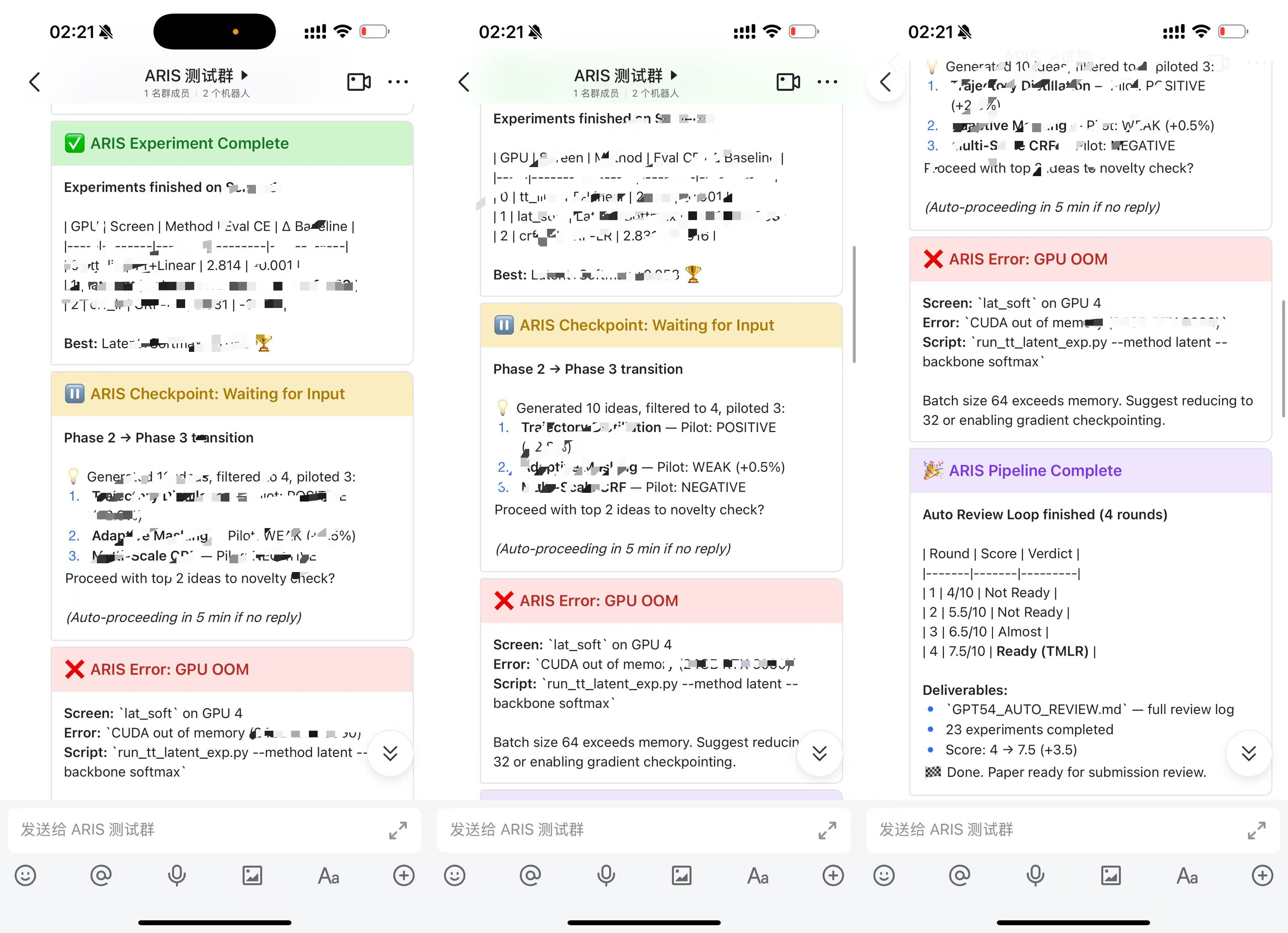
Interactive — private chat with Claude Code (approve/reject, custom instructions):
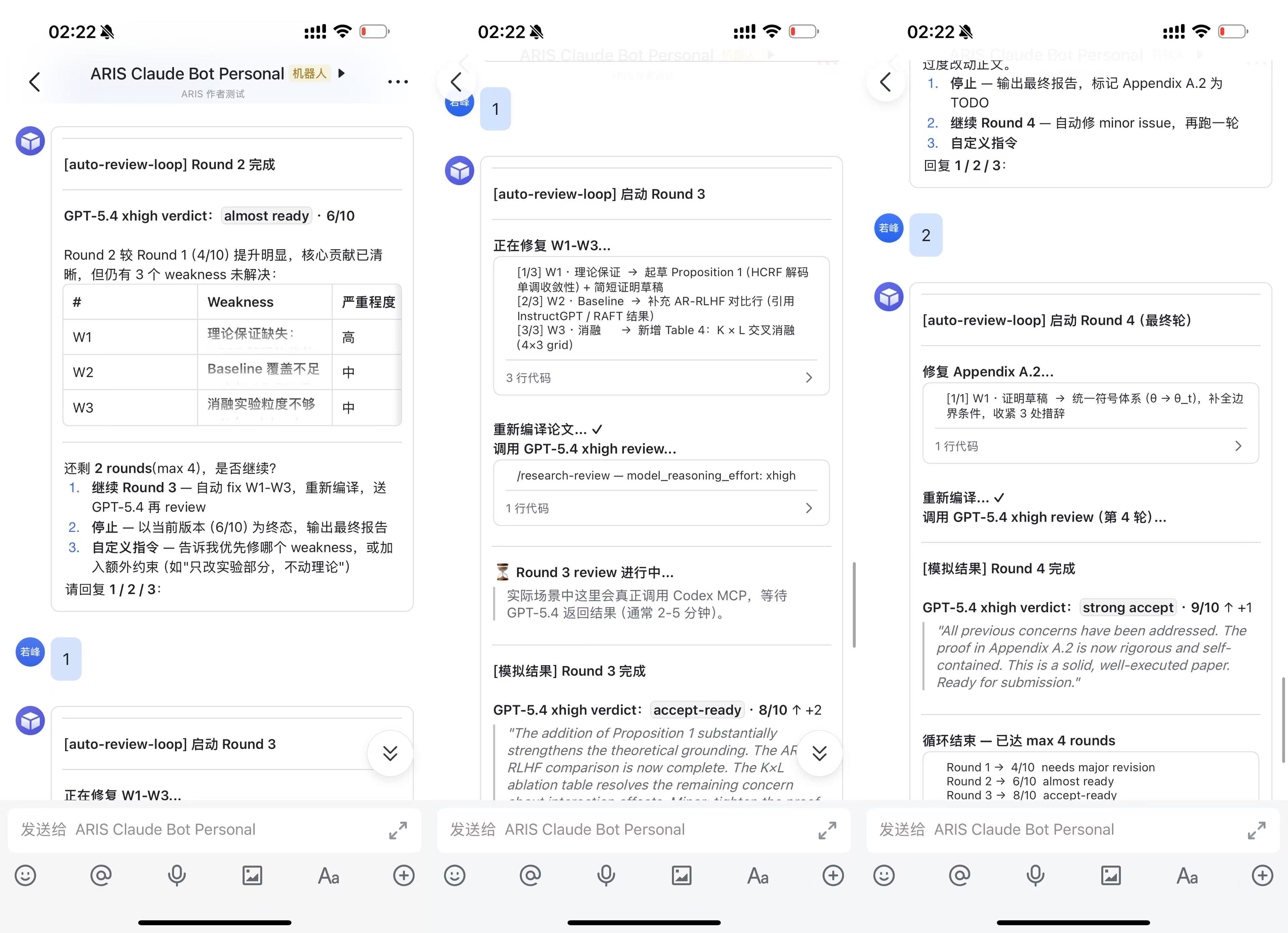
📚 Research Wiki — persistent knowledge base across papers/ideas/experiments/claims. Failed ideas become anti-repetition memory — ARIS gets smarter every run. Inspired by Karpathy's LLM Wiki
🧩 Extensible — domain-specific skills welcome! Add a
SKILL.mdand open a PR. See community skills likedse-loop(architecture/EDA)
ARIS ships 87+ skills across literature, ideation, experiments, audit, writing, talks, patents, and meta-utilities — the full catalog (role / category / requirements per skill) lives in docs/SKILLS_CATALOG.md to keep this README scannable.
Start here — common entry points (use case → skill)
| Use case | Start here |
|---|---|
| End-to-end research (idea → paper) | /research-pipeline |
| Idea discovery + method refinement | /idea-discovery |
| Run experiments from a plan | /experiment-bridge |
| Auto review → fix → re-review | /auto-review-loop |
| Narrative → polished PDF | /paper-writing |
| Reply to peer reviews | /rebuttal |
| Port a paper to a new venue | /resubmit-pipeline |
| Paper → conference talk | /paper-talk |
| Persistent research memory | /research-wiki |
| Patent drafting (CN / US / EP) | /patent-pipeline |
| ARIS optimizes itself | /meta-optimize |
→ Browse all 87 skills by category in the full catalog →
5. 📈 Score Progression (Real Run)
A real overnight 4-round run on an ML research project — the AI reviewer's score climbed 5.0/10 (borderline reject) → 7.5/10 (review-ready) as the loop autonomously ran 20+ GPU experiments, rewrote the narrative framing, and killed claims that didn't hold up, all without human intervention.
Round-by-round breakdown
| Round | Score | What Happened |
|---|---|---|
| Initial | 5.0/10 | Borderline reject |
| Round 1 | 6.5/10 | Added standard metrics, discovered metric decoupling |
| Round 2 | 6.8/10 | Key claim failed to reproduce, pivoted narrative |
| Round 3 | 7.0/10 | Large seed study killed main improvement claim |
| Round 4 | 7.5/10 ✅ | Diagnostic evidence solidified, submission ready |
6. 🏆 Community Showcase — Papers Built with ARIS
Real projects that used the full ARIS pipeline end-to-end. The scores listed are AI-review signals (CSPaper / Stanford Agentic Reviewer), not venue acceptances — and since ARIS optimizes through AI-review loops, high AI scores are an expected byproduct, not proof of acceptance (human reviewers still bring literature / venue / community judgment an AI reviewer misses). Used ARIS for a paper? Open an issue / PR to be featured!
Papers + their AI-review signals (3)
| Paper | AI-review signal | Submission status | Built by | Notes |
|---|---|---|---|---|
| CS Paper Submission | CSPaper 8/10 — AI reviewer recommendation: "Top 50% of accepted papers, clear accept" | Submitted to a CS conference; awaiting official feedback | @DefanXue & @Monglitay | Full ARIS pipeline: idea → experiments → auto-review → paper writing. The quote is from CSPaper's simulated review, not an official venue review. |
| AAAI 2026 Paper Submission | Stanford Agentic Reviewer 7/10 — AI reviewer recommendation: "Good paper, accept" | Submitted to AAAI 2026 Main Technical; awaiting official decision | @xinbo820-web | Pure Codex CLI (ARIS-Codex skills). The 7/10 signal comes from an AAAI-style Stanford Agentic Reviewer run, not an official AAAI acceptance result. |
| UAV-CC | Under review | Submitted to IEEE TGRS | @wxx827 | UAV change captioning benchmark. Claude Opus 4.6 (executor) + Codex GPT-5.5 xhigh (reviewer) + Cursor Opus 4.6 (assist). PDF → |
Reviewer screenshots
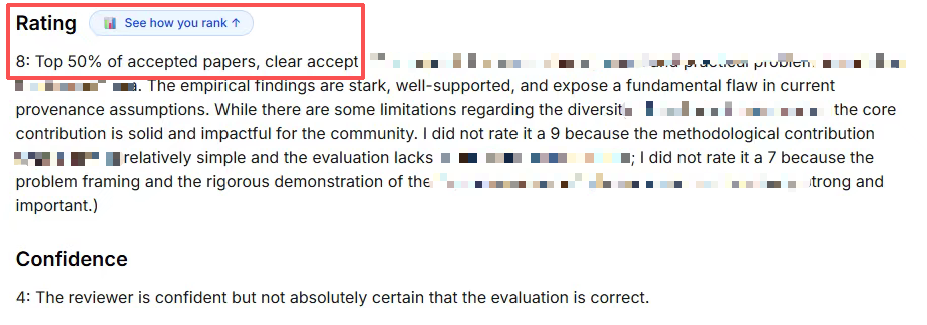
7. 🧩 Awesome Community Skills & Extensions
Domain-specific skills and external projects contributed by the community. PRs welcome — just add a skills/your-skill/SKILL.md and open a PR!
💡 How to use: Community skills are not auto-wired into core workflows. To use one, ask your executor (Claude Code / OpenClaw / etc.) to read the skill's
SKILL.md, then plug it into the appropriate workflow stage based on the description below.
🎉 Community Skills (15): research-refine · experiment-plan · research-refine-pipeline · grant-proposal · paper-poster (deprecated → paper-poster-html) · paper-slides · mermaid-diagram · proof-writer · comm-lit-review · dse-loop · idea-discovery-robot · formula-derivation · paper-illustration · writing-systems-papers · skills-codex
🌐 External Projects & Docs (16): rosetta · open-source-hardening-skills · CitationClaw · auto-hparam-tuning · paper-to-course · deep-research-skills · Antigravity Adaptation Guide · OpenClaw Adaptation Guide · Cursor Adaptation Guide · Codex+Claude Review Bridge · Trae Adaptation Guide · MiniMax-AI/cli · posterly · Claude Fleet · anti-defensive-writing-Skill · OrcaReplay
🙌 Thanks to every contributor! We fold the tables below to keep the README readable — but every skill and project here is equally valued. PRs always welcome!
🎉 Community Skills (15) — click to expand
| Name | Domain | Description | Codex MCP? |
|---|---|---|---|
🔬 research-refine |
General | Turn a vague idea into a problem-anchored, implementation-oriented method proposal. Best inserted between /idea-discovery and /auto-review-loop |
Yes |
🧪 experiment-plan |
General | Turn a refined proposal into a claim-driven experiment roadmap with ablations, budgets, and run order | No |
🧭 research-refine-pipeline |
General | One-shot chain: /research-refine → /experiment-plan for method refinement plus experiment planning |
Yes |
📝 grant-proposal |
General | Grant proposal drafting (KAKENHI/NSF/NSFC/ERC/DFG/SNSF/ARC/NWO). Chains /research-lit → /novelty-check → /research-review → /paper-illustration |
Yes |
🎤 paper-slides |
General | Conference talk slides (beamer → PDF + PPTX) with speaker notes, full talk script + Q&A prep. Auto slide count from talk type | Yes |
🖼️ paper-poster |
General | DEPRECATED — redirect stub to the core /paper-poster-html (measurement-gated HTML/CSS pipeline); the legacy LaTeX implementation lives in git history |
— |
📐 proof-writer |
ML Theory | Rigorous theorem/lemma proof drafting — feasibility triage, dependency maps, honest blockage reports | No |
📡 comm-lit-review |
Communications / Wireless | Domain-specific literature review — IEEE/ACM/ScienceDirect priority, venue tiering, PHY/MAC/transport/NTN taxonomy | No |
🏗️ dse-loop |
Architecture / EDA | Autonomous design space exploration — iteratively run, analyze, and tune parameters (gem5, Yosys, etc.) | No |
🤖 idea-discovery-robot |
Robotics / Embodied AI | Workflow 1 adaptation — grounds idea discovery in embodiment, benchmark, sim2real path, and real-robot safety constraints | Yes |
📐 mermaid-diagram |
General | Mermaid diagrams (20+ types) — free alternative to paper-illustration, no API key needed |
No |
🔢 formula-derivation |
General | Research formula development — derivation, verification, and LaTeX formatting | No |
🖥️ writing-systems-papers |
Systems | Paragraph-level blueprint for 10-12 page systems papers (OSDI/SOSP/ASPLOS/NSDI/EuroSys) — page allocation, writing patterns, self-check | Yes |
🎨 paper-illustration |
General | AI-generated architecture diagrams via Gemini, built on PaperBanana. Integrated into Workflow 3 | No |
🤖 skills-codex |
General | Codex CLI sync pack mirroring the main research skills (incl. result-to-claim, rebuttal, ablation-planner) + the shared-references/ support dir |
— |
🌐 External Projects & Docs (16) — click to expand
| Name | Domain | Description |
|---|---|---|
| 🪨 rosetta | Pro-tier ChatGPT MCP | Programmatic access to ChatGPT Pro / gpt-5.5-pro / DeepResearch from Node, via Chrome CDP Fetch interception + WebSocket second-leg streaming. Ships an MCP server for Claude Code / Codex / Cline — alternative implementation path to Oracle MCP for — reviewer: oracle-pro style high-tier review. Supports multi-turn, parallel concurrency, live token deltas, 15-min idle-timeout watchdog (long Pro thinks survive). MIT, by @SyntaxSmith |
| 📣 anti-defensive-writing-Skill | Press-release writing principle | "A paper is a launch, not a progress report": twelve rules against defensive writing — organize around the strongest advantage, pick the contest you win, every experiment has an argumentative duty, no self-weakening language. Skill (CN/EN) + copy-paste prompt. Four of its rules are folded into ARIS's writing contract. MIT, by @Adkid-Zephyr |
| 🛡️ open-source-hardening-skills | DevOps / OSS | 10-skill pipeline to harden research code into production-ready open-source projects — audit, refactor, test, CI, docs, review |
| 📊 CitationClaw | General | Citation impact analysis — input paper title → citation crawling, scholar identification, tiered analysis, HTML dashboard |
| 🚀 Antigravity Adaptation Guide | General | Use ARIS skills in Google Antigravity — native SKILL.md support, dual model (Claude Opus 4.6 / Gemini 3.1 Pro), MCP setup, EN + CN guides |
| 🐾 OpenClaw Adaptation Guide | General | Use ARIS workflow methodology in OpenClaw — skill-to-stage mapping, file-based orchestration, no Claude Code CLI needed |
| 🖱️ Cursor Adaptation Guide | General | Use ARIS skills in Cursor — @-reference skills, MCP setup, workflow mapping, state file recovery across sessions |
| 🖥️ Trae Adaptation Guide | General | Use ARIS skills in Trae (ByteDance AI IDE) — EN + CN guides |
| 🎛️ auto-hparam-tuning | General | Automatic hyperparameter tuning — AI agent reads project, plans strategy, runs experiments, analyzes TensorBoard, learns from results. Hydra-based |
| 🔁 OrcaReplay | Reproducibility | Records an agent run (Claude Code, Codex, OpenClaw, goose) and replays it offline, or forks it from any step onto a different model — so an overnight loop that went wrong can be re-examined without re-running it. Note: the trace stores the full request/response bytes, prompts and keys included — keep it where your unpublished work belongs. Apache-2.0. |
| 🔁 Codex+Claude Review Bridge | General | Codex executes + Claude reviews via local claude-review MCP bridge with async polling |
| 📚 paper-to-course | Education | Convert research papers (PDF/LaTeX) into interactive six-module HTML courses with formula breakdowns, literature timelines, quizzes, and glossary tooltips — single bundled file, no server needed |
| 🤖 MiniMax-AI/cli | General | Official MiniMax CLI — text, image, video, speech, and music generation + web search. skill/SKILL.md follows the agentskills.io standard. Drop-in companion for the Alt B (MiniMax reviewer) setup |
| 🔎 deep-research-skills | General / Web Search | Modular web-search strategy bundle — per-source playbooks for Stack Overflow, GitHub Issues / error-string debugging, Chinese tech communities (CSDN / 掘金 / 知乎 / V2EX / Tencent + Aliyun cloud forums), and general web (Reddit / HN / Dev.to / Medium). Complements ARIS's academic-paper-focused /research-lit stack with non-academic sources useful for debugging, version-compat tracking, and Chinese-language tech search. By @Weizhena |
| 🖼️ posterly | General / Posters | Academic conference posters as a single HTML/CSS file → print-ready PDF via headless Chromium (no LaTeX). A Claude Code skill — its gate machinery now powers ARIS’s default /paper-poster-html. By @Chenruishuo |
| 🛰️ Claude Fleet | Dashboard / DevEx | Local read-only dashboard for many concurrent Claude Code / Codex windows — triage (working / waiting-on-you / done), one-click Focus, ~50ms full-text search across transcripts, skill/memory analytics. By @tianyilt |
8. 🔄 Workflows
These skills compose into a full research lifecycle. Each workflow can be used independently or chained together:
- Exploring a new area (e.g., writing a survey)? Start with Workflow 1 →
/idea-discovery - Have a plan, need to implement and run? Workflow 1.5 →
/experiment-bridge - Already have results, need iterative improvement? Workflow 2 →
/auto-review-loop - Ready to write the paper? Workflow 3 →
/paper-writing(or step by step:/paper-plan→/paper-figure→/paper-write→/paper-compile→/auto-paper-improvement-loop) - Got reviews back? Need to rebuttal? Workflow 4 →
/rebuttal— parse reviews, draft safe rebuttal, follow-up rounds - Full pipeline? Workflow 1 → 1.5 → 2 → 3 → submit → 4 →
/research-pipeline+/rebuttal— from idea through submission and rebuttal - Need a multi-session proof campaign? Workflow 7 →
/proof-orchestrator— run-directory proof runs, GPT Pro handoff packages, cross-run continuation - Want ARIS to remember and learn? 📚
/research-wiki init— persistent memory across sessions. Papers, ideas, failed experiments compound over time - Want ARIS to improve itself? Workflow M →
/meta-optimize— analyze usage logs, propose skill improvements, reviewer-gated
⚠️ Important: These tools accelerate research, but they don't replace your own critical thinking. Always review generated ideas with your domain expertise, question the assumptions, and make the final call yourself. The best research comes from human insight + AI execution, not full autopilot.
Full Pipeline 🚀
/research-lit → /idea-creator → /novelty-check → /research-refine → /experiment-bridge → /auto-review-loop → /paper-writing → submit → /rebuttal → accept! 🎉
  (survey)      (brainstorm)    (verify novel)   (refine method)   (implement+deploy)  (review & fix)      (write paper)   (send)   (reply to reviewers)
  ├────────────── Workflow 1: Idea Discovery ──────────────┤ ├ Workflow 1.5 ─┤ ├── Workflow 2 ──┤ ├── Workflow 3 ──┤         ├── Workflow 4 ──┤

                                     📚 research-wiki (persistent memory — papers, ideas, experiments, claims)
                                        ↕ reads before ideation, writes after every stage, failed ideas = anti-repetition memory

                                              /meta-optimize (Workflow M — runs independently, improves ARIS itself)
                                                 ↑ reads .aris/meta/events.jsonl (accumulated from all runs above)
Workflow 1: Idea Discovery & Method Refinement 🔍
"What's the state of the art? Where are the gaps? How do we solve it?"
Don't have a concrete idea yet? Just give a research direction — /idea-discovery handles the rest:
- 📚 Survey the landscape (recent papers, open problems, recurring limitations)
- 🧠 Brainstorm 8-12 concrete ideas via GPT-6-Astra xhigh
- 🔍 Filter by feasibility, compute cost, and quick novelty search
- 🛡️ Validate top ideas with deep novelty check + devil's advocate review
- 🧪 Pilot top 2-3 ideas in parallel on different GPUs (30 min - 2 hr each)
- 🏆 Rank by empirical signal — ideas with positive pilot results rise to the top
- 🔬 Refine the top idea into a problem-anchored proposal via iterative GPT-6-Astra review
- 🧪 Plan claim-driven experiments with ablations, budgets, and run order
The output is a ranked IDEA_REPORT.md plus a refined proposal (refine-logs/FINAL_PROPOSAL.md) and experiment plan (refine-logs/EXPERIMENT_PLAN.md) for the top idea. Dead-end ideas are documented too, saving future exploration.
Show W1 flow diagram and example command sequence — research-lit → idea-creator → novelty-check → research-refine → experiment-plan
┌─────────────────────────────────────────────────────────────────┐
│              Idea Discovery & Method Refinement                  │
│                                                                  │
│   /research-lit    /idea-creator    /novelty-check               │
│   (find papers)    (brainstorm)     (verify novelty)             │
│         │               │                │                       │
│         ▼               ▼                ▼                       │
│   ┌──────────┐    ┌──────────┐     ┌──────────┐                │
│   │ Scan     │───▶│ Generate │────▶│ Check if │                │
│   │ local    │    │ 8-12     │     │ idea is  │                │
│   │ papers + │    │ ideas    │     │ novel    │                │
│   │ search   │    │ + rank   │     │          │                │
│   └──────────┘    └──────────┘     └──────────┘                │
│                         │                │                       │
│                         ▼                ▼                       │
│                   ┌──────────┐     ┌──────────┐                │
│                   │ Filter   │────▶│ External │                │
│                   │ by cost, │     │ LLM      │                │
│                   │ novelty  │     │ evaluates│                │
│                   └──────────┘     └──────────┘                │
│                                          │                       │
│                   /research-refine       ▼                       │
│                   (refine method)   ┌──────────┐                │
│                         │          │ Freeze   │                │
│                         ▼          │ problem  │                │
│                   ┌──────────┐     │ anchor + │                │
│                   │ Iterate  │◀───▶│ refine   │                │
│                   │ until    │     │ method   │                │
│                   │ score≥9  │     └──────────┘                │
│                   └──────────┘          │                       │
│                         │               ▼                       │
│                   /experiment-plan  ┌──────────┐                │
│                         │          │ Claim-   │                │
│                         ▼          │ driven   │                │
│                   ┌──────────┐     │ experiment│               │
│                   │ Plan     │────▶│ roadmap  │                │
│                   │ runs     │     └──────────┘                │
│                   └──────────┘                                  │
│                                                                  │
│   Typical flow:                                                  │
│   1. /research-lit "discrete diffusion models"                   │
│   2. /idea-creator "DLLMs post training"                         │
│   3. Review ranked ideas, pick top 2-3                           │
│   4. /novelty-check "top idea" (deep verification)               │
│   5. /research-review "top idea" (critical feedback)             │
│   6. /research-refine "top idea" (problem anchor + method)       │
│   7. /experiment-plan (claim-driven roadmap)                     │
│   8. /run-experiment → /auto-review-loop                         │
└─────────────────────────────────────────────────────────────────┘
Skills involved: research-lit + idea-creator + novelty-check + research-review + research-refine-pipeline
💡 One-command shortcut:
/idea-discovery "your research direction"runs this entire workflow automatically.
🔄 Human-in-the-loop: At each
AUTO_PROCEED-controlled selection checkpoint,truereports results and continues in the same turn;falseasks for your feedback before continuing. If you request changes, tell it what's missing — it refines the prompt and regenerates. Explicit gates such as Feishu interactive approval remain user-controlled.
⚙️ Pilot experiment budgets (max hours, timeout, GPU budget) are configurable — see Customization.
📝 Blog post: Claude Code 两月 NeurIPS 指北
Workflow 1.5: Experiment Bridge 🔗
"I have a plan. Now implement it, deploy it, and get me initial results."
Already have an experiment plan (from Workflow 1 or your own)? /experiment-bridge turns it into running code:
- 📋 Parse the experiment plan (
refine-logs/EXPERIMENT_PLAN.md) - 💻 Implement experiment scripts (reuse existing code, add proper argparse/logging/seeds)
- 🔍 GPT-6-Astra code review — cross-model review catches logic bugs before wasting GPU hours (
code review: trueby default) - ✅ Sanity check — run the smallest experiment first to catch runtime bugs
- 🚀 Deploy full experiment suite to GPU via
/run-experiment - 📊 Collect initial results and update the experiment tracker
Show W1.5 flow diagram — experiment plan → Claude implements → GPT-6-Astra code review → sanity check → GPU deploy → monitor → results
┌─────────────────────────────────────────────────────────────────┐
│                Workflow 1.5: Experiment Bridge                    │
│                                                                  │
│   EXPERIMENT_PLAN.md                                             │
│         │                                                        │
│         ▼                                                        │
│   ┌──────────┐     ┌──────────┐     ┌──────────┐               │
│   │ Claude   │────▶│ GPT-6-Astra  │────▶│ Sanity   │               │
│   │ Code     │     │ xhigh    │     │ Check    │               │
│   │ writes   │     │ reviews  │     │ (1 GPU)  │               │
│   │ code     │     │ code     │     │          │               │
│   └──────────┘     └──────────┘     └──────────┘               │
│                                          │                       │
│                                          ▼                       │
│   ┌──────────┐     ┌──────────┐     ┌──────────┐               │
│   │ Collect  │◀────│ Monitor  │◀────│ Deploy   │               │
│   │ results  │     │ progress │     │ to GPUs  │               │
│   │          │     │ (+ W&B)  │     │          │               │
│   └──────────┘     └──────────┘     └──────────┘               │
│         │                                                        │
│         ▼                                                        │
│   Ready for /auto-review-loop                                    │
└─────────────────────────────────────────────────────────────────┘
Skills involved: experiment-bridge + run-experiment + monitor-experiment
💡 One-command shortcut:
/experiment-bridgereadsrefine-logs/EXPERIMENT_PLAN.mdautomatically. Or point it to any plan:/experiment-bridge "my_plan.md".
⚙️
CODE_REVIEW,AUTO_DEPLOY,SANITY_FIRST,MAX_PARALLEL_RUNSare configurable — see Customization.
Workflow 2: Auto Research Loop 🔁 (sleep & wake up to results)
"Review my paper, fix what's wrong, repeat until it's good."
GPT-6-Astra reviews → identifies weaknesses → suggests experiments → Claude Code writes scripts, deploys to GPU, monitors results, rewrites the paper — all while you sleep. Just add your GPU server config to
CLAUDE.md.
- 🔍 Deep review — GPT-6-Astra xhigh reviews the current paper / claims / experiments and identifies weaknesses
- 🩹 Fix — Claude implements the fixes (rewrites sections, adds baselines, or runs new experiments via
/run-experiment); skips any experiment estimated > 4 GPU-hours and flags it for manual follow-up - 📊 Re-evaluate — collect results via
/monitor-experiment, update paper, feed back to the reviewer - 🔁 Repeat — until score ≥
POSITIVE_THRESHOLD(default 6/10) orMAX_ROUNDS(default 4) is hit; if context window fills mid-loop, the workflow auto-resumes fromREVIEW_STATE.json
Show W2 loop diagram — external review → implement fixes / run experiments → monitor results → repeat until threshold
┌─────────────────────────────────────────────────────────────┐
│                    Auto Review Loop                          │
│                                                              │
│   /research-review          /auto-review-loop                │
│   (single deep review)      (autonomous loop)                │
│         │                         │                          │
│         ▼                         ▼                          │
│   ┌──────────┐   ┌──────────┐   ┌──────────┐               │
│   │ External  │──▶│ Implement│──▶│ Monitor  │──▶ repeat     │
│   │ LLM      │   │ fixes    │   │ results  │    until       │
│   │ reviews  │   │ & run    │   │          │    score ≥ 6   │
│   └──────────┘   │ experiments│  └──────────┘               │
│                   └──────────┘                               │
│                                                              │
│   When reviewer suggests a new method direction:             │
│   /novelty-check — verify idea isn't already published       │
│                                                              │
│   Supporting skills:                                         │
│   /run-experiment    — deploy to local/remote/vast.ai GPU     │
│   /analyze-results   — interpret experiment outputs          │
│   /monitor-experiment — check progress, collect results      │
└─────────────────────────────────────────────────────────────┘
Skills involved: auto-review-loop + research-review + novelty-check + run-experiment + analyze-results + monitor-experiment
💡 One-command shortcut:
/auto-review-loop "your paper topic"runs this entire workflow automatically.
Show W2 usage examples, reviewer difficulty levels, and full safety guarantees — topic/scope arguments, medium/hard/nightmare, 6 safety rules
What to pass as argument? A short topic or scope is enough — the skill automatically reads your project's narrative docs (NARRATIVE_REPORT.md), memory files, experiment results, and prior reviews to build the full context for GPT-6-Astra. Examples:
/auto-review-loop "factorized gap in discrete diffusion LMs"— broad topic, skill finds everything/auto-review-loop "focus on Section 3-5, our CRF results are weak"— targeted scope with hints/auto-review-loop— also works: skill reads project files and infers the topic
🎮 Reviewer Difficulty — control how adversarial the reviewer is:
| Level | What changes | Use when |
|---|---|---|
medium (default) |
Standard MCP review — same as before | Normal workflow |
hard |
+ Reviewer Memory (GPT tracks suspicions across rounds) + Debate Protocol (Claude rebuts, GPT rules) | Want tougher feedback |
nightmare |
+ GPT reads repo directly via codex exec (Claude can't filter what it sees) + adversarial verification |
Preparing for top venue, want maximum stress test |
/auto-review-loop "topic" — difficulty: nightmare # GPT reads your code and verifies claims itself
🛡️ Key safety features:
- 🔒 MAX_ROUNDS = 4 — prevents infinite loops; stops early if score threshold is met
- ⏱️ > 4 GPU-hour experiments skipped — won't launch massive jobs; flags them for manual follow-up
- 🧠 Prefer reframing over new experiments — when both can address a weakness, chooses the cheaper path
- 🪞 No hiding weaknesses — explicit rule: "Do NOT hide weaknesses to game a positive score"
- 🔧 Fix before re-review — must actually implement fixes before resubmitting; no empty promises
- 💾 Compact recovery — persists state (
REVIEW_STATE.json) after each round. If the context window fills up and auto-compacts mid-loop, the workflow reads the state file and resumes from where it left off — no human intervention needed
⚙️ MAX_ROUNDS, score threshold, and GPU limits are configurable — see Customization.
📝 Blog post: 开源 | 睡觉 Claude 自动跑实验改文
Workflow 3: Paper Writing Pipeline 📝
"Turn my research narrative into a submission-ready PDF." Requires a local LaTeX environment — see Prerequisites.
- 📝 Narrate — write
NARRATIVE_REPORT.md(claims, experiments, results, figure descriptions); seetemplates/NARRATIVE_REPORT_TEMPLATE.md - 🧭 Plan —
/paper-planbuilds the claims-evidence matrix + section plan - 📊 Figures —
/paper-figuregenerates data-driven plots and comparison tables from JSON/CSV - ✍️ Write —
/paper-writeproduces section-by-section LaTeX - 🔧 Compile —
/paper-compilebuilds the PDF, fixes errors, runs the page-limit check - ✨ Improve —
/auto-paper-improvement-loopruns 2 rounds of GPT-6-Astra content review + final format check
Show W3 architecture diagram and exact writing flow — NARRATIVE_REPORT → /paper-plan → /paper-figure → /paper-write → /paper-compile → improvement loop
┌─────────────────────────────────────────────────────────────┐
│                   Paper Writing Pipeline                      │
│                                                               │
│   /paper-plan      /paper-figure     /paper-write             │
│   (outline)        (plots & tables)  (LaTeX draft)            │
│        │                │                 │                   │
│        ▼                ▼                 ▼                   │
│   ┌──────────┐    ┌──────────┐     ┌──────────┐              │
│   │ Claims-  │───▶│ Generate │────▶│ Section  │──┐           │
│   │ Evidence │    │ figures, │     │ by       │  │           │
│   │ Matrix + │    │ tables,  │     │ section  │  │           │
│   │ Section  │    │ LaTeX    │     │ LaTeX    │  │           │
│   │ Plan     │    │ includes │     │ draft    │  │           │
│   └──────────┘    └──────────┘     └──────────┘  │           │
│        │                                          │           │
│        │         /paper-compile                   │           │
│        │         (build PDF)                      │           │
│        │              │                           │           │
│        ▼              ▼                           ▼           │
│   ┌──────────────────────────────────────────────────┐       │
│   │ NARRATIVE_REPORT.md ──► PAPER_PLAN.md ──► paper/ │       │
│   │    (input)             (outline)      (LaTeX+PDF)│       │
│   └──────────────────────────────────────────────────┘       │
│                                                               │
│   Typical flow:                                               │
│   1. Write NARRATIVE_REPORT.md (from Workflow 2 results)      │
│   2. /paper-plan (claims-evidence matrix + section plan)      │
│   3. /paper-figure (comparison tables, training curves, etc.) │
│   4. /paper-write (section-by-section LaTeX generation)       │
│   5. /paper-compile (build PDF, fix errors, page check)       │
│   6. /auto-paper-improvement-loop (review ×2 + format check)  │
└─────────────────────────────────────────────────────────────┘
Skills involved: paper-plan + paper-figure + paper-write + paper-compile + auto-paper-improvement-loop + (post-acceptance) paper-poster-html + paper-slides
One-command shortcut:
/paper-writing "NARRATIVE_REPORT.md"runs this entire workflow automatically.
Input: A NARRATIVE_REPORT.md describing the research: claims, experiments, results, figures. The more detailed the narrative (especially figure descriptions and quantitative results), the better the output.
Output: A paper/ directory with LaTeX source, clean .bib (only cited entries), and compiled PDF. The PDF is labelled submission-ready only when run at — effort: max | beast (or explicit — assurance: submission) and tools/verify_paper_audits.sh reports green on the three mandatory audits (proof-checker, paper-claim-audit, citation-audit); see Assurance Gate below. At the default balanced level, the output is a reviewed draft.
Show W3 feature details — Claims-Evidence Matrix, figure modes, clean bib, Gemini API setup, ICLR end-to-end test
Key features:
- 📐 Claims-Evidence Matrix — every claim maps to evidence, every experiment supports a claim
- 📊 Auto figure generation — line plots, bar charts, comparison tables from JSON data
- 🧹 Clean bib — automated filtering removes uncited entries (948→215 lines in testing). Real BibTeX from DBLP/CrossRef instead of LLM-generated entries
- 📄 Flexible sections — 5-8 sections depending on paper type (theory papers often need 7)
- 🔍 GPT-6-Astra review — each step optionally reviewed by external LLM
- ✂️ De-AI polish — removes AI writing patterns (delve, pivotal, landscape...)
- 🎯 Page verification —
pdftotext-based precise check that main body fits page limit
⚠️ Figure generation scope:
/paper-figureauto-generates data-driven plots (training curves, bar charts, heatmaps) and comparison tables from JSON/CSV. For architecture diagrams and method figures:illustration: gemini(default) uses Claude→Gemini→Nano Banana Pro for publication-quality diagrams;illustration: mermaidgenerates Mermaid diagrams for free;illustration: falseskips AI figures entirely.Gemini API setup (for
illustration: gemini): Get your API key at Google AI Studio, then set it as an environment variable:export GEMINI_API_KEY="your-key". Or add to your shell profile (~/.zshrc/~/.bashrc). No other dependencies needed.
Tested end-to-end: Generated a 9-page ICLR 2026 theory paper (7 sections, 29 citations, 4 figures, 2 comparison tables) from a single NARRATIVE_REPORT.md — zero compilation errors, zero undefined references.
Auto Paper Improvement Loop ✨
After Workflow 3 generates the paper, /auto-paper-improvement-loop runs 2 rounds of GPT-6-Astra xhigh content review → fix → recompile, plus a final format compliance check, autonomously polishing the paper from rough draft to a reviewer-scored draft. Whether the result is tagged submission-ready is decided separately by the Phase 6 assurance gate (see Assurance Gate).
Show auto-paper-improvement benchmark — Score Progression on a real ICLR 2026 theory paper (4/10 → 8.5/10), plus Round 1/2/3 fix details
Score Progression (Real Test — ICLR 2026 theory paper):
| Round | Score | Key Changes |
|---|---|---|
| Round 0 | 4/10 (content) | Baseline |
| Round 1 | 6/10 (content) | Fixed assumptions, softened claims, renamed notation |
| Round 2 | 7/10 (content) | Added synthetic validation, stronger limitations |
| Round 3 | 5→8.5/10 (format) | Removed hero fig, appendix, compressed conclusion, float spacing |
Final: 8 pages main body (ICLR limit: 9), 0 overfull hbox, ICLR-compliant. +4.5 points across 3 rounds.
Round 1 fixes (6 items)
- CRITICAL — Assumption-model mismatch: A boundedness assumption contradicted the model's distributional family. Replaced with a tail-compatible assumption and added formal truncation bridge.
- CRITICAL — Theory-practice gap: Theory assumes idealized encoders, experiments use learned nonlinear encoders. Softened "validate" → "demonstrate practical relevance" and added explicit disclaimer.
- MAJOR — Missing quantitative metrics: Added parameter count table (latent vs total) with honest accounting of system cost.
- MAJOR — Theorem not self-contained: Added "Interpretation" paragraph listing all dependencies explicitly.
- MAJOR — Overclaim in novelty statement: Scoped a broad "first convergence guarantee" to precise conditions under which it holds.
- MAJOR — Notation confusion: Renamed a symbol that clashed with another key variable. Added Notation paragraph.
Round 2 fixes (4 items)
- MAJOR — Missing theory-aligned experiments: Added a synthetic validation subsection directly testing the two main theoretical predictions under controlled conditions.
- MAJOR — Overclaim softening: Replaced strong equivalence claims with appropriately hedged language across all files.
- MAJOR — Informal theoretical argument: Formalized an informal justification into a proper proposition with explicit error bounds.
- MINOR — Weak limitations: Expanded to explicitly list all assumptions and acknowledge missing standard evaluations.
Round 3 format fixes (8 items)
- Removed hero figure block (saved ~0.7 pages)
- Compressed conclusion from 15→9 lines
- Moved synthetic validation to Appendix A
- Moved comparison tables to Appendix B
- Fixed overfull hbox (85pt) with
\resizebox - Added compact float spacing (
\captionsetup,\textfloatsep) - Inlined centered question block in introduction
- Tightened
itemizeenvironments
Workflow 4: Rebuttal 📝 (reply to reviewers safely)
"Reviews are in. Help me draft a safe, grounded rebuttal."
Got reviews back? /rebuttal parses them, builds a strategy, and drafts a venue-compliant response:
- 📋 Parse — normalize reviews, validate venue rules (character limit, text-only, etc.)
- 🔍 Atomize — split each review into issue cards (type, severity, reviewer stance)
- 🗺️ Strategize — global themes, per-reviewer priorities, character budget, blocked claims
- 🧪 Evidence sprint — if
auto experiment: true, auto-run supplementary experiments via/experiment-bridge - ✍️ Draft — global opener + numbered per-reviewer responses + closing for meta-reviewer
- 🛡️ Safety check — 6 lints: coverage, provenance, commitment, tone, consistency, limit
- 🔬 GPT-6-Astra stress test — internal skeptical review of the draft
- 📄 Finalize — two outputs:
PASTE_READY.txt(exact character count) +REBUTTAL_DRAFT_rich.md(extended version for manual editing) - 🔄 Follow-up rounds — delta replies for reviewer discussions, technically escalating
Show W4 rebuttal flow diagram — parse reviews → strategy → optional evidence sprint → draft → GPT-6-Astra stress test → finalize 2 versions → follow-up rounds
┌─────────────────────────────────────────────────────────────────┐
│                   Workflow 4: Rebuttal                            │
│                                                                  │
│   Reviews arrive                                                 │
│         │                                                        │
│         ▼                                                        │
│   ┌──────────┐     ┌──────────┐     ┌──────────┐               │
│   │ Parse &  │────▶│ Strategy │────▶│ Evidence  │               │
│   │ atomize  │     │ plan     │     │ sprint    │               │
│   │ reviews  │     │          │     │ (optional)│               │
│   └──────────┘     └──────────┘     └──────────┘               │
│                                          │                       │
│                                          ▼                       │
│   ┌──────────┐     ┌──────────┐     ┌──────────┐               │
│   │ Finalize │◀────│ GPT-6-Astra  │◀────│ Draft    │               │
│   │ 2 versions│    │ stress   │     │ rebuttal │               │
│   │          │     │ test     │     │          │               │
│   └──────────┘     └──────────┘     └──────────┘               │
│         │                                                        │
│         ▼                                                        │
│   PASTE_READY.txt (strict) + RICH.md (extended)                  │
│         │                                                        │
│         ▼                                                        │
│   Follow-up rounds (delta replies, per-reviewer threads)         │
└─────────────────────────────────────────────────────────────────┘
Skills involved: rebuttal
💡 Quick mode:
/rebuttal — quick mode: truestops after parsing + strategy (Phase 0-3). See what reviewers want before committing to a full draft.
⚙️
VENUE,AUTO_EXPERIMENT,QUICK_MODE,MAX_STRESS_TEST_ROUNDSare configurable — see Customization.
Three safety gates — rebuttal will NOT finalize if any fails:
- 🔒 Provenance — every claim maps to paper/review/user-confirmed result. No fabrication.
- 🔒 Commitment — every promise is user-approved. No overpromising.
- 🔒 Coverage — every reviewer concern is tracked. Nothing disappears.
Workflow 5: Resubmit Pipeline 🔁 (port a paper to a new venue, text-only)
Port a polished paper from venue A → B under hard, non-overridable guardrails — no new experiments · no bib edits · no framework changes · never overwrites prior submissions — via physical isolation, a 5-layer anonymity check, soft-only audits, whitelist microedits, and a /kill-argument adversarial gate. Full flow + constraints → docs/RESUBMIT_AND_TALK.md
Workflow 6: Conference Talk Pipeline 🎤 (paper → slides → polish → audits)
/paper-talk turns an accepted paper into a talk: outline → /paper-slides (Beamer + PPTX + speaker notes + Q&A) → /slides-polish (per-page Codex visual pass) → optional conference-ready audit gate. Sister to /paper-writing / /paper-poster-html. Full flow → docs/RESUBMIT_AND_TALK.md
Workflow 7: Proof Orchestrator 🧭 (standalone theory track — attack a theorem across days, not turns)
"This proof will take a week and three tools. Keep every attempt, audit, and escalation on the record."
Hard theorems are campaigns, not chat turns. /proof-orchestrator runs proof work as a stateful, local-first pipeline — each run gets its own directory, completed runs become append-only evidence, and every new run records which prior claims were proved, conjectural, or rejected:
- 🎯 Freeze the target — exact theorem, assumptions, quantifiers, allowed sources; new run or continuation
- 🧱 Maintain local evidence — run directory with
task.md/materials.md/ stable source snapshots - 🧠 Attempt locally — full proof, disproof, counterexample, or diagnosis; a stall isolates the smallest hard obligation
- 🔍 Audit correctness — every lemma, bound, and quantifier checked against assumptions; claims labeled proved / imported / conjectural / repaired / unsupported
- ✒️ Edit for exposition — two gates: the 7-line notation scorecard (100% core-object retention, zero undefined symbols, zero collisions) and the top-down derivation-structure gate (acyclic dependency graph, no subgoal silently assuming the target — a bug-catcher in disguise: a proof that resists a clean target-first rewrite is usually hiding a gap, and circular reasoning surfaces the moment you try)
- 📦 GPT Pro handoff — a stalled proof becomes a package:
browser-prompt.md(copy-paste ready),source-manifest.md(source roles),handoff.md(upload order + return instructions) - 🧾 Re-audit the returned proof — format repair only, then the full correctness audit and exposition edit produce
final.md
Show W7 flow diagram — freeze target → local attempt → audit → notation/structure gates → GPT Pro handoff (when stalled) → re-audit → final.md, plus the optional DeepSeek branch
┌─────────────────────────────────────────────────────────────────┐
│              Workflow 7: Proof Orchestrator                     │
│                                                                 │
│   Theorem arrives (new run, or continuation of a prior run)     │
│         │                                                       │
│         ▼                                                       │
│   ┌──────────┐     ┌──────────┐     ┌──────────┐               │
│   │ Freeze   │────▶│ Local    │────▶│ Correct- │               │
│   │ target + │     │ proof    │     │ ness     │               │
│   │ evidence │     │ attempt  │     │ audit    │               │
│   └──────────┘     └──────────┘     └──────────┘               │
│                         │                │                      │
│                  LOCAL_BLOCKED     ┌──────────┐                │
│                         │          │ Notation │                │
│                         │          │ + struct │──▶ final.md    │
│                         │          │ gates    │                │
│                         │          └──────────┘                │
│                         ▼                                       │
│   ┌───────────────────────────────────────────┐                │
│   │ GPT Pro handoff package                   │                │
│   │ browser-prompt.md · source-manifest.md ·  │                │
│   │ handoff.md — you drive the browser        │                │
│   └───────────────────────────────────────────┘                │
│                         │                                       │
│                         ▼                                       │
│   gpt-pro-output.md → format repair → re-audit → gates → final │
│                                                                 │
│   Optional on request: DeepSeek adversarial audit via llm-chat  │
│   → validated locally → run-local provisional evidence          │
│                                                                 │
│   State: prompts/<run-id>/ — completed runs are append-only;    │
│   a new run reuses only audited claims                          │
└─────────────────────────────────────────────────────────────────┘
Skills involved: proof-orchestrator (+ llm-chat MCP for the optional DeepSeek branch)
⚖️ Optional DeepSeek second opinion: request it at the audit stage for a verified cross-family adversarial pass — findings are validated locally and recorded as run-local provisional evidence. An installed
call-gpt-proskill can likewise automate the GPT Pro dispatch when you ask for it on a run.
🧭 Standalone by design. Workflow 7 is theory work's own track — no Workflow 1–6 stage calls it, and
/proof-checkerkeeps the submission gate in Workflow 3. Reach for it when a theorem outgrows single-shot/proof-writerdrafting: multi-day campaigns, cross-run continuation, or when the strongest available prover lives in a browser tab.
💡 Continuation: point it at a prior run (
next.md/redo.md) — it readsfinal.md/audit.md, reuses only audited claims, and opens a fresh run directory with full provenance.
📚 Research Wiki — Persistent Research Memory
"Stop re-deriving. Start compounding." — inspired by Karpathy's LLM Wiki
Without the wiki, ARIS is stateless — every /idea-discovery starts from scratch. With the wiki, ARIS accumulates knowledge across the entire research lifecycle: papers read, ideas tested, experiments run, claims verified or invalidated.
The key insight: failed ideas are the most valuable memory. A researcher who knows what doesn't work generates better ideas than one starting from zero.
Setup:
> /research-wiki init # one-time, creates research-wiki/ in your project
That's it. Once initialized, the wiki works automatically.
Show the automatic wiki hooks — what fires at /research-lit, /idea-creator, /result-to-claim, plus the re-ideation nudge
| When | What happens | Wiki action |
|---|---|---|
/research-lit finds papers |
Papers auto-ingested | papers/<slug>.md created, edges added, query_pack rebuilt |
/idea-creator runs |
Reads wiki first | Failed ideas = banlist, gaps = search seeds, papers = known prior work |
/idea-creator finishes |
ALL ideas written back | Both recommended AND eliminated ideas → ideas/<id>.md |
/result-to-claim judges |
Results written back | Experiment page created, claim status updated (supported/invalidated) |
| 3+ ideas fail | Re-ideation suggested | "💡 Consider re-running /idea-creator — the wiki now knows what doesn't work" |
Show Research Wiki data model — Paper / Idea / Experiment / Claim entities and the typed graph edges that connect them
Four entity types:
| Entity | What it stores | Example |
|---|---|---|
| 📄 Paper | Structured summary: thesis, method, limitations, reusable ingredients | paper:chen2025_factorized_gap |
| 💡 Idea | Hypothesis, status (proposed/failed/succeeded), failure notes, lessons | idea:001 |
| 🧪 Experiment | Metrics, verdict, hardware, duration | exp:001 |
| 📋 Claim | Testable statement + evidence status (reported/supported/invalidated) | claim:C1 |
Typed relationships (stored in graph/edges.jsonl):
paper --extends--> paper              idea --inspired_by--> paper
paper --contradicts--> paper          idea --tested_by--> experiment
paper --addresses_gap--> gap          experiment --supports--> claim
paper --supersedes--> paper           experiment --invalidates--> claim
Show Research Wiki spiral-learning example and manual subcommands — failed ideas → better ideas across 3 rounds; ingest / query / update / lint / stats
Spiral learning in action:
Round 1: read 15 papers → wiki remembers → idea A → experiment → FAIL
         wiki records: "A fails because OOM at batch>32, loss diverges"

Round 2: /idea-creator reads wiki → sees A failed → generates idea D (avoids A's trap)
         → experiment → PARTIAL SUCCESS
         wiki records: "D works on small models, fails on large"

Round 3: /idea-creator reads wiki → knows A failed + D partial → generates idea F
         (combines D's success with new approach) → experiment → SUCCESS 🎉
Subcommands:
/research-wiki init                              # initialize wiki
/research-wiki ingest "paper title" — arxiv: xxx  # manually add a paper
/research-wiki query "topic"                      # rebuild query_pack.md
/research-wiki update idea:001 — outcome: negative # update entity
/research-wiki lint                               # health check (orphans, contradictions, stale claims)
/research-wiki stats                              # overview (paper/idea/experiment/claim counts)
🔒 Safe by design: All workflow hooks are guarded by
if research-wiki/ exists. No wiki = no impact. Zero dependencies (pure Python stdlib). You choose when to enable it.
Workflow M: Meta-Optimize 🧬 (ARIS optimizes itself)
"Analyze my usage patterns and improve your own skills."
Unlike Workflows 1–4 which optimize research artifacts (papers, code, experiments), Workflow M optimizes the harness itself — the SKILL.md instructions, default parameters, and convergence rules that govern how ARIS operates. Inspired by Meta-Harness (Lee et al., 2026).
Show Workflow M one-time setup and usage commands — Claude Code hook install, /meta-optimize variants (project / per-skill / --global / apply)
Setup (one-time, in normal terminal):
mkdir -p .claude .aris/meta tools/meta_opt
cp Auto-claude-code-research-in-sleep/templates/claude-hooks/meta_logging.json .claude/settings.json
cp Auto-claude-code-research-in-sleep/tools/meta_opt/*.sh tools/meta_opt/
chmod +x tools/meta_opt/*.sh
claude   # hooks active immediately
Usage (after 5+ workflow runs):
> /meta-optimize                        # analyze current project
> /meta-optimize "auto-review-loop"     # focus on one skill
> /meta-optimize --global               # analyze trends across ALL projects
> /meta-optimize apply 1                # apply recommended change #1
How it works:
- 📊 Passive logging — Claude Code hooks silently record every skill invocation, tool call, failure, parameter override, and user prompt. Events are written to both project-level (
.aris/meta/events.jsonl) and global (~/.aris/meta/events.jsonl, with a"project"tag) logs. Zero user effort. - 🔍 Pattern analysis —
/meta-optimizereads the log and identifies:- Parameters users override most often (bad defaults)
- Tools that fail repeatedly in specific skills (missing error handling)
- Review score plateaus (convergence rules too loose/tight)
- Manual corrections users make (skill gaps)
- 🩹 Patch proposal — generates minimal diffs to target SKILL.md files with data-backed justifications
- 🔬 Reviewer gate — GPT-6-Astra xhigh reviews each patch: does the evidence support it? could it hurt other users?
- ✅ User approval — only applied with explicit user consent. All changes are logged and reversible.
Show Workflow M diagram and "what gets optimized" component table — event logs → SKILL.md patches → GPT-6-Astra review → user approval; prompts / defaults / convergence / error handling
┌─────────────────────────────────────────────────────────────────┐
│                  Workflow M: Meta-Optimize                        │
│                                                                  │
│   Normal ARIS usage (W1-W4)                                      │
│         │ (hooks log events passively)                           │
│         ▼                                                        │
│   .aris/meta/events.jsonl                                        │
│         │                                                        │
│         ▼                                                        │
│   ┌──────────┐     ┌──────────┐     ┌──────────┐               │
│   │ Analyze  │────▶│ Propose  │────▶│ GPT-6-Astra  │               │
│   │ patterns │     │ SKILL.md │     │ reviews  │               │
│   │          │     │ patches  │     │ patch    │               │
│   └──────────┘     └──────────┘     └──────────┘               │
│                                          │                       │
│                                          ▼                       │
│                                    User approves?                 │
│                                     Yes → Apply                  │
│                                     No  → Skip                   │
└─────────────────────────────────────────────────────────────────┘
What gets optimized (harness components):
| Component | Example |
|---|---|
| Skill prompts | Reviewer instructions, quality gates, step descriptions |
| Default parameters | difficulty, MAX_ROUNDS, threshold |
| Convergence rules | When to stop the review loop, retry counts |
| Error handling | Auto-debug patterns, failure recovery steps |
What does NOT get optimized: research artifacts (papers, code, experiments) — that's what W1–W4 do.
Skills involved: meta-optimize
💡 This is a maintenance workflow, not part of the W1→W1.5→W2→W3→W4 research pipeline. Run it periodically, like
git gcfor your research harness.
⚡ Effort Levels
Every skill takes — effort: lite | balanced | max | beast — scaling breadth/depth (papers · ideas · pilots · rounds · seeds · audit depth) from ~0.4× to ~5–8×; balanced is the default (zero change for existing users). What never changes at any level: Codex reasoning stays at its tier floor (regular xhigh; deep audits ultra), DBLP/CrossRef citations on, reviewer independence on, experiment integrity on. 📖 Full spec + per-skill counts → effort-contract.md
Assurance Gate (effort: max | beast)
A second axis, orthogonal to effort: assurance decides whether mandatory audits are load-bearing. lite/balanced ⇒ draft (audits non-blocking — current behavior, zero change); max/beast ⇒ submission (paper-writing Phase 6 force-runs /proof-checker + /paper-claim-audit + /citation-audit in fresh threads and refuses the Final Report if tools/verify_paper_audits.sh exits non-zero). Escape hatch: — effort: beast, assurance: draft. 📖 Full spec → assurance-contract.md
🧿 Optional: GPT-5.5 Pro via Oracle
Add — reviewer: oracle-pro to any reviewer-aware skill (/proof-checker, /research-review, /experiment-audit, /rebuttal, …) to route review through GPT-5.5 Pro — strongest reasoning for deep proof / code / experiment-design critique. Default stays Codex xhigh; Oracle not installed ⇒ graceful fallback + warning (zero impact). 📖 Setup + per-skill examples → reviewer-routing.md
9. ⚙️ Setup
📖 New to ARIS?
SETUP_GUIDE.md(中文) gives a prescriptive 6-step walkthrough for macOS local + remote Linux GPU server with Claude Code + Codex MCP — the recommended path. The section below is a quick reference; deeper GPU / customization / model-combo setup lives in the linked docs.
9.1 Prerequisites
- Claude Code installed
- (For review skills) Codex CLI installed and configured as MCP server:
The path isnpm install -g @openai/codex claude mcp add codex -s user -- python3 "$HOME/aris_repo/mcp-servers/codex-exec/server.py"mcp-servers/codex-exec/server.pyinside your ARIS clone — codex-cli 0.154 removedcodex mcp-server, this bridge stands in for it. - (For Workflow 3: paper writing) LaTeX environment with
latexmkandpdfinfo:# macOS brew install --cask mactex # or: brew install basictex brew install poppler # provides pdfinfo # Ubuntu/Debian sudo apt install texlive-full latexmk poppler-utils # Verify latexmk --version && pdfinfo -vWindows (PowerShell): Install a TeX distribution using the MiKTeX Basic Installer or TeX Live for Windows. Install Poppler for Windows separately, add the directory containing
pdfinfo.exetoPATH, and open a new PowerShell window. Then verify:latexmk --version pdfinfo -vIf either command is not found, refresh the TeX distribution's package/path settings and check that the Poppler directory containing
pdfinfo.exeis onPATH. If you only need Workflow 1 & 2 (idea discovery + auto review), LaTeX is not required.
9.2 Install Skills
💡 Recommended: project-local flat symlink install (since 2026-04-20). Each ARIS skill is symlinked individually into
.claude/skills/<skill-name>, so Claude Code's slash-command discovery picks them up. A manifest at.aris/installed-skills.txttracks what ARIS installed — uninstall and reconcile only ever touch managed entries, never your own skills.🤖 Codex mirror route: keep Claude on
install_aris.sh/smart_update.sh. For Codex-native project installs, useinstall_aris_codex.sh; for copied Codex installs, usesmart_update_codex.sh.
🧩 Plugin route (Claude Code only):
claude plugin marketplace add wanshuiyin/Auto-claude-code-research-in-sleep, thenclaude plugin install aris@aris, then/aris:setuponce — it registers the Codex reviewer bridge that ships inside the plugin and points helper resolution at it; restart Claude Code afterwards. All skills arrive at once (no clone, no symlinks, no group selection) and are typed with the prefix:/aris:idea-discovery,/aris:paper-writing. Updates:claude plugin update aris@aris. Codex CLI reads the same repo as a plugin and gets the Codex-native mirror instead:codex plugin marketplace add wanshuiyin/Auto-claude-code-research-in-sleep, thencodex plugin add aris@aris, then point helper resolution at it once —printf '%s\n' ~/.codex/plugins/cache/aris/aris/local > ~/.aris/repo(the pathcodex plugin listshows). Use the installers above for selective groups or the.aris/installed-skills.txtmanifest.
# 1. Clone ARIS once to a stable location
git clone https://github.com/wanshuiyin/Auto-claude-code-research-in-sleep.git ~/aris_repo

# 2. For each project that uses ARIS, attach via symlinks:
cd ~/your-paper-project
bash ~/aris_repo/tools/install_aris.sh
# → creates one symlink per skill: .claude/skills/<skill> → ~/aris_repo/skills/<skill>
# → writes manifest .aris/installed-skills.txt (tracks every entry ARIS installed)
# → updates managed CLAUDE.md ARIS block (best-effort, compare-and-swap)
# → re-runnable: rerun anytime to reconcile new/removed upstream skills

# 3. To update existing skills' content for ALL attached projects:
cd ~/aris_repo && git pull   # symlinks resolve to live upstream — content updates automatically

# 3a. To pick up newly added or removed upstream skills, rerun the installer:
bash ~/aris_repo/tools/install_aris.sh ~/your-paper-project   # adds new symlinks, removes broken ones

# Install only what you need (#366 selective install; a bare TTY run opens a checkbox picker):
bash ~/aris_repo/tools/install_aris.sh --list-groups                  # show the 10-group catalog
bash ~/aris_repo/tools/install_aris.sh --groups paper-core,lit-search # install by group
bash ~/aris_repo/tools/install_aris.sh --skills paper-writing         # by skill; hard pipeline deps auto-included
bash ~/aris_repo/tools/install_aris.sh --exclude patent-pipeline      # opt out (declined; never re-asked on update)
# On update, NEW upstream skills need per-skill confirmation; --add-new accepts all / --skip-new skips all

# Other useful flags:
bash ~/aris_repo/tools/install_aris.sh --dry-run        # show plan, no changes
bash ~/aris_repo/tools/install_aris.sh --uninstall      # remove only managed symlinks (per manifest)
bash ~/aris_repo/tools/install_aris.sh --from-old       # migrate from old nested .claude/skills/aris/

# Windows (PowerShell, no WSL required; creates flat per-skill junctions):
.\tools\install_aris.ps1 C:\path\to\your-paper-project -Platform claude
.\tools\install_aris.ps1 C:\path\to\your-codex-project -Platform codex
Why "git pull" alone isn't enough for new/removed skills: the flat layout uses one symlink per skill, so upstream additions/deletions don't propagate until the installer is re-run. The trade-off bought us Claude Code's automatic slash-command discovery (which only scans one directory level deep).
Migrating from the old nested install (pre-2026-04-20)
If you previously installed via install_aris.sh (which created .claude/skills/aris/ as a single nested symlink) or via smart_update.sh --target-subdir .claude/skills/aris, your slash commands probably weren't being auto-discovered by Claude Code. Migrate to the flat layout:
# Symlink-style legacy install:
bash ~/aris_repo/tools/install_aris.sh ~/your-project --from-old

# Copy-style legacy install (with possible local edits — chose strategy explicitly):
bash ~/aris_repo/tools/install_aris.sh ~/your-project --from-old --migrate-copy keep-user
#   → keeps your nested .claude/skills/aris/ copy intact alongside the new flat install
bash ~/aris_repo/tools/install_aris.sh ~/your-project --from-old --migrate-copy prefer-upstream
#   → archives nested copy to .aris/legacy-copy-backup-<timestamp>/, then flattens
Alternative installs (advanced)
Project-local copy (no symlinks, useful for per-project skill edits):
mkdir -p ~/your-project/.claude/skills
bash ~/aris_repo/tools/smart_update.sh --project ~/your-project --apply
# Default --target-subdir is .claude/skills (flat), which is what Claude Code expects.
# (The old --target-subdir .claude/skills/aris is now deprecated — see migration block above.)
Global install (one copy in your home dir, available to every project):
mkdir -p ~/.claude/skills
cp -r ~/aris_repo/skills/* ~/.claude/skills/
# Update with: bash tools/smart_update.sh --apply
Global install increases the risk of skill name collisions with other globally-installed packs. Use only if you don't mix ARIS with Superpowers / OpenHands / etc. — otherwise prefer the project-local install above.
💡 New Claude Code versions may not auto-create
~/.claude/skills/. If using global install, create it first:mkdir -p ~/.claude/skills/. The symlink installer handles directory creation automatically.
Optional: Codex Plugin for Code Review
codex-plugin-cc provides additional Codex capabilities that ARIS auto-detects when installed:
# In Claude Code:
/plugin marketplace add openai/codex-plugin-cc
/plugin install codex@openai-codex
/reload-plugins
/codex:setup
Where ARIS uses the plugin:
| Skill | Workflow | What it does |
|---|---|---|
/codex:review |
Workflow 1.5 | Review experiment code before GPU deployment |
/codex:adversarial-review |
Workflow 1.5 | Adversarial code review (find edge cases, bugs) |
/codex:rescue |
Workflow 1.5 + 3 | Auto-debug rescue — when experiment or LaTeX compilation fails after 2 attempts, Codex independently diagnoses the root cause before the next retry |
All plugin features are optional — if not installed, ARIS falls back to Claude's own diagnosis. The plugin just adds a second pair of eyes.
Note: ARIS's core cross-model review (paper scoring, idea evaluation, rebuttal stress test) still uses Codex MCP, which allows custom prompts. The plugin cannot replace this.
9.3 Update Skills
cd Auto-claude-code-research-in-sleep
git pull

# 🧠 Smart update (recommended) — analyzes what's safe to update
bash tools/smart_update.sh          # dry-run: shows what would change
bash tools/smart_update.sh --apply  # apply: updates safe ones; NEW upstream skills prompt
                                     # one-by-one on a TTY, or use --add-new / --skip-new

# Manual options (if you prefer):
# cp -r skills/* ~/.claude/skills/       # Option A: overwrite all
# cp -rn skills/* ~/.claude/skills/      # Option B: only add new, keep yours
# cp -r skills/experiment-bridge ~/.claude/skills/  # Option C: specific skill
💡 Smart update compares your local skills with upstream, detects personal customizations (server paths, API keys, etc.), and only updates skills that are safe to replace. Skills with your personal info are flagged for manual review.
9.4 Usage
# Workflow 1: Idea Discovery
> /idea-discovery "your research direction"          # full pipeline
> /research-lit "topic"                              # just literature survey (all sources)
> /research-lit "topic" — sources: zotero, web        # mix and match sources
> /research-lit "topic" — sources: deepxiv            # DeepXiv-only progressive retrieval
> /research-lit "topic" — sources: exa                # Exa AI-powered web search with content extraction
> /research-lit "topic" — arxiv download: true         # also download top arXiv PDFs
> /arxiv "discrete diffusion" — download               # standalone arXiv search + download
> /idea-creator "topic"                              # just brainstorm

# Workflow 2: Auto Research Loop
> /auto-review-loop "your paper topic"               # review → fix → repeat
> /research-review "your paper"                      # single deep review

# Workflow 3: Paper Writing
> /paper-writing "NARRATIVE_REPORT.md"               # full pipeline
> /paper-plan "NARRATIVE_REPORT.md"                  # just outline
> /paper-compile "paper/"                            # just compile

# Full Pipeline
> /research-pipeline "your research direction"       # Workflow 1 → 2 → 3 end-to-end

# Supporting Skills
> /run-experiment train.py --lr 1e-4 --epochs 100
> /analyze-results figures/*.json
> /monitor-experiment server5
9.5 🌙 Auto-Allow for Overnight Runs (Optional)
Skip permission prompts on overnight runs — add a snippet to .claude/settings.local.json
To run the auto-review loop without clicking permission prompts, add to .claude/settings.local.json:
{
  "permissions": {
    "allow": [
      "mcp__codex__codex",
      "mcp__codex__codex-reply",
      "Write",
      "Edit",
      "Skill(auto-review-loop)"
    ]
  }
}
🖥️ GPU for Auto-Experiments (Optional)
When the reviewer says "run an ablation", Claude Code writes the script and runs it on your GPU — you just declare your server in CLAUDE.md. Three modes (Remote SSH · Local GPU · Vast.ai on-demand): config snippets + setup → docs/GPU_SETUP.md (Vast.ai deep-dive → Vast.ai guide). No GPU? Review/rewrite skills still work; experiment fixes are flagged for manual follow-up.
🔌 Integrations (Optional)
Plug your library / vault / notifications into ARIS — each auto-skips silently if unconfigured:
- Zotero — collections + annotations + BibTeX in
/research-lit(before web search). - Obsidian + arXiv — search your vault notes; arXiv is built-in, no setup.
- Feishu / Lark — mobile push + interactive approve/reject for overnight runs.
10. 🎛️ Customization
Skills are plain Markdown — fork and tune them. Per-skill environment variables (GPU target, code review, reviewer routing, human checkpoints, paper-writing knobs) and parameter pass-through live in docs/CUSTOMIZATION.md.
Reviewer quota tight? The defaults are chosen for quality and stay as they are: skills start from natural language, and every review goes to the cross-model reviewer at its full tier. If a casual sentence starting a skill costs you quota, these are yours to opt into:
| Option | Saves | Costs |
|---|---|---|
Paste the paragraph below into your project's CLAUDE.md |
Skills starting from a sentence that merely resembles a trigger | You name the skill to start it. It is guidance to the model, not a guarantee |
— reviewer: manual |
Every reviewer call | You paste the review in yourself, so no unattended overnight run |
— effort: lite |
Papers read, ideas generated, rounds run | Nothing on the reviewer: its tier is never lowered |
Start ARIS skills or external reviewers only when I name an ARIS skill or explicitly
request an ARIS workflow. That request includes its child skills and reviewers;
continue under AUTO_PROCEED without asking for confirmation.
11. 🔀 Alternative Model Combinations
No Claude / OpenAI API? Swap in other providers — same cross-model architecture. ARIS ships 10 alternative routes (Z.ai GLM, Alibaba Kimi/Qwen/MiniMax, free DeepSeek-V3.1 via ModelScope, OpenRouter as a pin-one-of-many reviewer backend, Codex-as-executor with Claude/Gemini reviewers, Google Antigravity). Full routing table + per-route setup in docs/MODEL_COMBINATIONS.md.
12. 💬 Community
Domain-specific skills welcome! The core skills cover general research workflows, but every field has its own tools and patterns. We welcome PRs that add new skills for your domain — EDA, bioinformatics, robotics, HPC, or anything else. Just add a skills/your-skill/SKILL.md and open a PR. See dse-loop for an example.
Join the WeChat group for discussion on Claude Code + AI-driven research workflows:

13. 📖 Citation
If you use ARIS in your research, please cite:
@article{yang2026aris,
  title={ARIS: Autonomous Research via Adversarial Multi-Agent Collaboration},
  author={Yang, Ruofeng and Li, Yongcan and Li, Shuai},
  journal={arXiv preprint arXiv:2605.03042},
  year={2026}
}
14. ⭐ Star History

15. 🙏 Acknowledgements
Inspired by — 🧪 AI Scientist (Sakana) · 📖 AutoResearch (Karpathy) · 🔭 FARS (Analemma) · 🎨 PaperBanana (PKU).
Core infra — Claude Code (execution backbone) · Codex CLI (cross-model review via MCP).
Integrations — Zotero (guide): zotero-mcp, Zotero. Obsidian (guide): mcpvault, obsidian-skills (by Obsidian CEO Steph Ango). Feishu/Lark (guide): feishu-claude-code, clawdbot-feishu, cc-connect, lark-openapi-mcp.
Paper-writing inspiration — claude-scholar · Research-Paper-Writing-Skills · baoyu-skills. Community — awesome-agent-skills (featured).
Platform adaptation — 🤖 @Falling-Flower (Codex CLI adaptation via spawn_agent) · 🔧 @No-518 (Codex skill maintenance) · 🖱️ @YecanLee (Cursor guide + local GPU docs) · 🏆 @DefanXue & @Monglitay (first ARIS community paper, CS conference 8/10).
Architecture & vision — 💡 @JingxuanKang: beyond code (training-check, result-to-claim, ablation-planner, watchdog, templates, session recovery), deeply shaped ARIS through discussions on compact mode, workflow state management, and the vision of autonomous research — many of today's core features (structured project files, context-aware session recovery) grew out of these conversations.
16. License
MIT
Auto-claude-code-research-in-sleep (ARIS ⚔️🌙)







🌱 ARIS 是方法论,不是平台。重要的是科研工作流——带着它去任何地方。
💡 在 Claude Code / Codex CLI / Cursor / Trae / Antigravity / GitHub Copilot CLI / OpenClaw / DeepSeek Harness 里以 skill-based workflow 用 ARIS——任你选!
执行者干活,另一个独立模型(默认 Codex MCP)审稿。替代模型组合(包括 ModelScope 上托管的模型)不需要 Claude 或 OpenAI API。
📦 上面是直接安装 skills 的用法。想一条命令装好?ARIS 也提供独立 CLI 和插件: 
❗ codex mcp-server——ARIS 所有审稿调用原来都走这个入口。对 ARIS 没有任何影响: codex MCP 现在是 ARIS 自己用 codex exec 复写的桥接(mcp-servers/codex-exec/),工具名、返回形状一模一样,82 个 skill 零改动,ultra 档和按线程续聊都在。只需重新注册一次——已经装了?→ 快速开始 2b 步 · 新装 → 第 2 步 · 更新说明。
🧩 ARIS 家族 —— 同一套方法,干别的活。每个一行,细节在各自仓库。
CLAUDE.md / AGENTS.md 的约 550 token 契约,治 agent 过度防御的四种形状(哈希、边界情况、评分表、过度建设),约束它提议什么,不约束它找什么。Anti-Autoresearch:61 个诚信信号汇成一份确定性的、审稿人能直接用的报告——造假取证,不是 AI 文本检测。
/method-figure)。
cd aris-monitor && ./run.sh。窗口多的话,Claude Fleet(by @tianyilt)是完整看板。
🔥 ARIS-Code CLI — 独立安装版 · English | ⬇️ 下载 — v0.4.28:ARIS_REASONING_EFFORT 在 Anthropic 通道生效;经 {} 占位符中转站的工具调用修复;系统代理直接生效。v0.4.27:启动 REPL 后直接退出不再留下空 session 文件。v0.4.26:fable 别名与 /model 现指向 Fable 5.1(默认仍是 Opus 5)。v0.4.25:codex-cli ≥ 0.154 上 Codex 审稿恢复可用(内建 codex exec 桥接,无需任何注册);/since 回到你上一次输入的地方;/resume 按序号列出会话;Windows 多行粘贴修复(待确认);内置 83 个 skill,reviewer 为 GPT-6-Astra。
ARIS-Code —— 截图、头条、逐版本详情、更早版本
📰 ARIS-Code v0.4.28(2026-09)—— 最新:ARIS_REASONING_EFFORT 在 Anthropic 通道生效(#446),经由会先发 {} 占位符的中转站时工具调用不再失败(#444),Windows / macOS 的系统代理不用导出 HTTPS_PROXY 就生效(#401)。v0.4.27:启动 REPL 后直接退出不再留下空 session 文件,/resume 只列出有消息的会话(#439 后续)。v0.4.26 让 Fable 5.1 成为 fable 别名与 /model 菜单的第一项(默认 executor 仍是 Opus 5)。v0.4.25 是 reviewer 桥接版:codex-cli 0.154 删掉了 codex mcp-server,升级过 codex 的用户从 ARIS-Code 发起的每次 Codex 审稿都会失败;现在审稿走内建 codex exec 桥接——不需要 mcpServers.codex 条目,旧条目在内存里自动迁移,线程记录与 ARIS 的 Python 桥互通。同版还有:/since 重放你上一次输入之后发生的一切(按现场显示折叠,/since full 看完整输出),/resume 带序号列出会话并显示停在哪(#439),Windows 多行粘贴不再逐行提交(#430,待确认),Windows shim 报错带上原生安装命令(#428),内置 skills 升到 83 个、reviewer 为 GPT-6-Astra。头牌特性:v0.4.24 —— Claude 5 模型刷新(默认 Opus 5、Fable 5 计价档、可用性链)和 v0.4.23 —— 输出折叠。收官 24 个 release(v0.4.5 → v0.4.28);逐版本详情见下。贡献者:@GetIT-Sunday、@Anduin9527、@GO-player-hhy、@Jxy-yxJ、@screw-44、@StevenUST、@opposj、@ShijunLei-cn、@algojogacor、@YukinoshitaLove、@jinliye-2026、@SajimJC、@JasmineLCY。
逐版本详情(v0.4.5 → v0.4.28)
v0.4.28 (2026-09-28) —
ARIS_REASONING_EFFORT在 Anthropic 通道生效(#446):low/medium/high/xhigh/max,主会话和子代理都支持;不设置则请求不变。ARIS_MAX_TOKENS调高输出上限,effort 高到撞上限时用。settings 里autoCompactEnabled: false关闭自动压缩。🐛 #444 经由会先发{}占位符的中转站时,工具调用不再报invalid tool input JSON。🌐 系统代理:Windows / macOS 的系统代理直接生效,不用再导出HTTPS_PROXY(#401,by @JasmineLCY);想照旧直连就设NO_PROXY=*。**升级前看一眼:**已经导出过ARIS_REASONING_EFFORT、系统里配了代理、或 settings 里写过autoCompactEnabled: false的,见升级说明。v0.4.27 (2026-09-19) — 启动 REPL 后直接退出不再留下空的 session 文件;
/resume只列出有消息的会话(#439 后续)。v0.4.26 (2026-09-16) — Fable 5.1:
fable别名现在指向claude-fable-5-1,/model菜单把 Fable 5.1 放在第一位(Fable 5 仍可选);默认 executor 仍是claude-opus-5。v0.4.25 (2026-09-16) — reviewer 桥接版。 codex-cli 0.154 删掉了
codex mcp-server,升级过 codex 的用户从 ARIS-Code 发起的每次 Codex 审稿都会失败。🔴 内建codex exec桥接:mcp__codex__codex改走codex exec,不需要任何注册 —— 不用mcpServers.codex条目,老的codex mcp-server条目在内存里自动迁移(env、-c默认、超时、trust 保留),线程记录与 ARIS 的 Python 桥互通,aris doctor显示实际后端;ARIS_CODEX_BRIDGE=0回旧路径。顺带修掉一个老 bug:模型从来拿不到 Codex 结果里的threadId,所以codex-reply一直续不上线程。🆕/since重放你上一次输入之后发生的一切(按现场显示折叠;/since full看完整输出;/resume之后也可用);工具调用 ≥8 次的回合结束时打一行提示(ARIS_TURN_SUMMARY=0关闭)。🐛 #430(待 Windows 用户确认)多行粘贴不再逐行提交,Ctrl+C 能停住(ARIS_PASTE_BURST=0)。🐛 #439/resume无参数列出会话并带[n]序号,接受序号 / id 前缀 / 路径,恢复后直接显示停在哪。#428 Windows shim 的报错带上官方原生安装命令。📦 skills 81 → 83(+/proof-orchestrator、/research-implement-feature;教义与系统提示改为 GPT-6-Astra,回退 gpt-5.6-sol → gpt-5.5;32 个 helper + 仓库根 templates 一并打包)。测试:api 35+6 / aris-cli 225 + 4 e2e / runtime 252 / tools 71 / commands 6 全绿;codex-cli 0.154.0 上codex exec真机往返通过。Codex MCP(gpt-6-astra):ultra 设计 gate + 每步 xhigh 实现 gate。v0.4.24 (2026-08-09) — Claude 5 模型刷新(#392):Claude Opus 5 与 Claude Fable 5(Mythos 级旗舰)一等公民支持。显式
--model claude-opus-5/claude-fable-5本来在所有平台就能透传使用 —— 这一版让它们进菜单、算对钱。🆕 默认模型 →claude-opus-5(与 Opus 4.8 同为 $5/$25 档),覆盖主会话、子代理与aris setup;可用性 fallback 升级为有序链:非显式会话在精确的404 not_found_error上沿 Opus 5 → Opus 4.8 → Opus 4.7 逐步前进、每步警告一次(显式选择的模型永不静默更换);旧的单跳 latch 在新默认下会把仅有 4.7 权限的账号卡死在 4.8、并让 v0.4.23 setup 存下的配置彻底失去回落 —— 该回归被跨模型审当场抓住,现由端到端 mock-404 链测试锁死。/model选择器新增 Fable 5 / Opus 5 / Sonnet 5(4.8 / 4.6 / Haiku 仍可选);别名:fable→claude-fable-5(新增)、opus→claude-opus-5、sonnet→claude-sonnet-5。💰 新增 Mythos 级计价档(2026-08 联网核实):fable/mythos= $10/$50(cache write $12.50、read $1)—— 此前claude-fable-5不含任何家族子串,落到保守的未知模型兜底档($15/$75),/cost全项高估 1.5×;Opus 5 本就被现行 Opus 档算对,现加测试钉死。测试:api 41 / aris-cli 213 + 4 e2e / runtime 226 / tools 70 / commands 5 全绿;claude-opus-5、claude-fable-5、fable别名三发真机冒烟端到端通过。Codex MCP(gpt-5.6-sol xhigh):实现 gate NO-GO(抓到 fallback 链回归 + 定价史实错误)→ 修复后 GO。v0.4.23 (2026-08-02) — 输出折叠版 —— 修掉真实用户投诉第一名:CLI 会把读到的文档全文 dump 到屏幕(2000 行论文=刷 2000 行)、bash 全量 stdout、grep 全量匹配内容。🧹 工具输出折叠(仅显示层):Read/Grep 显示前 6 行,Bash 每流显示前 4 + 后 4(stderr 保持红色),然后一行暗色 "… (+N more lines — set ARIS_TOOL_OUTPUT_LINES=0 for full output)";保留行截 240 字符(防 minified 单行);session、模型上下文、
--output-format json和/export始终保留完整内容。经核实 thinking 本来就不打屏(体感来自上述 dump)—— 新增两个端到端 sentinel 测试锁死 thinking/reasoning 永不落终端。🐛 bash 超时现在真杀进程 —— 此前超时报告了 interrupted 但命令还在跑、副作用事后落地;ARIS_BASH_KILL_ON_TIMEOUT=0可回旧行为。📦 内置 skills 79→81:/integrity-forensics(Anti-Autoresearch SHA-pin 启动器:证据台账→GPT 审计→确定性裁决→BLOCK/WARN 门)与/web-debug-search。grep content 模式不再误报 "0 matches";全部本地 mock 测试代理免疫(此前 shell 挂代理会红 15 个测试)。测试:api 41 / aris-cli 212 + 3 e2e / runtime 225 / tools 69 / commands 5,真代理环境下全绿。Codex MCP(gpt-5.6-sol ultra)裁定折叠设计与 scope(cost/压缩包刻意留到 v0.4.24 —— 两项耦合)。v0.4.22 (2026-07-11) — skills 大同步 + GPT-5.6-Sol 版。📦 bundle 追平主仓 93 个 commit:79 个内置 skill(新增
meta-apply、paper-poster-html—— 新的测量门控 HTML 海报流水线)、28 个 tools helper(+8)、11 篇新 shared-references 规范文档;同步脚本新增ARIS_SYNC_EXPECT_SHA钉版本护栏 + 精确清单漂移测试。🎛 Reviewer 控制面升级到新 skills 携带的 GPT-5.6-Sol 双档制:system prompt 现在放行 skills 显式 pin 的model: gpt-5.6-sol+ 每次调用的 effort(旧的"绝不传 model"规则会把深度审从 ultra 静默压到 xhigh)、携带规范的仅-能力型 fallback 链、并在每次 fresh codex 调用上 pinapproval-policy: "never"+ 显式sandbox;HTTP LlmReview fallback 默认刻意保持 gpt-5.5(gpt-5.6-sol 在 chat-completions + reasoning_effort 真烟测通过前仅作实验性选项);落地 gpt-5.6 家族计价(sol $5/$30、terra $2.50/$15、luna $1/$6);banner / Reviewer 行 //reviewer全部诚实区分 primary 与 fallback。🐛 8 个核实修复:显式--model不再被 saved model 静默覆盖(来源全程追踪;4.8→4.7 可用性回落尊重显式选择);saved model 不再跨 provider 泄漏(OpenAI transport 无模型时 fail-fast);--output-format json绝不弹审批(单 JSON 文档契约恢复);Windowsaris login修好(PKCE 读 /dev/urandom → getrandom)、Windows 命令探测修好(PowerShell 工具此前用sh探测自己);codex.cmdshim 诚实分类(setup 不再写下 MCP 起不来的配置);嵌套 config.json 现在会警告而非静默变全默认;NotebookEdit 不再铸重复 cell id。🖥 新增 windows-latest CI job(编译门 + 3 组定向测试)。测试:api 41 / aris-cli 204 + 1 e2e / runtime 223 / tools 69 / commands 5(+54)全绿。Codex MCP(gpt-5.6-sol ultra):5 轮设计 gate(NO-GO ×4 → GO)+ subagent 实现磁盘核实。v0.4.21 (2026-06-28) — bug-fix 补丁(Codex 对抗式猎杀挖出的 5 个新真用户 bug —— 全部磁盘核实、与 v0.4.20 不重叠;设计 + 实现两道跨模型审)。🐛 头条:OpenAI-compatible 流式把跨网络 chunk 切断的多字节 UTF-8(中文 / emoji)解成
�—— 每个 HTTP chunk 单独from_utf8_lossy,于是一个 3 字节中文字或 4 字节 emoji 落在 chunk 边界上就两边都坏(对中文用户 + 国产 OpenAI-compatible provider —— Kimi/GLM/MiniMax/DeepSeek/Qwen/豆包 —— 是高频命中)。流式缓冲改为原始字节,只解码完整 SSE 行。还修:saved 的 OpenAI/custom executor 配置不再覆盖 shell 设的EXECUTOR_PROVIDER(启动"shell 优先"路径有一处没加 gate → 走错 executor / model not found);Anthropic 流在有内容但无终止信号时 clean-EOF 现在硬报错(premature_eof)而非把半截回答存成完整 turn(与 OpenAI#249guard 对称;stop_reason-only 兼容路径保留,且ARIS_ALLOW_EOF_WITHOUT_STOP=1让"合法地从不发终止信号"的代理回到旧行为);grep_search的multiline: true在 content 模式真能跨行匹配了(此前静默返回空);只装在structuredContent里的 MCP 工具结果不再被丢弃。测试(CI 模式):api 35 / runtime 212 / tools 67 / aris-cli 181 / commands 5(+21,含 2 个流级集成测试)全绿。Codex MCP(gpt-5.5 xhigh):设计审(NO-GO → 修掉一个 off-by-one 后 GO)→ 实现审(NO-GO → 补流级集成测试后 GO)。(两个潜在候选 —— Anthropic block-index路由、OpenAI 多行 SSE —— 仍留硬化 pass。)v0.4.20 (2026-06-19) — bug-fix 补丁:Codex 对抗式排查出的 7 个用户可见 bug,每个放行前审 3 轮(reviewer 在 GO 前抓到一处 redraw 缺口、一处尾随空行、一处 spinner 残尾、一处空行边界)。🐛 头牌(#299):短 REPL 回复只剩 "✔ Done" —— spinner 用 Save/RestorePosition 画 "⠋ Thinking…",让流式输出在同一行覆盖它,但
finish随后清掉了整行,把一条短的单行回复也抹了。现在这一轮若打印过可见文本,REPL 收尾不再清行(Clear(UntilNewLine)只擦回复之后的 spinner 残尾)。流式多段回复粘连("para1para2")—— 每个 chunk 的段落分隔符在流边界被裁掉;markdown 流式渲染器现在用 held-separator 保留分隔符,使流式输出等同一次完整渲染(无悬空空行)。含 CJK/全角内容的 markdown 表格错位 —— 宽度现在按显示单元计(CJK = 2)而非字符数。aris "prompt"/aris setup存的 executor 模型(此前仅 REPL 生效)—— 配了 OpenAI/自定义 executor 的人,请求却把 Anthropic 默认发到了它的 endpoint;一次性与 REPL 两条路径现在共用一个 resolver。Esc 现在真能关掉补全下拉(之前会被立刻重算回来)。glob_search截断时报告匹配总数(而非封顶的 100,否则模型会以为 1000 个匹配只有 100 个文件)。/model的自定义菜单读 executor 实际用的环境,而非过期的磁盘配置。测试(CI 模式):api 32 / runtime 205 / tools 67 / aris-cli 172 / commands 5 全绿;新增 7 个;真机验证(短回复正常显示 + "✔ Done";段落保留空行)。Codex MCP(gpt-5.5 xhigh):排查 → 3 轮审(NO-GO → NO-GO → GO)。两个仅潜伏的候选(Anthropic block-index路由、OpenAI 多行 SSE)推迟到一次加固 pass。v0.4.19 (2026-06-14) — 诚实度 / guardrails 补丁(主题来自一次 Codex fresh-eyes 审计;健康配置零行为变化)。🔴 MCP 协议版本协商守卫 —— stdio 握手请求
2025-03-26,却从不读 server 协商回来的版本(一个被解析但没用的字段),于是 server 同意了一个 ARIS 不会说的版本也被静默接受,后续tools/list/tools/call跑在不兼容协议上、报错晦涩。ARIS 现在把协商版本对一个受支持集合(2025-11-25/2025-06-18/2025-03-26/2024-11-05—— 这些之间 stdio 分帧一致)校验,遇到不支持的就终止子进程 + 清槽 + 给出清晰的 per-server 报错(aris doctor会显示)—— 正是 MCP 生命周期规范要求的"版本谈不拢就终止"。请求仍发2025-03-26(对codex mcp-server验证过),健康 server 不受影响 —— 端到端验证:真实 Codex MCP server 在守卫下仍能拉起 + 初始化 + 暴露工具。🧹 小瑕疵:OpenAI 系 subagent 的响亮报错去掉了过期的 "lands in v0.4.18" 字样(现在版本无关 + 可操作,仍不含凭证);OpenAI 上游错误体现在会被截断(500 字符)+ 凭证脱敏(sk-…key 和Bearer …token,用子串扫描器抓住误配代理可能反射回来的紧凑 JSON 形态{"api_key":"sk-…"})而非原样喷出;system prompt 的 hook 事件摘要现在只数运行时真正执行的 hook(带command字符串的commandhook),和解析器对齐。测试(CI 模式):api 32 / runtime 204 / tools 67 / aris-cli 167 / commands 5 全绿;live smoke 确认真实 Codex MCP server 在守卫下仍能初始化。Codex MCP(gpt-5.5 xhigh)审:design GO → impl NO-GO(漏了紧凑 secret + command-string 严格性)→ 修后 GO。v0.4.18 (2026-06-14) — 默认模型 → Claude Opus 4.8,附计费修正 + 安全网。这次升级把
DEFAULT_MODEL、opus别名、模型选择器、aris setup、subagent 默认都移到claude-opus-4-8—— 并带可用性 fallback:若账号没有 4.8(API 返回404 not_found_error),ARIS 本会话自动回退到claude-opus-4-7,重建 system-prompt 的模型身份以保持自洽(绝不在实际服务 4.7 时还告诉模型它是 4.8),告警一次后重试 —— 主会话(文本 + JSON)和 subagent 都覆盖。它只在那个精确的 404 上触发(绝不在 400/限流/鉴权上),有防循环 latch,文本路径从回合前快照重建,使重试绝不重复 append 用户消息;有 4.8 的账号与单纯升级字节一致。💰 计费已修正(对 Anthropic 公布的价目表核对过;此前高估了 3–5×):当前 Opus 4.5–4.8 =$5/$25(弃用的 Opus 4/4.1 保持$15/$75,按词边界切分,使未来的opus-4-10不被错分档);Sonnet 4.x =$3/$15(与通用未知模型 fallback 解耦,后者仍$15/$75);Haiku 本就正确。🧹 待办清理:aris setup选项 10 把 Codex MCP reviewer 钉到model_reasoning_effort="xhigh"(对新配置确定、独立于~/.codex/config.toml;幂等合并绝不覆盖已有条目);启动时 +aris doctor的误配提示(#259)针对被静默忽略/放错位置的配置(坏 JSON,或一个多余的~/.aris/config.yaml—— 仅 stderr,使SessionStart/SessionEnd/… —— 推迟到单独 issue)。测试(CI 模式):api 32 / runtime 202 / tools 67 / aris-cli 166 / commands 5 全绿;一次 live one-shot smoke 端到端返回model=claude-opus-4-8。Codex MCP(gpt-5.5 xhigh)审了 design + 两批实现(design REWORK→GO,impl NO-GO→GO,batch-2 GO)。v0.4.17 (2026-06-13) — MCP 版本。 v0.4.17 之前,
settings.json里的mcpServers只是被解析、在aris doctor里显示,却什么都不做;现在 ARIS 会拉起每个配置的 stdio server、走 MCP 握手、发现工具,并在 Anthropic + OpenAI 两条 provider 路径上以mcp__<server>__<tool>暴露,端到端调度 + 单 server 软降级 + 未受信 MCP 工具的审批门(--allowedTools现接受mcp__名)。🆕 零 API key 的跨模型 reviewer:aris setup→ 选项 10(Codex MCP,ChatGPT 订阅,无需 API key) 把幂等的mcpServers.codex写进运行时真正读取的配置文件(原子写 + 备份,trust: true前显式确认),可选 API reviewer 作 fallback(ARIS_REVIEWER_PROVIDER=codex-mcp+ARIS_REVIEWER_FALLBACK_PROVIDER);REPL 内/setup重建 system prompt + runtime,reviewer 改动无需退出即生效。🔴 假 server 测不出的协议 bug:真机 e2e 对着codex mcp-server才暴露——我们的 stdio 传输在用 LSP 式Content-Length:分帧,而 MCP 规范(和 codex)用换行分隔的 JSON-RPC;所有 fake-server 测试都过,是因为 fake 也讲同一种错方言。现在写为 NDJSON、读两种都自动识别,并在initialize后补发规范要求的notifications/initialized(顺带用 select 往返修掉 #286 大请求死锁)。Hooks:object 式 Claude Code hook 保留matcher/timeout/async(锚定正则匹配;每 hook 超时,默认 30s kill = 警告而非拒绝)。收尾:codexcodex/event通知刷屏默认静默(ARIS_MCP_STDERR=inherit开),system prompt 现告诉模型别给 Codex 传model参数(账号默认 = gpt-5.5 + xhigh),Codex-MCP 为主且无 fallback 的LlmReview调用返回清晰的 “用mcp__codex__codex” 提示而非误导性的OPENAI_API_KEY报错。沿用 v0.4.16 零回归方法论(24 个新 characterization 测试)。测试(CI 模式):runtime 199 / aris-cli 165 / tools 67 / api 30 / commands 5 全绿。Codex MCP(gpt-5.5 xhigh)逐 phase 审 17 轮(7 个 NO-GO 全解决)。v0.4.16 (2026-05-30) — REPL UX + provider 加固,零回归纪律交付:先写 64 个 characterization(golden)测试锁死当前 provider 路由 / 计费 / reviewer / subagent / REPL 行为,再动手改,全程保持绿。关闭 #274:命令历史持久化到
~/.config/aris/history(0600 权限),启动自动加载;ARIS_NO_HISTORY一键关闭;disk-only secret-skip——疑似凭证的行保留在会话内历史但永不落盘。bash 风格 Ctrl+R 反向增量搜索(CJK 显示宽度感知的单行渲染;不改任何现有按键;零新依赖)。安全:OpenAI 系主会话(Kimi / GLM / MiniMax / …)派 subagent 此前会静默扣用户的 Anthropic OAuth/Keychain 凭证,现在改为响亮报错(错误信息不含凭证名);完整 OpenAI 系 subagent 路由是跨 crate 改动,推迟到 v0.4.17。地基(零行为变化):3 处字节级相同的词边界匹配器合并为唯一权威runtime::word_match;新增纯分类器ProviderFamily(未接线)。测试(CI 模式):runtime 164 / aris-cli 128 / tools 49 / commands 5 全绿。Codex MCP(gpt-5.5 xhigh)逐 phase 审 + 最终集成审。v0.4.15 (2026-05-29) — OpenAI-兼容流式健壮性 hotfix。关闭 #249:MiniMax(及其他 OpenAI-compatible provider / 代理)实际不可用,因为 clean-EOF 完成判定把
data: [DONE]哨兵当成唯一权威完成信号。非空choices[].finish_reason才是 Chat Completions spec 定义的终止帧标志,[DONE]只是部分 compat provider 不发的 transport 约定(MiniMax 发finish_reason: "stop"然后直接关连接不发[DONE])。clean-EOF 判定现在抽成可单测纯函数stream_eof_action(...),见到[DONE]或 非空finish_reason任一即算完成;不在 finish_reason 处提前停读(include_usage 尾随 usage-only chunk 仍消费);真截断仍硬报错,出输出前 proxy abort 仍重试。配套:OE7 finish_reason 移到deltaguard 前读(只带 finish_reason 无 delta 的终止 choice);OE2 任何非空 finish_reason 都 flush pending tool;OE4 mid-stream error 信封硬报错不再静默吞;OE3 容忍data:{...}冒号后无空格。+5 单测(77→82)把此前零覆盖的 SSE 完成逻辑抽成纯函数。Anthropic SSE 路径未动。Codex MCP(gpt-5.5 xhigh)3 轮(GO-WITH-NITS → GO-WITH-NITS → GO)。v0.4.14 (2026-05-25) — 安全 + 文档卫生 release,关闭 v0.4.13 codex audit(gpt-5.5 xhigh,6/10 NEEDS-REWORK)最关键的几项。🔴 S9 (P0) system prompt 配置脱敏 — v0.4.14 之前
render_config_section()把合并后的settings.json原样塞进发给 LLM provider 的 system prompt,会泄漏env、mcpServers.<name>.headers.AuthorizationBearer token、hook command env、签名 URL 的 query 参数、apiKey等字段。新渲染器:白名单顶层字段(model/permissionMode/theme/outputStyle/permissions/sandbox子树仍走递归 redact)原样输出;敏感 key(apikey/token/secret/password/authorization/headers/env/_KEY/_SECRET/_TOKEN)递归替换成[REDACTED];MCPcommand替换<configured>占位符;MCPurl仅保留<scheme://host[:port]>origin(scheme 仅http/https/ws/wss,host 仅 ASCII,port 仅数字,IPv6 走[...]);hook command 字符串完全不输出。Regression test 覆盖 9 处 leak 面;URL parser 单独测 7 种 smuggling(含 codex round-3 抓到的 port 位置 secret 注入)。🟡 P9 (P1):DeepSeekaris --help指向aris setupoption 7(真正的 anthropic-compat 菜单项),不再印那条 resolver 根本不认的EXECUTOR_PROVIDER=anthropic-compatenv 路径。🟡 M1/M2 (P1) 文档:aris doctor+ README + README_CN 在mcpServers.len() > 0时打黄色实验性 warning(完整 MCP 工具分发 v0.4.16 落地)。🟢 C11 (P2) 流式 idle timeout — AnthropicMessageStream和 OpenAI SSE loop 都在response.chunk().await外包tokio::time::timeout(envARIS_STREAM_IDLE_TIMEOUT_SECS,默认 120,clamp[10, 1800],0/负数关闭);关闭"aris 永远卡死无输出"症状(broken proxy 不发 keepalive 时)。Bundle:77 skills(+1/wiki-enrich,同日 late sync 到 main7e3ab67顺带把上游check_ready.shawk + grep-c null-match 修复也带进来),54 helpers。Codex MCP 6 轮(NO-GO + 4 → GO-WITH-NITS + 3 → NO-GO + port smuggling → GO → release metadata GO → sync GO)。v0.4.13 (2026-05-25) — 收尾 release,关闭从 v0.4.10 到 v0.4.12 累积的所有 codex audit P1 + 补长尾 regression test。🟡 v0.4.10 P1.D per-server MCP timeout —
mcpServers.<name>.requestTimeoutSecsoverride >MCP_REQUEST_TIMEOUT_SECSenv > 300s default(clamp 1..=1800),让 codex MCP 可以 5 分钟而 fs MCP 5 秒 timeout 共存。🟡 v0.4.10 known limitation 关闭 —McpStdioProcess::request()跳过 JSON-RPC notification (id 缺失/null) 继续读直到 response。🟢 meta_opt hook 通过aris init部署 —tools/meta_opt/{log_event,check_ready}.sh嵌入 binary,aris init写 ARIS-namespacedaris-meta-opt-log-event.sh/aris-meta-opt-check-ready.sh到~/.claude/hooks/(codex round-1 #1:永远不覆盖用户已有同名 hook);settings.json 合并 idempotent + backup 强保证 + tempfile + rename 原子写。🧪 9 个 v0.4.12 targeted regression test 覆盖 sandbox.strictMode (3) + parse strictMode + provider_match pricing + has_word o-series + stream_options 400 + meaningful-content classification + premature-EOF retry truth table(codex round-1 #3 —should_retry_on_premature_eof()提成纯函数 + 7 行真值表)。Bundle:76 skills,54 helpers(+2 meta_opt 脚本 vs v0.4.12)。Codex 3 轮(NO-GO + 3 → NO-GO + metadata → GO)。v0.4.12 (2026-05-22) — Bug-fix + 小功能 release。#238
sandbox.strictModeopt-in 配置项;为true时SandboxConfig::resolve_request()忽略全部 5 个 LLM-supplied override(dangerouslyDisableSandbox、namespaceRestrictions、isolateNetwork、filesystemMode、allowedMounts)—— 关掉 tool-call 静默绕过用户 sandbox 策略的漏洞。aris doctor加 "Sandbox:" 一行;bash tool schema 文档化 strictMode 语义。#232auto-review-loop-llm从老的deepseek-chat/deepseek-reasoner(2026-07-24 弃用;reasoner rejecttool_choice)改成deepseek-v4-flash/deepseek-v4-pro。v0.4.10 audit P1 follow-up:P1.A Anthropic 流式 retry 改成基于has_emitted_meaningful_content(只发了MessageStart就 EOF 也能 retry);P1.Bsupports_reasoning_effort+ reviewer 镜像都用 word-boundary 匹配,openai/o3-mini/proxy:o4走对路径;P1.Cstream_options.include_usage:trueproxy fallback —— 真的 400 报 unknown field 时去掉这个字段 retry 一次;P2 pricing 用新provider_match()让qwen3.6-plus/kimi-k2.5走对 tier,同时拒绝my-kimi-clone这种 mid-word 误判。Skills 追新(76 skills, 52 helpers):嵌入/interview-cheatsheet+/render-html;build.rsALLOWED_EXTS加html;EXCLUDED_SKILL_PREFIXES→starts_with("skills-codex")。CI fetch-depth: 0 + origin/main fetch 让 drift-test ancestor check 真生效。Codex MCP(gpt-5.5 xhigh)4 轮 review。v0.4.11 (2026-05-18) — Skills bundle 刷新 + sync 基础设施。v0.4.10 binary 嵌入的 skills 已落后 main(56 个 main
skills/commits 中只有 ~6 个被 cherry-pick 进 bundle);v0.4.11 sync 完整集合 + 落 sync infrastructure 防漂移再扩大。Bundle:65→74 个 user-facing skill,34→49 个 helper resource。新嵌入 10 个 skill:/citation-audit(第四层文献审计:存在性 + metadata + 引用 context)、/experiment-queue(SSH 多 seed 任务队列,含 OOM retry)、/kill-argument(理论论文双线对抗审)、/resubmit-pipeline(W5:纯文本换会议投稿)、/paper-talk(端到端 conference talk pipeline)、/slides-polish(逐页 Codex 排版审)、/overleaf-sync(双向 Overleaf Git-bridge)、/gemini-search+/openalex(更广文献源)、/qzcli(启智 GPU 任务)。46 个已有 SKILL.md 刷新——最关键是 canonical resolver chain 全面铺开(修复真实事故:硬编码tools/research_wiki.py让/research-wiki空了一周)+ submission assurance gate + external verifier(/paper-writingPhase 6 现在能跑通)。tools/ 9→18:9 个 baseline 刷新(research_wiki.py从 315 行刷到 767 行含 canonicalingest_paperAPI)+ 9 个新增(extract_paper_style.py、figure_renderer.py、paper_illustration_image2.py、overleaf_{setup,audit}.sh、verify_wiki_coverage.sh、watchdog.py、experiment_queue/{build_manifest,queue_manager}.py)。新tools/sync_main_skills.sh自动化 main → bundle rsync(symlink 前置检测 + codex-mirror prune +SKILLS_SOURCE_COMMIT钉版本)。crates/runtime/src/cache.rs新增 3 个 CI drift test 覆盖全部 4 个 resolver layer pattern。/research-lit和/gemini-search的 Gemini MCP 调用改成model: 'auto-gemini-3'(避免 OAuth-personal 在 capacity 满时 silent downgrade 到 2.5-pro)。CLI runtime 行为不变——codex-audit P1 follow-up 留在 v0.4.12 backlog。Codex MCP(gpt-5.5 xhigh)5 轮交叉评审(REQUEST CHANGES → APPROVE WITH NITS → NO-GO → GO → final GO)。v0.4.10 (2026-05-17) — 流式 + MCP 可靠性 + 多 provider 计费。C6 Anthropic
MessageStream和 OpenAI SSE 循环都支持 chunk decode 失败 / 早 EOF 时整段重启请求(ARIS_STREAM_RETRY,default 2,clamp 0..=5,仅在尚未输出任何内容时触发——关闭 #228 "error decoding response body" 循环)。M3 MCP stdio 用tokio::time::timeout同时包 send + read(default 300s,envMCP_REQUEST_TIMEOUT_SECSclamp 1..=1800)+response.id ↔ request.id关联校验 +ensure_server_ready()try_wait()检测死进程并 respawn + 任何失败路径kill().await让下次调用从干净状态开始(关闭 #151 / #172 "Calling codex..." 卡死)。C8/P4 OpenAI 流式请求加stream_options.include_usage:true+ 解析cached_tokens;Anthropic 流式合并MessageStart.usage(input/cache)和MessageDelta.usage(output)。C9 多 provider 计费 registry(15+ 模型,OpenAI cache_read = input × 0.1 修正之前 generic 50% 高估 5×,DeepSeek cache_hit/cache_miss 分层,has_word()boundary matcher 让provider/<model>slug 走对 tier)。9 个 dead-code warning 修复;aris setuphelp 文案与实际行为同步。v0.4.9 (2026-05-17) — 关闭 Codex v0.4.7 audit 三个 cross-cutting 残留(L1 TLS 双栈 / L3 reasoning_cache 错位 / L4 reasoning replay 无 cap)。2 个新 skill 嵌入(
/figure-spec+/paper-illustration-image2含scripts/子目录,新 Layer 0b =$ARIS_CACHE_DIR/skills/<name>/scripts/);research_wiki.py提升到 sharedtools/(9+ 调用方);5 个 SKILL.md 迁移到 fallback chain。v0.4.8 (2026-05-17) — Skill helper 子系统重写。Bundled helper 在 startup 提取到
~/.config/aris/cache/<version>/;每次 Skill 调用输出helperReportJSON + 4 层 resolver preamble;/skills export一并导出 helper;新integration-contract.md含 6 个失败策略;8 个 shared helper(arxiv/deepxiv/exa/S2/openalex/save_trace/verify_papers/verify_paper_audits)嵌入;/research-lit+/deepxiv迁移。另 4 个 bug 修复:gpt-5.5+tools 在 OpenAI 400;Custom reviewer 重启变 gpt-5.5;缺signature字段 (#228);--versionBuild date 硬编码。v0.4.7 (2026-05-16) — DashScope Coding Plan 405 修复 (#159) 通过
native-tls切换 (#225);所有 reasoning model 的reasoning_contentreplay(不只 Kimi)(#226);600+ 行死代码 +rustyline移除 + "Claw Code" → "ARIS-Code" 品牌统一。v0.4.6 (2026-05-14) — 🚨 两个长期静默 bug 修复:
PermissionMode::Prompt因 derived-Ord顺序错误一直在静默放过所有 tool;system prompt 硬编码current_date = "2026-03-31"让 model 把真实数据判为"未来 / prompt injection"。另 Custom OpenAI 兼容 provider(/setup选项 11)+ dynamic/models发现(@Anduin9527 #221 + #222)。v0.4.5 (2026-05-13) — 推理模型一等公民支持:thinking content blocks 全链路(修 #161)+
reasoning_effort='xhigh'真正发到 GPT-5.5 / o1 / o3 / o4 / DeepSeek-thinking。DeepSeek V4 Pro + Xiaomi MiMo + Qwen 3.6 + Doubao 加入/setup(选项 7-10)。对象式 hooks 解析器。默认模型升级 Claude Opus 4.7 + GPT-5.5。REPL 输入加固(折行 / Cmd+V 粘贴 / CJK 边界)。新增 GitHub Actions CI workflow。贡献者:@GO-player-hhy (#186)、@Jxy-yxJ (#171)、@GetIT-Sunday (#216 部分)。更早历史版本
v0.4.4 (2026-04-20) — Setup UX + reviewer 路由修复(修 #158 / #162)| Anthropic + 自定义 URL 不再强制 Bearer | LlmReview 智能 fallback
v0.4.3 (2026-04-17) — 第三方 Anthropic-compat 代理支持(Bedrock 等)| 致谢 @screw-44
v0.4.2 (2026-04-17) — Auto-compaction 修复 | OpenAI-compat 摘要保留 | Shell API key 不再被清
v0.4.1 (2026-04-15) — Plan 模式 + Ctrl+C 协作中断 + 自动重试 (429/5xx) | 多文件 Memory
💭 为什么不用单模型自我博弈? 用 Claude Code 的 subagent 或 agent team 同时做执行和审稿在技术上可行,但容易陷入局部最优——同一个模型审自己的输出会产生盲区。
类比 bandit 问题:单模型自审是 stochastic bandit(噪声可预测),跨模型审稿则是 adversarial bandit(审稿者会主动探测执行者未预料的弱点)——而 adversarial bandit 天然更难被 game。
💭 为什么是两个模型而不是更多? 两个是打破自我博弈盲区的最小配置,且双人博弈收敛到 Nash 均衡的效率远高于多人博弈。增加更多审稿者只会增加 API 开销和协调成本,边际收益递减——最大的提升来自 1→2,而非 2→4。
Claude Code 的优势是快速丝滑的执行,Codex(GPT-6-Astra xhigh)虽然慢但审稿更严谨深入。两者速度 × 严谨的互补特性,比单模型自我对话效果更好。
🧿 想要最强审稿者? 任何 skill 加
— reviewer: oracle-pro即可通过 Oracle MCP 调用 GPT-5.5 Pro。Pro 级推理能力适合证明验证、实验审计和最终 stress test。支持 API key 或免费浏览器模式。设置 →
目录
- 不止一句 Prompt
- 最近更新 · changelog
- 快速开始 · 安装 + 第一次跑
- 功能亮点
- 真实运行效果
- 社区实操 — 用 ARIS 完成的论文
- Awesome 社区 Skills & 扩展
- 工作流 · 13 个命名 pipeline(W1 / W1.5 / W2 / W3 / W4 / W5 / W6 / Wiki / WM + Effort / Assurance / Oracle)
- 安装 · prerequisites / install / update / usage / GPU 服务器配置
- 自定义 · 每个 skill 的配置开关
- 替代模型组合 · GLM / MiniMax / Kimi / 等
- 交流群
- 引用
- Star History
- 致谢
- License
1. 🎯 不止一句 Prompt
基础模式 — 给 ARIS 一个研究方向,全自动:
/research-pipeline "离散扩散语言模型的 factorized gap"
🔥 精准模式 — 有篇论文想改进?把论文 + 代码给 ARIS:
/research-pipeline "改进方法 X" — ref paper: https://arxiv.org/abs/2406.04329, base repo: https://github.com/org/project
ARIS 读论文 → 找弱点 → 克隆代码 → 针对那些弱点用那套代码生成改进方案 → 跑实验 → 写论文。就像跟研究助手说:"读这篇论文,用这个 repo,找出哪里不行,然后修好它。"
自由组合:
ref paper单独 = "这篇论文哪里能改进?",base repo单独 = "这个代码能做什么?",两个都给 = "用这个代码改进这篇论文。"
🛠️ 直接实现一个功能 —— 已经知道要做什么?
/research-implement-feature "给 decoder 加 KV-cache 复用" — base repo: https://github.com/org/project
先跑通脊柱,再一次加一个功能,每个带一条可执行检查。需求没说清的决定先写进假设台账再写代码,最后换一个模型家族读原始 diff,专找没申报的假设。它只说"检查过了",不说"方法有效"。由 @heroarmor 贡献。
🔥 Rebuttal 模式 — 审稿意见来了?别慌。ARIS 读每条意见、制定策略、起草安全的 rebuttal:
/rebuttal "paper/ + reviews" — venue: ICML, character limit: 5000
三道安全门:
- 🔒 不编造 — 每句话有出处
- 🔒 不过度承诺 — 没批准的不承诺
- 🔒 全覆盖 — 每个审稿意见都追踪
两版输出:PASTE_READY.txt(精确字数,直接粘贴)+ REBUTTAL_DRAFT_rich.md(详细版,自己改)
展开 rebuttal 参数 —— venue、character limit(必填)、quick mode、auto experiment、压测轮数、follow-up 上限
| 参数 | 默认值 | 作用 |
|---|---|---|
venue |
ICML |
目标会议 |
character limit |
— | 必填。 字符限制 |
quick mode |
false |
仅解析 + 策略(Phase 0-3),先看审稿人要什么 |
auto experiment |
false |
自动跑补充实验(/experiment-bridge) |
max stress test rounds |
1 |
GPT-6-Astra 压力测试轮数 |
max followup rounds |
3 |
每个 reviewer follow-up 上限 |
中稿之后 — 论文录了,准备展示:
/paper-slides "paper/"     # → Beamer PDF + PPTX + 演讲稿 + Q&A 预案
/paper-poster-html "paper/" # → 测量门控 HTML/CSS 海报 → 可印刷 PDF
💡 从 idea 到论文到讲台到 rebuttal——一条工具链。🌱 以上是全流程——你也可以单独用任何一个工作流。已有 idea?直接进工作流 1.5。有结果了?跳到工作流 3。见快速开始查看所有命令,工作流了解完整流程。
2. 📢 最近更新
⚠️ 凡涉及 skill 变更的条目:跑
bash tools/smart_update.sh --apply拉取。
- 2026-10-19 — 🔀 在 Claude Code 和 Codex 两套完整技能包内选择审阅者——通过
— reviewer:或项目配置,使用已配置的审阅工具选择 Codex、Gemini/Antigravity、Grok 或 Claude Code。用法见路由说明与 Codex 说明。Claude Code MCP 桥接现已正确使用指定工作目录,并记录 CLI 返回的模型信息,也支持 DeepSeek 等已配置的提供方。同家族审阅仍标记为 provisional。(#473、#472) - 2026-10-19 — 📚 新增
/citation-crosscheck,逐字段核对参考文献——将本地.bib条目与从论文来源重新获取的书目信息比较,导出并排对照表,定位作者、年份、会议期刊、DOI 和 arXiv ID 的差异。支持 Claude Code 与 Codex,可配合现有引用审计使用。(#371,感谢 @dty0606) - 2026-10-19 — 🔬 为科研并行任务增加明确边界——选题生成、文献提取和证明核查采用统一的分工约定:限制工作批次规模、记录任务覆盖情况,并在宿主不支持并行时顺序执行。工作代理收集候选与证据,最终判断仍交由指定审阅者。(#372,感谢 @Dennis-Huangm)
- 2026-10-07 — 🧮 从数学命题到可核验的 Lean 证明——新增
/lean-formalize,支持 Claude Code 与 Codex:探索证明路线、把中间引理接回原命题,检查最终声明和公理依赖,交付可复现的 Lean 源码。跨模型家族审阅覆盖命题表达、关键论证与最终装配。已按需接入五个证明/研究技能,用户要求或具体证明义务值得形式检查时启用。(#461) - 2026-10-05 — 🔌 新增 Grok 和 Gemini / Antigravity MCP 桥接:复用已有 CLI 登录,在 Claude Code 或 Codex 中调用,支持文件读取和会话续接。(#454)
更早的更新(2026-03-12 — 2026-09-28,89 条)
2026-09-28 —
curl能通;verify_papers.py把这个拒绝当成"查无此文",有用户在 38 篇真实论文上跑出 47% 的幻觉率。现在 406 会改走curl,被拒绝(406 / 401 / 403)一律标verify_pending,不再标unverified。设了SEMANTIC_SCHOLAR_API_KEY的话标题核对会用上它。最近见过可疑的幻觉率?带--no-cache重跑一次。同一轮还有:五个 skill 现在真的能调用正文让它调的子 skill(#440,@Jeremy-xuan);watchdog 并发注册不再互相覆盖(#443,@hiro-nikaitou);xhigh按实际写成审稿常规档(#442,@dreamworld2023)。2026-09-16 —
claude plugin marketplace add wanshuiyin/Auto-claude-code-research-in-sleep→claude plugin install aris@aris→ 跑一次/aris:setup→ 重启。setup 会把插件里自带的 Codex 审稿桥接注册好,codex-cli 0.154+ 上开箱即用。插件 skill 输入时带前缀(/aris:idea-discovery),内部互相调用不受影响。Codex CLI 也能把同一个仓库当插件装(codex plugin marketplace add …→codex plugin add aris@aris),拿到的是 Codex 原生镜像。Cursor、Trae、DeepSeek Harness 各走各的路线。2026-09-10 —
codex mcp-server,codexMCP 要重新注册。 ARIS 所有审阅调用都走这个入口;0.154 起它会打开交互界面,MCP 握手直接失败。ARIS 自带了替身mcp-servers/codex-exec/server.py:工具名、返回形状一模一样,底下跑codex exec,skill 一行不改。跑一次:先在你的 ARIS clone 里git pull(老 clone 里没有这个文件),再claude mcp remove codex -s user && claude mcp add codex -s user -- python3 "$HOME/aris_repo/mcp-servers/codex-exec/server.py"(写你 clone 的绝对路径),然后重启 Claude Code。新装和已装的分步指引见 快速开始。0.153 上同样能用,升级前就可以换。OpenAI 官方给的替代是 Claude Code 插件,没有ultra档、不能按线程续聊,深审 skill 用不了。Cursor / Trae / Antigravity / Copilot CLI 的配置同一个 key,改成python3+ 这个路径,见各自适配文档。2026-09-07 —
gpt-6-astra。 所有钉gpt-5.6-sol的审阅调用改钉gpt-6-astra;两档 effort(七个深审 ultra、其余 xhigh)不变,执行者也不变——你在哪个 agent 里跑 ARIS 就是哪个。账号还没有这个模型?回退链会依次试gpt-5.6-sol、gpt-5.5(都 xhigh),不用改配置。2026-09-06 —
.github/agents/放两个 Copilot 审稿人 profile 的软链接,不管你用不用——Claude Code 和 Codex 用户拿到的是死文件,提交上去还是坏链接。现在只在装了auto-review-loop时才部署;--no-agent-profiles永久关掉(--agent-profiles撤销)。下次重跑安装会顺手删掉以前生成的链接,你自己写的文件一律不动。2026-09-03 —
/auto-paper-improvement-loop按同样标准挑毛病。收录在 Awesome 社区。2026-08-26 —
/research-review是唯一没带范围约束块的审阅 prompt,现在补上了,简报结尾从光秃秃的"往死里挑"变成"撑得住就明说"——敌意立场一字未动。/research-pipeline不再因为缺VENUE死在过夜跑里:找 idea、实验、分析、叙事报告都与 venue 无关,照常跑完——只推迟排版,盖章等 resume。它还一边写着VENUE = ICLR默认值一边禁止静默默认;默认值已删。2026-08-26 —
2026-08-26 —
2026-08-21 —
2026-08-21 —
AUTO_PROCEED=true真的自己往下走了;idea-discovery 的门要见真审稿回执,不认打勾;缓存的 wiki 上下文读之前先扫描;选 Claude 当审稿人的 Codex 用户找回三个论文 skill。2026-08-09 —
/auto-review-loop默认用原生 rubber-duck 审稿(#360,closes #258)。只在 Copilot CLI 会话里启用;审稿证据从宿主事件复验,同族/不明一律 fail-closed。标准 Claude Code + Codex 搭配不受影响。2026-08-09 —
/idea-discovery不能再静默跳过阶段(#383,closes #285;by @3mom3)。五个阶段每个都要有记录在案的证据,否则报告写明BLOCKED,不装完整。2026-08-05 —
<年份>_untitled还被当重复丢掉。已有 UTF-8 wiki 不受影响。2026-08-04 —
/paper-poster-html的引擎——大幅设计升级(MIT,by @Chenruishuo;今年 ICML 约 50 张海报出自它)。GitHub · Blog。2026-08-03 —
/proof-orchestrator——工作流 7:带记忆的证明战役(#381;by @shenmuxing,改编自其 EtaSkill)。有状态的 local-first 证明 run,跨 session 延续,卡住时产出可直接粘贴的 GPT Pro 交接包。/proof-checker仍是投稿门。2026-07-15 —
/citation-crosscheck:两个 agent 盲审——一个从本地.bib读取每条被引条目,一个从网上独立重抓——再由确定性 gate 逐字段 diff(作者集合+顺序、年份、venue、arXiv-id/DOI),输出并排.xlsx,每条给出MATCH/MINOR/MISMATCH。与/citation-audit(context-fit)互补;这个负责字段准确性。2026-07-14 —
/web-debug-search(Issue #211)。新增聚焦调试/发现的检索流程:搜索 GitHub Issues 与 Discussions,支持精确/归一化错误字符串匹配、版本兼容性追踪和明确的失败处理。所有结果都标记为调试用途,不能作为论文引用证据。2026-07-14 —
--list-groups/--groups X,Y/--skills X/--exclude Y,或 TTY 下的全屏勾选界面),pipeline 硬依赖自动带全。更新时上游新增的 skill 会逐个确认(--add-new/--skip-new供脚本化;拒绝的记住、不再重复问)。同时修了全局 copy 安装(~/.claude/skills)找不到 helper 脚本的问题,新增指针文件~/.aris/repo。⚠️ 向后兼容:--quiet全新安装仍是全装;跑一次任意安装器/更新器即可拿到指针文件。选择性安装 →2026-07-12 —
/integrity-forensics:SHA-pin 薄启动器,把 Anti-Autoresearch 那套敌意审稿人能跑的扫描(证据账本、九个审计维度、数值核心、纯规则裁决器)先跑在你自己的论文上。结论进一道 typed gate——flag 能拦下投稿,"没查出问题"只记作"无新阻断"、不算无罪判决;finding 只有带类型、带 hash 的证据、或人签字的 waiver 才能销项(把句子改个措辞不算数,台账会记下来)。/paper-writing在 submission 档默认就跑(— self_forensics: false可关;Codex 镜像是 opt-in,且只能跑上游的确定性切片——能报 flag,永远说不出 CLEAN)。⚠️ 首次运行需要联网克隆并校验上游;跑bash tools/smart_update.sh --apply拉取更新。2026-07-10 —
ultra档(#354)。codex-cli 0.144.1 在xhigh之上加了max、ultra;ARIS 审阅默认走gpt-5.6-sol,七个重量级裁决(/proof-checker、/kill-argument、/research-review、/experiment-audit、/paper-claim-audit、/result-to-claim、/meta-apply)用ultra,其余保持xhigh。codex-cli 版本旧或没有这个模型会自动降级(5.6-sol → 5.5,均xhigh)——永远不低于xhigh,单纯超时不降级。顺手修了:/result-to-claim审稿模型连不上时诚实停下,不再自判自己的实验。⚠️ 升级 codex-cli 到 ≥ 0.144.1,重启 session,跑bash tools/smart_update.sh --apply。2026-07-03 —
bash tools/smart_update.sh --apply拉取更新。2026-07-02 —
/meta-optimize会问哪些东西该删,/paper-writing会在动笔前先定清楚"写完"的标准。⚠️ 运行bash tools/smart_update.sh --apply拉取更新。2026-06-20 —
/idea-creator记下的 idea,重新生成时不见了 —— 因为 wiki 页面是 freehand(LLM 手写)写的,这种 prose 步骤在"再生成一版"时容易被跳过。现在每层都有专属research_wiki.py写入器,与ingest_paper并列:add_claim(claim 出生于/proof-checker)、upsert_idea(/idea-creator)、add_experiment(/result-to-claim),每个都有 drift-check 守护、防止退化成死代码。claim 的status现在是严格的证明轴(verified/refuted/unproven/…),实验支持改由supports/invalidates边承载(修掉一个共享 validator 会拒绝的潜伏矛盾);Codex-CLI skill 镜像也已同步。无research-wiki/时零行为变化。2026-06-19 —
2026-06-07 —
/paper-poster-html成为默认海报流水线;旧的 LaTeX/paper-poster退役。 它把海报做成一个 HTML/CSS 文件,尺寸就是会议真实印刷尺寸,并且先用测量 gate 检查排版和素材,再让内容 reviewer 看,所以审阅时间不用浪费在列没对齐这类问题上。它还带了模板、可复用海报组件和会议 token 包;核心 gate 机制改造自 posterly(MIT,by @Chenruishuo)。⚠️/paper-poster现在重定向到/paper-poster-html;LaTeX 旧流水线只留在 git history 里。2026-05-31 —
2026-05-29 —
shared-references文档把广度和裁决解耦:fan-out-pattern.md(skill 用同家族 Claude subagent 生成候选 —— Tier-1 Workflow / Tier-2 Agent / Tier-3 顺序 —— 全部汇入同一个跨模型裁判席),acceptance-gate.md("loop 可以 DRIVE,不能 ACQUIT" —— 可自判执行完成度,绝不可自判质量/正确性),external-cadence.md(/loop和CronCreate只是 fire-control,绝非裁判席)。已接入/idea-creator、/research-lit、/proof-checker、/kill-argument(fan-out)+ 16 个 skill(cadence fence/affordance)。另外:清理 48 个 vestigialAgentgrant(最小权限 + drift 守卫),修掉/idea-creator的同家族 idea 预筛,并校正/auto-review-loop的OR→AND停止条件矛盾。没有 ultracode 的用户也立刻受益 —— fan-out 退化成顺序执行,最终裁判席不变。2026-05-28 —
/render-htmltoolchain 能产出的 long-form 研究分析深度。2026-05-26 —
/idea-discovery、/auto-review-loop、/research-pipeline、/kill-argument、/proof-checker、/paper-claim-audit、/citation-audit、/rebuttal跑完会自动调/render-html把主 MD 工件渲染成单文件 HTML。成本分层:interim view 用--no-review,audit / reviewer-facing 交付物保留 full Codex render-fidelity gate。默认开(RENDER_HTML = true),每个 skill 可单独 opt-out。失败非阻塞 —— MD 源始终是 canonical。2026-05-26 —
/wiki-enrich(#247 by @hungchun0201) 补全ingest_paper留下的论文 TODO 占位 —— Karpathy LLM-wiki 原则,fetch 链 alphaxiv→deepxiv→arXiv。Mirror drift checker + CI (#241 by @VeraPyuyi) 防 main↔mirror 漂移。/research-pipelineStage 2/3 统一到/experiment-bridge委托 (#243 by @ZBigFish) —— 老的 inline 实现本来就是 bridge 的严格子集。Windows PowerShell 安装器对齐 + reparse-chain 内仓守卫 +-FromOldlegacy 迁移 + Windows CI matrix (#242 by @VeraPyuyi)。加manual-reviewMCP (#246 by @ZBigFish) —— 第三个 reviewer backend— reviewer: manual,零 API 成本跨模型 review(把 prompt 粘贴到任意非 Claude 模型:DeepSeek / Kimi / ChatGPT / Gemini / 本地 llama),跨模型不变量靠双语 UI 警告 + per-session token 认证 + manual MCP 未装时 fail-closed 保护。2026-05-17 —
SKILL.md+ MCP 支持,无需 skill mirror。安装器(install_aris_copilot.sh)+ smart-updater + 13 个 pytest。社区贡献 by @EarendelH(#229,关闭 #214 / #227 / #203)。2026-05-17 —
install_aris.sh跑完但 helper script 在用户项目里找不到。Phase 1 —— 10 个 canonical helper 的所有 SKILL.md 调用方现在统一通过integration-contract.md§2 定义的 3 层链.aris/tools/→tools/→$ARIS_REPO/tools/解析(§2 同时定义 5 种 failure policy A/B/C/D1/D2/E)。Phase 2 —— 新增 advisory CI lint 在 PR 扫硬编码python3 tools/foo.py模式(仅警告,永不卡 CI)。Phase 3 —— 3 个 single-owner helper(figure-spec、paper-illustration-image2、experiment-queue)迁入对应 SKILL 的scripts/目录,owner SKILL 用 Layer 0${CLAUDE_SKILL_DIR}/scripts/优先于 canonical chain,原tools/路径保留os.execvPython 转发 shim。⚠️ 现有用户:无需操作,legacytools/入口现在是转发 shim。如果 2026-04-30 之后没跑过install_aris.sh,幂等重跑一次即可全部对齐。2026-05-14 —
/paper-plan+/paper-write学会GAP_REPORT.md+<!-- DATA_NEEDED -->规则 (#217)。当— style-ref:启用且用户项目下存在结构性 assets(figures/、results/、NARRATIVE_REPORT.md等)时,/paper-planemit Gap Report,把 exemplar 的 section 拓扑 + 密度(从style_profile.md)对照用户实际 assets,暴露没有证据填充的结构性槽位(如"exemplar 有 3×4 ablation 表,你没有 ablation 数据")。然后/paper-write在 missing 槽位写<!-- DATA_NEEDED: <Slot ID> — <描述> -->HTML 注释而不是编造内容——PDF 不可见,grep友好供人审 triage //experiment-bridge后续补实验。是对默认"no placeholders"规则的窄 carve-out,只在 GAP_REPORT 列出的 missing 槽位生效。原始想法来自 @zhangpelf。2026-05-14 —
gpt-5.4→gpt-5.5,覆盖 ~30 个 SKILL.mdREVIEWER_MODEL默认值。Codex MCP 自 2026-04-24 起 runtime 就是gpt-5.5,本次让文档对齐 runtime。⚠️ 行为变化:(a) 之前 run 留下的.aris/traces/*JSON 不可复现——重跑用 5.5,边界 case 可能给出不同的WARN/FAIL判决(reviewer 质量提升,不是回归)。(b) ChatGPT Plus/Pro 月度配额在重度使用下消耗更快。回退:单次调用传— reviewer-model: gpt-5.4,或在 skill 文件里固定REVIEWER_MODEL = gpt-5.4。Oracle Pro tier(— reviewer: oracle-pro)走独立路由,不受影响。2026-05-13 —
tools/verify_papers.py+ Pre-Search Verification Protocol —— 给文献类 skill 加反幻觉过滤。新 helper 走 3 层 fallback 验证(arXiv batch API 每次最多 40 个 ID → CrossRef DOI 查询 → Semantic Scholar 模糊标题匹配,默认 0.6 词重叠阈值),每篇 paper 输出 4 态(verified/unverified/verify_pending/error),顶层 verdict 对齐assurance-contract.md(PASS/WARN/BLOCKED/ERROR)。关键设计点:网络瞬时失败(5xx、超时、429)单独标verify_pending且不计入幻觉率,避免网络挂被当成伪造引用。per-project 缓存路径<project>/.aris/cache/verify_papers.json,30 天 TTL;缓存键优先级arxiv:{id_去版本号}→doi:{小写}→title:{sha1[:16]}。shared-references/citation-discipline.md新增Pre-Search Verification Protocol小节,明确 search-time vs write-time 分工:本协议是 SEARCH(Step 1)和完整 VERIFY(Step 2)之间的快速过滤器;/citation-audit和/paper-claim-audit仍是 submission 时的硬性 audit gate,没被替代。/research-lit新增 mandatoryStep 1.5: Verify Candidate Papers调 helper;/idea-creator和/novelty-check各加 1 行 Key Rule 引用,覆盖 landscape 引用和 Closest Prior Work 表格。保留而非静默删除:未验证 paper 留在输出里打[UNVERIFIED]标记,让搜索质量问题对用户可见。可选:shell 里export ARIS_VERIFY_EMAIL=you@institution.edu进 CrossRef polite-pool 提高速率。最初由 @YiwenZhu77 在 #120 提出——做了干净重写而非直接合 PR(PR 5 周老 + scope creep 到 figure-style)。2026-05-06 —
/paper-talkworkflow +/slides-polishskill —— 端到端 conference talk pipeline。/paper-talk编排 paper → slide outline → Beamer + PPTX → per-page polish → assurance 审计 → final report(/paper-writing、/paper-poster的姊妹 workflow);组合/paper-slides、/slides-polish,assurance: conference-ready时再叠/paper-claim-audit+/citation-audit。/slides-polish是 post-generation 视觉打磨阶段:per-page Codex 对照 reference PDF 一页一页审 + 一套针对性 python-pptx / Beamer fix pattern(PPTX 字号 1.5-1.8× 缩放保证投影可读、字号 bump 后 text frame resize、banner 真用 tcolorbox 而不是 centered text、italic style 泄漏防御、em-dash 间距、中文 EA font hint 走 PingFang SC、anonymity placeholder 纪律)。Assurance 阶梯draft / polished(默认)/ conference-ready与 effort 轴正交——effort: lite, assurance: conference-ready合法,意为「快流水线 + 每个审计必出 verdict 才能 final」。Phase 4 staging adapter 把 slide 文字 + 讲稿 + 完整 script 物化成合成 paper 目录(.aris/paper-talk/audit-input/sections/*.tex+ symlink 真实.bib/results//figures/),让现有/paper-claim-audit和/citation-audit用它们 paper-shaped 合约审 talk 内容,输出 6 态 JSON verdict(见shared-references/assurance-contract.md)。2026-05-05 —
/resubmit-pipeline—— Workflow 5:跨 venue 文本-only 重投流程 (#208)。把已经打磨好的 paper 从一个 venue 移到另一个,硬约束:不跑新实验、不改 bib、不动 framework、不覆盖任何先前 submission 目录。5 阶段:物理隔离 → 5 层匿名检查 → 三审(proof / claim / citation--soft-only)→/auto-paper-improvement-loop --edit-whitelist微编辑 + 每轮 diff gate →/kill-argument对抗 gate → 终编译 +/overleaf-sync推送。同 PR 一起落地两个前置 skill 升级:/auto-paper-improvement-loop --edit-whitelist <path>(YAML schema,含allowed_paths/forbidden_paths/forbidden_operations(如new_cite/new_theorem_env/numerical_claim)/forbidden_deletions/requires_user_approval_for/max_edits_per_round)和/citation-audit --soft-only(bib 冻结时把 KEEP/FIX/REPLACE/REMOVE 翻译成文本改写建议;hallucinated 引用走drop_cite_in_body_only动作)。MasterRESUBMIT_REPORT.jsonledger 兼容shared-references/assurance-contract.md;7 态 verdict 表(含USER_DECISIONruntime 状态)。2026-05-05 —
/kill-argument—— 理论论文的对抗式 Attack-Adjudication review (#206)。两个新鲜 codex 5.5 + xhigh thread:Thread 1 写senior area chair 会写的最强 200 字 rejection memo;Thread 2 是独立 adjudicator(不是 paper 的辩护人),读当前 paper 把每个攻击点分类为answered_by_current_text/partially_answered/still_unresolved,带 file:line evidence。输出KILL_ARGUMENT.{md,json},detect-only。集成为/paper-writing的 Phase 5.6(在 claim-audit 和 citation-audit 之间),同时作为/auto-paper-improvement-loopStep 5.5 的 canonical 调用——两处都不再内嵌 prompt 模板。assurance: submission时对理论/scope-heavy paper 强制运行;非理论纯 empirical paper 自动 emitNOT_APPLICABLE。审计 JSON 兼容verify_paper_audits.sh(完整 schema 见shared-references/assurance-contract.md,6 态 verdict)。补 score-based review 漏掉的失败模式:每个 local 组件都对(数字对、引用对、定理证)但论文整体还是 oversell 了它真正证明的东西。2026-05-04 —
/research-wiki和 8 个调用方 skill 改用 fallback chain 解析 helper (#204)。Bug:跑过bash tools/install_aris.sh后 helper 在.aris/tools/research_wiki.py(symlink),但 skill 写死了tools/research_wiki.py,调用时 silently 失败——整个 W1 跑完research-wiki/一直是空的。修复:3 层 chain(.aris/tools/→tools/→$ARIS_REPO/tools/),canonical pattern 在shared-references/wiki-helper-resolution.md。手动cp到<project>/tools/research_wiki.py的临时方案是 chain 第二层,照常 work。⚠️ 已装 ARIS 用户:重跑一次bash tools/install_aris.sh——同时拿到 helper 的 Python 3.9ImportError修复(独立 bug)。2026-05-03 —
— style-ref: <source>参数 (#202)。/paper-{plan,write,writing,illustration,poster,slides}、/grant-proposal、/auto-paper-improvement-loop接受可选的— style-ref: <source>参数,模仿参考论文的结构性风格(section 顺序、theorem/figure 密度、句长节奏、引用风格),但不复制其 prose / claim / 术语。支持的 source:本地.tex目录/文件、本地 PDF、arXiv id(2501.12345或arxiv:2501.12345)、HTTP/HTTPS URL。Overleaf URL/ID 会被拒绝——先/overleaf-sync setup <id>把项目 clone 到本地再传路径。默认关闭;不传参数时所有 8 个 skill 行为完全不变。Reviewer / auditor 子 skill(/proof-checker、/paper-claim-audit、/citation-audit、improvement-loop reviewer)永远拿不到 style ref——跨模型 review 独立性保留。⚠️ 已安装 ARIS 的用户:helper 是新的tools/extract_paper_style.py,通过.aris/toolssymlink 分发(install_aris.shPhase 0,#192 引入)。重跑一次bash tools/install_aris.sh刷新 symlink 即可拿到 helper。手动 fallback:cp <ARIS-repo>/tools/extract_paper_style.py <你的项目>/tools/。两者都没做的话,writer skill 会 abort 并给清晰错误指向这条 News2026-05-02 —
gpt-5.5-pro/ DeepResearch——Chrome CDP Fetch 拦截 + WebSocket second-leg streaming;自带 MCP server(Claude Code / Codex / Cline)。是 ARIS 用户— reviewer: oracle-pro调高 tier reviewer 的另一种实现路径——同样的能力目标(Pro 级 reviewer),不同机制。已收录到社区 Skills & 扩展。觉得有用 🌟 一下!2026-05-02 —
/gemini-search默认升级到gemini-3-pro-preview(最强 Gemini 开箱默认)。⚠️ 需要操作:需要gemini-cliv0.40+(gemini --version查版本;老版本npm i -g @google/gemini-cli升级)。Legacy override:/gemini-search "topic" — model: gemini-2.5-pro。其他 override:gemini-3-flash-preview(更快)、auto-gemini-3(按负载 route)。(b)/idea-discoveryPhase 1 现在默认包含 Gemini 文献检索 (#199)——除非用户显式传— sources:,否则给/research-lit自动注入— sources: all, gemini;没装gemini-cli时优雅 skip。(c) Oracle MCP 上游 PR 队列(steipete/oracle/pulls)是用— reviewer: oracle-pro(尤其o3-deep-research/gpt-5.5-pro)时开 issue 之前的第一排查点——ARIS 不 vendor Oracle MCP,你跑的是@steipete/oraclenpm 发布版(reviewer-routing.md)2026-05-02 —
install_aris.sh创建可选.aris/tools符号链接 (#192, 关闭 #174)——4 步 tools-stability 迁移(#174 → #176 → #177 → #178)的 Phase 0;幂等,对老用户零影响直到 rerun installer。(b)/experiment-queue编排路径修复 (#193)——symlink 第一个真实用户;修了 7 个串联 bug,3 轮 Codex MCPgpt-5.5xhigh review 抓出 cascade。纯 prose + docstring;queue_manager.pyPython 逻辑未动。Windowsinstall_aris.ps1平行更新作为 follow-up2026-05-02 —
/citation-audit --uncited扫出 bib 里没人\cite{}的死条目(纯检测)。/proof-checker --deep-fix给 Phase 1 reviewer prompt 加 repair-grade 修复计划(corrected_statement / patch plan / closure tests + Schur/quadratic-form 代数 sanity)。/proof-checker --restatement-check加 Phase 3.6 跨位置定理飘移检测(6 类 drift signature)。flag 不传时零行为变化。同期合了两条文档 PR(#190 thread-policy / #191 auto-loop xref)。delegated-agent + maintainer-fixup 模式;Codex MCPgpt-5.5xhigh review 抓出 6+ 个 blocker2026-05-01 —
/research-lit新增 Gemini + OpenAlex 文献源 (#175,社区贡献 @stdAri)。两个 opt-in 源:/gemini-search(AI 驱动的广覆盖检索,走jamubc/gemini-mcp-toolMCP)+/openalex(2.5 亿+ 条目开放引用图,免 API key)。— sources: gemini或openalex显式触发;默认all不含(老用户零变化)。Maintainer fixup:修正@google/gemini-clinpm 包名 + 加try/except ImportError让缺requests时 OpenAlex silent skip2026-04-20 —
.claude/skills/aris/)让 Claude Code 的 slash command 自动补全发现不了 skill(CC 只扫一层目录)。在此日期之前用过install_aris.sh的项目都中招但大多没意识到。新的install_aris.sh给每个 skill 单独创建 symlink 到.claude/skills/<name>,写版本化 manifest 到.aris/installed-skills.txt,可重入——再跑一次会自动 reconcile 上游的新增/删除。防御性设计:13 条安全规则(不写穿 symlinked 父目录、mutate 前精确 revalidate target、slug 正则、同目录 atomic rename、绝不覆盖真实文件、mkdir 锁跨平台、ADOPT 状态用于崩溃恢复、…)。--force拆成细粒度--adopt-existing/--replace-link。迁移路径:--from-old走老 symlink;--migrate-copy keep-user|prefer-upstream走老 copy。smart_update.sh --target-subdir .claude/skills/aris已弃用并重定向到install_aris.sh。同时修了cp -r的 stale-file bug(现在用rm -rf && cp -r,上游删的文件不再残留)2026-04-19 —
/overleaf-sync— 本地 ARIS 论文目录与 Overleaf 项目的双向桥接,基于官方 Overleaf Git Bridge(Premium)。让合作者继续在 Overleaf 网页端编辑,本地同时跑 ARIS 审计/改写流水线(/paper-claim-audit、/citation-audit、/auto-paper-improvement-loop)。子命令:setup(一次性,由用户在终端完成,agent 全程不接触 token)/pull(diff-protocol——自动识别半截草稿、typo、需要重新触发审计的数字/引用改动)/push(写入共享 Overleaf 状态前必须用户确认)/status(三方差异诊断)。Token 永远不进入 agent 或任何文件——只在用户终端里输入一次,存进 macOS Keychain,之后 agent 所有操作都免认证2026-04-19 —
/citation-audit— 证据-到-claim 审计栈的第四层也是最后一层(experiment-audit→result-to-claim→paper-claim-audit→citation-audit)。新鲜跨家族 reviewer(gpt-5.4 通过 Codex MCP)配合 web/DBLP/arXiv 实时查找,对每个\cite{...}沿三条独立轴进行验证:存在性(论文是否真在所声称的 arXiv ID/DOI/会议)、元数据正确性(作者/年份/会议/标题与权威源一致)、上下文恰当性(被引论文是否真正支持引用处的 claim——这是最具诊断价值的检查)。每条 entry 给出 KEEP / FIX / REPLACE / REMOVE 判决。已自动集成到 Workflow 3 Phase 5.8 作为投稿前的参考文献门控。实证动机:在一次真实投稿 run 中,多篇真实论文被引用在它们实际不支持的语境中,至少一条 entry 的author字段是"Anonymous"——这些都是仅做元数据检查会漏掉的问题2026-04-17 —
/experiment-queue集成到 Workflow 1.5 + research-pipeline —experiment-bridgePhase 4 Deploy 阶段按 milestone 任务数自动路由:≤5 jobs →/run-experiment,≥10 jobs 或 phase 依赖 →/experiment-queue(自带 OOM 重试 / stale screen 清理 / wave 切换门控 / 崩溃安全状态)。新增--- batch: queue全局强制选项。EXPERIMENT_PLAN.md里的大型多种子 sweep(如 36 格N × seed × n_traingrid)现在自动用队列调度,无需手动调用2026-04-17 —
bash tools/install_aris.sh自动检测平台(Claude Code / Codex CLI),创建.claude/skills/aris或.agents/skills/arissymlink 指向 ARIS 仓库,在CLAUDE.md/AGENTS.md添加<!-- ARIS:BEGIN -->管理块告知 agent 仅用项目本地 skill,并在.aris/skill-source.txt记录安装元数据。解决 skill 命名冲突问题——当 ARIS 与 Superpowers / OpenHands 等社区 skill 包共用全局目录时,agent 会错误调用其他包的 skill 打断 ARIS 工作流。Windows 用户用install_aris.ps1(基于 junction)。同时smart_update.sh新增--target-subdir参数支持 Codex.agents/skills/aris项目级 copy 安装;symlink 安装会被拒绝并提示用git pull更新。全局安装继续支持给 power user2026-04-16 —
/figure-spec— 确定性 JSON→SVG 渲染器正式包装为一级 skill。论文架构图/工作流/流水线/审计级联图的首选默认方案。形状感知边裁剪(矩形/圆/椭圆/菱形)、自环、弯曲边、多行标签含 CJK 宽度估算。矢量输出可编辑、可复现(相同 spec → 相同 SVG)、无外部 API。Workflow 3 Phase 2b 恢复:illustration: figurespec(新默认)/gemini/mermaid/false——四档作图引擎互补并存2026-04-16 —
/experiment-queue— 面向多 seed 多配置 ML 实验的 SSH 任务队列。从真实 36 格 NeurIPS sweep 的痛点反推设计:OOM 感知重试(延迟退避)、stale screen 清理、wave 切换竞争防护、teacher→student 阶段依赖、崩溃安全的调度器(从 JSON 状态恢复)。声明式 grid 自动展开(如N × seed × n_train → 36 jobs)。conda_hook+gpu_free_threshold_mib可配置以适应非标准环境。≥10 jobs 时使用;/run-experiment继续服务单点实验2026-04-15 —
REVIEWER_BIAS_GUARD=true:每轮 review 用全新 thread(codex-reply 导致分数从真实 3/10 膨胀到虚假 8/10)。Reviewer Independence Protocol:禁止向 reviewer 传递修复摘要。Step 4.5 定理重述回归测试:捕捉修复轮次中的定理漂移。Step 5.5 Kill Argument Exercise:理论论文最终轮对抗攻防。位置感知 overfull 阻断。/paper-write新增 Theory Paper Consistency Pass。Bib Hygiene 强制 DBLP/CrossRef 验证。Phase 5.5 Mandatory Final Claim Audit 作为投稿门控。Review Tracing Protocol:完整 prompt/response 对保存到.aris/traces/,支持 reviewer-independence 审计(review-tracing.md,save_trace.sh)。灵感来自社区贡献 @李傲龍2026-04-15 —
/paper-illustration新增--- mode: vector模式2026-04-14 —
/paper-claim-audit— 零上下文论文-证据验证。全新 reviewer(无任何先验上下文)逐一比对论文中的每个数字与原始结果文件。捕捉四舍五入膨胀、最优种子挑选、配置不匹配、增量误差、范围过度声明。自动集成到工作流 3(Phase 4.7)。完成三层审计链:/experiment-audit(代码)→/result-to-claim(科学)→/paper-claim-audit(报告)。👁️ Visual PDF review 同步加入 improvement loop——reviewer 现在看编译后 PDF,不只是 LaTeX 源码2026-04-13 —
— reviewer: oracle-pro调用最强推理模型。API 模式(快)或浏览器模式(免费)。支持/research-review、/auto-review-loop、/experiment-audit、/proof-checker、/rebuttal、/idea-creator、/research-lit。默认仍为 Codex xhigh。未安装 = 零影响。设置 →2026-04-13 —
/proof-checker— 严格数学证明验证。20 类问题分类、双轴严重度、侧条件检查表(DCT/MCT/Fubini/IFT/...)、反例红队、证明义务台账。自动集成到工作流 3。2026-04-10 —
— effort: lite | balanced | max | beast。控制工作强度。Codex reasoning 永远xhigh。beast= 全部拉满。默认balanced= 零变化。2026-04-10 —
— sources: deepxiv。pip install deepxiv-sdk。社区贡献 by @DreamEnding2026-04-10 —
/experiment-audit— 跨模型实验诚实度验证。GPT-5.4 直接读你的评估脚本和结果,检查伪造 GT、分数归一化作弊、幽灵结果、范围夸大(#131, #57)。仅警告不阻断。/result-to-claim自动读取审计结果。新增 experiment-integrity.md 共享规则。执行者不得审判自己的诚实度。2026-04-10 —
tools/smart_update.sh— 智能技能更新器。对比本地 vs 上游,检测个人定制(服务器路径、API key 等),只更新安全的 skill。bash tools/smart_update.sh --apply2026-04-10 —
community_papers/2026-04-08 —
/research-wiki— 持久化研究知识库,灵感来自 Karpathy 的 LLM Wiki。跨研究全生命周期积累论文、想法、实验、claim 及其 typed 关系。Wiki hooks 集成到/research-lit(论文入库)、/idea-creator(读 wiki + 写回 idea)、/result-to-claim(更新 claim 状态 + 触发重新构思)。失败的 idea 成为防重复记忆。ARIS 现在能从错误中学习。2026-04-05 —
/meta-optimize— ARIS 外循环 harness 优化。通过 Claude Code hooks 被动记录技能调用、工具执行、失败和参数覆盖。运行/meta-optimize分析使用数据,提出 SKILL.md 改进方案——经 reviewer 审核、用户批准。灵感来自 Meta-Harness(Lee et al., 2026)。ARIS 现在可以优化自己。2026-04-04 —
/codex:rescue让 GPT 独立诊断 bug,再由 Claude 重试。两个 AI 一起 debug。codex exec驱动 nightmare review,/codex:rescue驱动 auto-debug,各司其职2026-04-03 —
gpu: modal,一条命令跑实验,无需 SSH/Docker,跑完自动停止。$30/月免费额度,pip install modal && modal setup即可体验 ARIS 全流程。社区贡献 by @zeyuzhangzyz2026-04-03 —
medium(默认,不变)、hard(reviewer memory + 辩论协议)、nightmare(GPT 通过codex exec直接读代码仓库,Claude 无法隐藏任何东西)。投顶会前用— difficulty: nightmare做极限压测2026-03-27 — 📄 IEEE 模板(9 个 venue 族)+ 🔎 Semantic Scholar。By @ypd666
2026-03-26 — 📄 文档输入 —
RESEARCH_BRIEF.md自动检测2026-03-24 — 📝 工作流 4:
/rebuttal— 7 阶段,3 道安全门2026-03-23 — 🔧
/training-check、/result-to-claim、/ablation-planner集成。📦compact模式。By @JingxuanKang & @couragec2026-03-22 — 📋 模板 + 📄 7 个会议模板 + 🛡️ 反幻觉修复 + 🔗
base repo2026-03-22 — 🔍 Codex + Gemini 审稿 — Codex 执行,Gemini 审稿
2026-03-20 — 🚀 Antigravity 适配。社区贡献 by @PeppaPigw
2026-03-20 — 🖥️ Trae 适配。社区贡献 by @Prometheus-cotigo。🔢
formula-derivation。社区贡献 by @Falling-Flower2026-03-19 — 🖼️
paper-poster。社区贡献 by @dengzhe-hou2026-03-19 — 🔗 工作流 1.5 升级 — GPT-5.4 代码审查 + W&B 修正
2026-03-18 — 🎤
paper-slides+ 🔁 Codex+Claude bridge + 🖱️ Cursor 适配 + 🤖 Codex CLI skills + 📝grant-proposal+ 🎨paper-illustration+ 📊 CitationClaw2026-03-17 — 🔧 Git 代码同步 + 🆓 ModelScope 指南 + 参数透传
更早的更新(2026-03-12 — 2026-03-16)
- 2026-03-16 — 🔬
research-refine+experiment-plan— 模糊 idea → 问题锚点明确的方案 + claim-driven 实验路线图。社区贡献 by @zjYao36 - 2026-03-16 — 🇨🇳 阿里百炼 Coding Plan 接入指南 — 一个 API Key、4 款模型。社区贡献 by @tianhao909
- 2026-03-15 — 🔀 自带模型! 任意 OpenAI 兼容 API 均可作为审查器
- 2026-03-15 — 🐾 OpenClaw 适配指南 — 在 OpenClaw 中使用 ARIS 工作流
- 2026-03-15 — 📐
proof-writer+ 📚 反幻觉引用(DBLP/CrossRef) - 2026-03-14 — 📱 飞书集成:三种模式(关闭/推送/交互)
- 2026-03-13 — 🛑 Human-in-the-loop:
AUTO_PROCEED检查点 - 2026-03-12 — 🔗 Zotero + Obsidian + arXiv/Scholar 多源文献检索
- 2026-03-12 — 🚀 三大工作流端到端贯通 + 📝 论文写作流水线(4/10 → 8.5/10)
3. 🚀 快速开始
# 1. 安装 skills —— 项目级 symlink(推荐)
git clone https://github.com/wanshuiyin/Auto-claude-code-research-in-sleep.git
bash Auto-claude-code-research-in-sleep/tools/install_aris.sh ~/your-project   # 把 ARIS skill symlink 进 <project>/.claude/skills/
# (想全局安装?cp -r Auto-claude-code-research-in-sleep/skills/* ~/.claude/skills/)
# (不需要全部 87 个?--list-groups / --groups X,Y / --skills X —— 见下方"选择性安装")

# 可选:Codex mirror 项目级受管安装
bash Auto-claude-code-research-in-sleep/tools/install_aris_codex.sh ~/your-codex-project

# Codex 受管项目更新
cd Auto-claude-code-research-in-sleep && git pull
bash Auto-claude-code-research-in-sleep/tools/install_aris_codex.sh ~/your-codex-project --reconcile

# 仅用于 Codex copy install(不要用于 install_aris_codex.sh 管理的项目)
bash Auto-claude-code-research-in-sleep/tools/smart_update_codex.sh --local ~/.codex/skills
bash Auto-claude-code-research-in-sleep/tools/smart_update_codex.sh --local ~/.codex/skills --apply

# 2. Codex 审稿人(review 类 skill 通过它调 GPT)——在第 1 步 clone 所在的目录里执行
npm install -g @openai/codex && codex login       # 一次性 ChatGPT 登录;审稿模型由 ~/.codex/config.toml 决定
claude mcp add codex -s user -- python3 "$(pwd)/Auto-claude-code-research-in-sleep/mcp-servers/codex-exec/server.py"
# 然后重启 Claude Code,`claude mcp list` 必须显示:codex: python3 …/codex-exec/server.py - ✔ Connected

# 2b. 2026-09-11 之前就装了 ARIS?codex-cli 0.154 删掉了 `codex mcp-server`,旧注册已经失效。
cd Auto-claude-code-research-in-sleep && git pull   # 拉到 mcp-servers/codex-exec/(git pull 就够,smart_update 只同步 skills)
claude mcp remove codex -s user
claude mcp add codex -s user -- python3 "$(pwd)/mcp-servers/codex-exec/server.py"
# 重启 Claude Code,按上面检查 `claude mcp list`。skill 不用改。codex 还在 0.153 也照做——那上面也能用,升级后不会断。
# Cursor / Trae / Antigravity / Copilot CLI:同一个 "codex" key,command 改 python3 + 这个路径,见 docs/ 里各自的适配文档。
# 当年是直接复制 skills/ 装的、没有 clone?随便 clone 一份指向它的 server.py 即可,这个文件是自包含的。

# 3. 在 Claude Code 中使用
claude
> /idea-discovery "你的研究方向"              # 工作流 1 — 方向要具体!不要 "NLP",要 "离散扩散语言模型的 factorized gap"
> /experiment-bridge                         # 工作流 1.5 — 有计划了?实现 + 部署 + 收结果
> /auto-review-loop "你的论文主题或范围"         # 工作流 2:审稿 → 修复 → 再审,一夜完成
> /paper-writing "NARRATIVE_REPORT.md"       # 工作流 3:研究叙事 → 精修 PDF
> /rebuttal "paper/ + reviews" — venue: ICML  # 工作流 4:解析 review → 起草 rebuttal → follow-up
> /resubmit-pipeline "paper/" — venue: NeurIPS  # 工作流 5:把已打磨论文移植到新 venue(纯文本,不跑新实验)
> /paper-talk "paper/" — venue: ICLR            # 工作流 6:论文 → Beamer + PPTX talk slides + 讲稿 + 评审审计
> /research-pipeline "你的研究方向"            # 全流程:工作流 1 → 1.5 → 2 → 3 端到端
> /research-wiki init                          # 📚 启用持久化研究记忆(一次性)
> /meta-optimize                               # 元优化:分析使用记录 → 提出技能改进方案
可选 Grok CLI 桥接:
grok-exec复用已有 CLI 登录,提供grok/grok-reply,默认grok-4.7+xhigh,支持会话续接、进度与取消。
可选 CLI reviewer: 完整包可通过
— reviewer: antigravity/grok使用 Antigravity 和 Grok,详见 backend 契约。旧— reviewer: agy仍使用gemini-review。
不需要全部 87 个 skill?见下方选择性安装按组/按 skill 挑选。
📚 Research Wiki(可选) —— 一行 init 启用跨 session 持久记忆;完整说明见 § Research Wiki
给 ARIS 装上持久记忆。论文、idea、失败实验——什么都不忘:
# 在 Claude Code 中:
> /research-wiki init                         # 创建 research-wiki/ 目录
# 搞定。此后 /research-lit 自动入库论文,/idea-creator 读 wiki 再想 idea
# (并把 idea 写回),/result-to-claim 更新 claim 状态。
# 失败的 idea 成为未来构思的防重复记忆。
🧬 元优化(可选) —— 被动使用日志 + /meta-optimize 出数据驱动的 SKILL.md 改进建议;完整说明见 § 工作流 M
在普通终端(不是 Claude Code 会话内)运行以下命令启用被动日志:
# 在项目目录下一次性设置
mkdir -p .claude .aris/meta tools/meta_opt
cp Auto-claude-code-research-in-sleep/templates/claude-hooks/meta_logging.json .claude/settings.json
cp Auto-claude-code-research-in-sleep/tools/meta_opt/*.sh tools/meta_opt/
chmod +x tools/meta_opt/*.sh
# 然后启动 Claude Code — hooks 立即生效
claude
事件同时记录到项目级(.aris/meta/events.jsonl)和全局(~/.aris/meta/events.jsonl)日志。累积 5 次以上工作流运行后,运行 /meta-optimize 查看改进建议。使用 /meta-optimize --global 分析跨项目的使用趋势。
📝 模板 + 🔎 DeepXiv + 🔎 Exa + 🔎 Keenable + 🔎 Firecrawl + 🗑️ 卸载 —— 输入模板、四个额外文献源、以及卸载命令
📝 模板可用! 见 templates/ 目录——每个工作流都有现成输入模板:研究简报(工作流 1)、实验计划(工作流 1.5)、研究叙事(工作流 3)、论文大纲(工作流 3)。
🔎 可选:DeepXiv 渐进式论文检索
pip install deepxiv-sdk
安装后可直接使用 /deepxiv,或在 /research-lit 中通过 — sources: deepxiv / — sources: all, deepxiv 显式启用。
🔎 可选:Exa AI 智能网页搜索
pip install exa-py
export EXA_API_KEY=your-key-here
安装后可直接使用 /exa-search,或在 /research-lit 中通过 — sources: exa / — sources: all, exa 显式启用。覆盖博客、文档、新闻和研究论文,并内置内容提取。
🔎 可选:Keenable 网页搜索(无需 API key)
export KEENABLE_API_KEY=your-key-here # 可选,仅用于提高速率限制
可直接使用 /keenable-search 搜索网页(每条结果含标题、URL 和网页正文片段),或将指定 URL 抓取为 Markdown。无需 key,也无需额外 Python 包。
🔎 可选:Firecrawl 网页搜索与抓取
export FIRECRAWL_API_KEY=your-key-here
安装后可直接使用 /firecrawl-search:搜索网页并为每条结果返回整页 Markdown,或把一个 URL(HTML 或 PDF)抓取成 Markdown。无需额外 Python 依赖。
🗑️ 卸载: 仅删除 ARIS skills,不影响你自己的 skills:
cd Auto-claude-code-research-in-sleep && ls skills/ | xargs -I{} rm -rf ~/.claude/skills/{}
展开全部 15 个内联参数和 10 个 override 示例 —— AUTO_PROCEED / sources / arxiv download / DBLP_BIBTEX / code review / wandb / illustration / venue / base repo / compact / ref paper / effort / reviewer / difficulty(完整 per-skill 默认值见 § 自定义)
所有流水线行为均可通过内联参数配置——在命令后追加 — key: value:
| 参数 | 默认 | 说明 |
|---|---|---|
AUTO_PROCEED |
true |
在 idea 选择关卡自动继续。设为 false 可在花 GPU 前手动挑选 idea |
human checkpoint |
false |
每轮 review 后暂停,让你查看分数、给出修改意见、跳过特定修复或提前终止 |
sources |
all |
搜索哪些文献源:zotero、obsidian、local、web、semantic-scholar、deepxiv、exa、gemini、openalex、all。semantic-scholar、deepxiv、exa、gemini 和 openalex 都需显式指定 |
arxiv download |
false |
文献调研时下载最相关的 arXiv PDF。为 false 时仅获取元数据(标题、摘要、作者) |
DBLP_BIBTEX |
true |
从 DBLP/CrossRef 获取真实 BibTeX,替代 LLM 生成。杜绝幻觉引用。零安装 |
code review |
true |
GPT-6-Astra xhigh 部署前审查实验代码。设 false 跳过 |
wandb |
false |
自动给实验脚本加 W&B 日志。设 true + 在 CLAUDE.md 配 wandb_project。/monitor-experiment 从 W&B 拉训练曲线 |
illustration |
gemini |
工作流 3 AI 作图:gemini(默认,需 GEMINI_API_KEY,获取)、mermaid(免费)、false(跳过) |
venue |
ICLR |
目标会议:ICLR、NeurIPS、ICML、CVPR、ACL、AAAI、ACM、IEEE_JOURNAL、IEEE_CONF。决定 LaTeX 样式和页数限制 |
base repo |
false |
GitHub 仓库 URL,克隆作为实验基础代码(如 — base repo: https://github.com/org/project)。没有代码?基于开源项目开发 |
compact |
false |
生成精简摘要文件(IDEA_CANDIDATES.md、findings.md、EXPERIMENT_LOG.md),适合短 context 模型和 session 恢复 |
ref paper |
false |
参考论文(PDF 路径或 arXiv URL)。先总结论文,再基于它找 idea。配合 base repo 实现"论文+代码"工作流 |
effort |
balanced |
工作强度:lite(0.4x)、balanced(默认)、max(2.5x)、beast(5-8x)。Codex reasoning 永远 xhigh |
reviewer |
codex |
审稿后端:codex(GPT-6-Astra,分档 xhigh/ultra,默认)、oracle-pro(GPT-5.5 Pro via Oracle) |
difficulty |
medium |
审稿对抗强度:medium(默认)、hard(+ memory + 辩论)、nightmare(+ GPT 通过 codex exec 直读仓库) |
/research-pipeline "你的课题" — AUTO_PROCEED: false                          # 在 idea 选择关卡暂停
/research-pipeline "你的课题" — human checkpoint: true                       # 每轮 review 后暂停,可给修改意见
/research-pipeline "你的课题" — sources: zotero, web                         # 只搜 Zotero + 网络(跳过本地 PDF)
/research-pipeline "你的课题" — sources: all, deepxiv                        # 默认源 + DeepXiv 渐进式检索
/research-pipeline "你的课题" — sources: all, exa                            # 默认源 + Exa AI 智能网页搜索
/research-pipeline "你的课题" — sources: all, gemini                         # 默认源 + Gemini 智能发现
/research-pipeline "你的课题" — sources: all, openalex                       # 默认源 + OpenAlex 引用图
/research-pipeline "你的课题" — arxiv download: true                         # 文献调研时下载最相关的 arXiv PDF
/research-pipeline "你的课题" — difficulty: nightmare                        # 投顶会前极限压测
/research-pipeline "你的课题" — AUTO_PROCEED: false, human checkpoint: true  # 组合使用
Sandbox 行为与 strict mode —— 控制 tool call 是否可以改变配置中的 sandbox 策略
运行时的 sandbox 配置提供一个基线,但 tool request 也可能携带 sandbox 相关 override。在旧版兼容模式下,最终生效的 request 可能与 settings.json 中写入的值不同。
如果希望配置中的策略成为硬约束,可以开启 strictMode:
{
  "sandbox": {
    "enabled": true,
    "strictMode": true
  }
}
当 strictMode: true 时,运行时会忽略 LLM 传入的以下 override:dangerouslyDisableSandbox、namespaceRestrictions、isolateNetwork、filesystemMode 和 allowedMounts。即使 tool call 请求了不同值,配置中的 sandbox 策略仍然生效。该选项默认关闭,以保持已有配置的兼容行为。
可以运行 aris doctor 查看当前报告的 sandbox 状态。strictMode 只控制 tool request 是否能够覆盖运行时配置;它不替代宿主机的权限、文件系统保护或网络策略。
Codex MCP 配置 + 替代 reviewer 路由 —— 在 ~/.codex/config.toml 钉模型;Codex+Claude 审稿、Codex+Gemini 审稿、Codex mirror 安装链的入口指向
重要: ARIS skill 现在在每个 fresh call 里显式钉住 reviewer(model: gpt-6-astra + 按档位的 reasoning effort)——~/.codex/config.toml 不再静默决定 reviewer。仍建议在其中写 model = "gpt-6-astra":它覆盖 codex 原生/mirror 会话和任何未钉住的调用。ultra/max 档需要 codex-cli ≥ 0.144.1 并重启 session。
在 Codex 中选择 reviewer: 安装完整 skills/skills-codex/ 包,调用时指定 — reviewer: claude-code、antigravity 或 grok。桥接配置和续接规则见 backend 契约。
旧 Claude/Gemini partial overlays 已冻结,保留已有安装;请按安全迁移说明切换完整包。原 Claude 和 Gemini 指南保留为旧安装资料。
想走 Codex mirror 安装链? 项目级受管安装用 tools/install_aris_codex.sh,copy 安装更新用 tools/smart_update_codex.sh。Claude 脚本仍然是 Claude 主线入口。
Codex 基础镜像默认使用新的 Codex reviewer,同家族审阅仍为 provisional。其他路由须核对实际模型身份并完成指定范围审阅,才能记录跨家族验收;选择后端本身不代表通过。投稿及确定性验证 gate 继续适用。
详见完整安装指南和替代模型组合(无需 Claude/OpenAI API)。
4. ✨ 功能亮点
ARIS 用 87 个可组合 skill 覆盖科研全生命周期——文献查新 → idea 发现 → GPU 实验 → 自动 review 循环 → 论文写作 → peer review——配合跨模型对抗审(Claude 执行 · GPT-6-Astra xhigh 审 · 可选 GPT-5.5 Pro via Oracle)、DBLP/CrossRef 反幻觉引用、持久化 Research Wiki、灵活模型后端、human-in-the-loop 检查点,以及可选的飞书 / Zotero / Obsidian / GPU 集成。
🔥 而且这套"广度 / 审 / 记忆"三角能适配任何 agent 的 ultracode 式深度模式:广度 pass 适配运行时暴露的能力(Claude Code 原生 ultracode / workflows + Opus 4.8、Codex spawn_agent,或纯顺序执行),并按层级干净降级(fan-out → agent spawn → 顺序)。三件事分得很清楚:广度 · 跨模型对抗审 → 准确性 · research wiki → 记忆性。无论循环由谁推进,最后都回到同一套跨模型对抗审 + research wiki:能推进,不能定案。
完整功能清单
📊 87 个可组合 skill — 自由混搭,或串联为完整流水线(
/idea-discovery、/auto-review-loop、/paper-writing、/research-pipeline)。完整目录 →🔍 文献 & 查新 — 多源论文搜索(Zotero + Obsidian + 本地 PDF + arXiv/Scholar)+ 跨模型查新验证
💡 Idea 发现 — 文献调研 → 头脑风暴 8-12 个 idea → 查新 → GPU pilot 实验 → 排名报告
🔄 自动 review 循环 — 4 轮自主审稿,一夜从 5/10 提升到 7.5/10,自动跑 20+ 组 GPU 实验
📝 论文写作 — 研究叙事 → 大纲 → 图表 → LaTeX → PDF → 自动审稿(4/10 → 8.5/10),一条命令。通过 DBLP/CrossRef 反幻觉引用
🤖 跨模型协作 — Claude Code 执行,GPT-6-Astra xhigh 审稿。对抗式而非自我博弈。可选:
— reviewer: oracle-pro→ GPT-5.5 Pro via Oracle📝 Peer Review — 以审稿人视角审阅他人论文,结构化打分 + meta-review
🖥️ 审稿驱动实验 — GPT-6-Astra 说"跑个消融",Claude 自动写脚本、rsync 到 GPU、
screen启动、收结果、写回论文。CLAUDE.md里配服务器(配置),或用gpu: vast从 Vast.ai 按需租🔀 灵活模型 — 默认 Claude × GPT-6-Astra,也支持 GLM、MiniMax、Kimi、LongCat、DeepSeek 等——无需 Claude 或 OpenAI API
🛑 Human-in-the-loop — 关键决策点可配置检查点。
AUTO_PROCEED=true全自动,false逐步审批📱 飞书通知 — 三种模式:关闭(默认,推荐)、仅推送(webhook → 手机)、双向交互(飞书里审批/回复)。未配置时零影响
预览:推送卡片(群聊)& 交互对话(私聊)
仅推送 — 群聊彩色卡片(实验完成、checkpoint、报错、流水线结束):
双向交互 — 与 Claude Code 私聊(审批/拒绝、自定义指令):
📚 Research Wiki — 持久化知识库,跨论文/idea/实验/claim 累积记忆。失败的 idea 成为防重复记忆——ARIS 每跑一次都更聪明。灵感来自 Karpathy 的 LLM Wiki
🧩 可扩展 — 欢迎贡献领域专用 skill!添加一个
SKILL.md即可提 PR。参见社区 skills,如dse-loop(体系结构/EDA)
ARIS 现有 87+ 个 skill,覆盖文献调研、idea 生成、实验、审计、论文写作、演讲、专利、meta 工具等——完整目录(每个 skill 含 role / category / 依赖)在 docs/SKILLS_CATALOG.md,独立成文以保持 README 可扫读。
常用入口 —— 场景 → 入口 skill
| 场景 | 入口 skill |
|---|---|
| 端到端研究(idea → paper) | /research-pipeline |
| Idea 发现 + 方案精炼 | /idea-discovery |
| 按计划跑实验 | /experiment-bridge |
| 自动 review → 修 → 再 review | /auto-review-loop |
| 报告 → 打磨 PDF | /paper-writing |
| 回应审稿意见 | /rebuttal |
| 跨 venue 移植论文 | /resubmit-pipeline |
| 论文 → 会议演讲 | /paper-talk |
| 持久化研究记忆 | /research-wiki |
| 专利撰写(CN / US / EP) | /patent-pipeline |
| ARIS 自我优化 | /meta-optimize |
→ 按 category 浏览全部 87 个 skill →
5. 📈 真实运行效果
某 ML 研究项目上的 4 轮通宵自动循环 —— AI 审稿评分从 5.0/10(borderline reject)爬到 7.5/10(审稿就绪),期间自主跑了 20+ 个 GPU 实验、重写叙事框架、杀掉经不住检验的声明,全程无人干预。
逐轮明细
| 轮次 | 分数 | 发生了什么 |
|---|---|---|
| 初始 | 5.0/10 | Borderline reject |
| 第 1 轮 | 6.5/10 | 补了标准指标,发现指标脱钩 |
| 第 2 轮 | 6.8/10 | 核心声明不可复现,转换叙事 |
| 第 3 轮 | 7.0/10 | 大规模 seed 研究推翻了主要改善声明 |
| 第 4 轮 | 7.5/10 ✅ | 诊断证据确立,可以投稿 |
6. 🏆 社区实操 — 用 ARIS 完成的论文
ARIS 全流程完成并进入投稿/审稿阶段的真实项目。所列分数是 AI 审稿信号(CSPaper / Stanford Agentic Reviewer),不等于正式录用 —— 而且 ARIS 本就靠 AI-review 循环迭代,AI 分偏高是正常副产物、不是录用证据(真实人类审稿仍会带来 AI 没建模到的文献 / venue / 社区判断)。你也用 ARIS 完成了论文?提 Issue / PR 来上榜!
论文 + AI 审稿信号(3 篇)
| 论文 | AI 审稿信号 | 投稿状态 | 作者 | 备注 |
|---|---|---|---|---|
| CS 论文投稿 | CSPaper 8/10 — AI 审稿建议:"Top 50% of accepted papers, clear accept" | 已投 CS 会议,等待正式审稿反馈 | @DefanXue & @Monglitay | ARIS 全流程:idea → 实验 → auto-review → 论文写作。该评价来自 CSPaper 模拟审稿,不是会议官方审稿意见。 |
| AAAI 2026 论文投稿 | Stanford Agentic Reviewer 7/10 — AI 审稿建议:"Good paper, accept" | 已投 AAAI 2026 Main Technical,等待官方结果 | @xinbo820-web | 纯 Codex CLI(ARIS-Codex skills)。7/10 来自 Stanford Agentic Reviewer 的 AAAI-style 模拟审稿,不代表 AAAI 官方审稿/录用结果。 |
| UAV-CC | 审稿中 | 已投 IEEE TGRS | @wxx827 | 无人机变化描述基准。Claude Opus 4.6(执行)+ Codex GPT-5.5 xhigh(审阅)+ Cursor Opus 4.6(辅助)。PDF → |
审稿截图
7. 🧩 Awesome 社区 Skills & 扩展
社区贡献的领域专用 skills 和外部项目。欢迎 PR——添加 skills/your-skill/SKILL.md 即可!
💡 使用方法: 社区 skill 不会自动接入核心工作流。使用时,让你的执行者(Claude Code / OpenClaw 等)先读一遍该 skill 的
SKILL.md,再根据下方描述接入对应的工作流阶段。
🎉 社区 Skills(13 个): research-refine · experiment-plan · research-refine-pipeline · grant-proposal · paper-poster (deprecated → paper-poster-html) · paper-slides · mermaid-diagram · proof-writer · comm-lit-review · dse-loop · idea-discovery-robot · paper-illustration · skills-codex
🌐 外部项目 & 文档(14 个): rosetta · open-source-hardening-skills · CitationClaw · auto-hparam-tuning · paper-to-course · deep-research-skills · Antigravity 适配指南 · OpenClaw 适配指南 · Cursor 适配指南 · Trae 适配指南 · posterly · Claude Fleet · anti-defensive-writing-Skill · OrcaReplay
🙌 感谢每一位贡献者!为了 README 的可读性,下方表格折叠展示——但每个 skill 和项目都同样珍贵。欢迎 PR!
🎉 社区 Skills(13 个) — 点击展开
| 名称 | 领域 | 描述 | Codex MCP? |
|---|---|---|---|
🔬 research-refine |
通用 | 把模糊 idea 精炼成问题锚点明确、可实现的方法方案 | 是 |
🧪 experiment-plan |
通用 | claim-driven 实验路线图,含 ablation、预算和执行顺序 | 否 |
🧭 research-refine-pipeline |
通用 | 一条龙:/research-refine → /experiment-plan |
是 |
📝 grant-proposal |
通用 | 基金申请书(科研費/NSF/国自然/ERC/DFG/SNSF/ARC/NWO) | 是 |
🎤 paper-slides |
通用 | 会议演讲幻灯片(beamer → PDF + PPTX),含完整演讲稿、speaker notes、Q&A 预案 | 是 |
📐 proof-writer |
ML 理论 | 严格定理/引理证明撰写——可行性分类、依赖图谱 | 否 |
📡 comm-lit-review |
通信 / 无线 | 通信领域文献检索——IEEE/ACM 优先、venue 分层、PHY/MAC/NTN 分类 | 否 |
🏗️ dse-loop |
体系结构 / EDA | 自动设计空间探索——迭代调参(gem5、Yosys 等) | 否 |
🤖 idea-discovery-robot |
机器人 / 具身智能 | 工作流 1 适配版——按 embodiment、sim2real、安全约束筛选 idea | 是 |
🖼️ paper-poster |
通用 | 已弃用——重定向 stub,指向核心 /paper-poster-html(测量门控 HTML/CSS 流水线);旧 LaTeX 实现仅存于 git history |
— |
📐 mermaid-diagram |
通用 | Mermaid 图表(20+ 种类型)——paper-illustration 的免费替代,无需 API key |
否 |
🎨 paper-illustration |
通用 | AI 生成架构图(Gemini),基于 PaperBanana,集成到工作流 3 | 否 |
🤖 skills-codex |
通用 | 主线科研技能的 Codex CLI 同步包(含 result-to-claim、rebuttal、ablation-planner)+ shared-references/ 支持目录 |
— |
🌐 外部项目 & 文档(14 个) — 点击展开
| 名称 | 领域 | 描述 |
|---|---|---|
| 🪨 rosetta | Pro 级 ChatGPT MCP | Node 程序化访问 ChatGPT Pro / gpt-5.5-pro / DeepResearch——通过 Chrome CDP Fetch 拦截 + WebSocket second-leg streaming 实现。自带 MCP server(Claude Code / Codex / Cline),是 Oracle MCP 在 — reviewer: oracle-pro 高 tier review 上的另一种实现路径。支持多轮对话、并发、live token deltas、15 分钟 idle-timeout watchdog(长 Pro thinking 不会被误杀)。MIT,by @SyntaxSmith |
| 📣 anti-defensive-writing-Skill | 发布会写作原则 | 「论文是发布会,不是工作汇报」:十二条反防御性写作规则——围绕最强优势组织、只打赢得了的比赛、每个实验都有论证职责、禁用自我削弱表达。Skill(中/英)+ 复制即用提示词。其中四条已并入 ARIS 写作契约。MIT,by @Adkid-Zephyr |
| 🔁 OrcaReplay | 可复现 | 录下一次 agent 运行(Claude Code、Codex、OpenClaw、goose),离线原样回放,或从任意一步换个模型分叉——过夜跑坏了不用再跑一夜去查。注意:录像里是完整的请求/响应字节,prompt 和 key 都在,未发表的东西放哪儿自己掂量。Apache-2.0。 |
| 🛡️ open-source-hardening-skills | DevOps / 开源 | 10 个 skill 流水线,将研究代码加固为生产级开源项目 |
| 📊 CitationClaw | 通用 | 引用影响力分析——论文标题 → 引用爬取、学者识别、HTML 报告 |
| 🚀 Antigravity 适配指南 | 通用 | 在 Google Antigravity 中使用 ARIS skills——原生 SKILL.md 支持,双模型(Claude Opus 4.6 / Gemini 3.1 Pro),MCP 配置,中英文指南 |
| 🐾 OpenClaw 适配指南 | 通用 | 在 OpenClaw 中使用 ARIS 工作流 |
| 🖱️ Cursor 适配指南 | 通用 | 在 Cursor 中使用 ARIS skills |
| 🖥️ Trae 适配指南 | 通用 | 在 Trae(字节跳动 AI IDE)中使用 ARIS skills |
| 🎛️ auto-hparam-tuning | 通用 | 自动超参调优——AI agent 读项目、规划策略、跑实验、分析 TensorBoard、从结果中学习。基于 Hydra |
| 📚 paper-to-course | 教育 | 论文转交互式课程——PDF/LaTeX 论文自动转为六模块 HTML 课程,含公式拆解、文献时间线、测验、术语提示。单文件打包,无需服务器 |
| 🔎 deep-research-skills | 通用 / Web 搜索 | 模块化 web 搜索策略包——按源拆分独立模块:Stack Overflow / GitHub Issues 错误串调试 / 中文技术社区(CSDN / 掘金 / 知乎 / V2EX / 腾讯阿里云社区)/ 通用 Web(Reddit / HN / Dev.to / Medium)。补 ARIS /research-lit 以学术源为主的栈,给非学术场景(调试、版本兼容追踪、中文技术检索)提供查询策略。by @Weizhena |
| 🖼️ posterly | 通用 / 海报 | 把学术会议海报做成单个 HTML/CSS 文件 → 可印刷 PDF(headless Chromium,无需 LaTeX)。一个 Claude Code skill——其门控机制现已成为 ARIS 默认 /paper-poster-html 的核心。by @Chenruishuo |
| 🛰️ Claude Fleet | 看板 / DevEx | 本地只读看板,同时盯住一堆并行的 Claude Code / Codex 窗口——triage(干活 / 等你 / 跑完)、一键 Focus、~50ms 全文搜 transcript、skill/memory 用量分析。by @tianyilt |
8. 🔄 工作流
所有 Skills 组成完整科研流水线。每个工作流都可以单独使用,也可以串联:
- 探索新方向(比如写 survey)? 从工作流 1 开始 →
/idea-discovery - 有计划了,需要实现和跑实验? 工作流 1.5 →
/experiment-bridge - 已有结果,需要迭代改进? 工作流 2 →
/auto-review-loop - 准备写论文了? 工作流 3 →
/paper-writing(或分步:/paper-plan→/paper-figure→/paper-write→/paper-compile→/auto-paper-improvement-loop) - 全流程? 工作流 1 → 1.5 → 2 → 3 →
/research-pipeline,从文献调研一路到投稿 - 要打一场跨 session 的证明攻坚战? 工作流 7 →
/proof-orchestrator— run 目录制证明战役、GPT Pro 交接包、跨 run 接续 - 想让 ARIS 记住并学习? 📚
/research-wiki init— 跨会话持久记忆,论文、idea、失败实验复合积累 - 想让 ARIS 优化自己? 工作流 M →
/meta-optimize— 分析使用日志,提出技能改进,reviewer 审核
⚠️ 重要提醒: 这些工具加速科研,但不能替代你自己的思考。生成的 idea 一定要用你的领域知识审视,质疑其假设,最终决策权在你手上。最好的研究 = 人的洞察 + AI 的执行力,而不是全自动流水线。
完整流程 🚀
/research-lit → /idea-creator → /novelty-check → /research-refine → /experiment-bridge → /auto-review-loop → /paper-plan → /paper-figure → /paper-write → /auto-paper-improvement-loop → 投稿
  (调研文献)      (找idea)       (查新验证)      (打磨方案)      (实现+部署)       (自动改到能投)      (大纲)        (作图)        (LaTeX+PDF)     (审稿×2 + 格式检查)     (搞定!)
  ├────────────── 工作流 1:找 Idea + 方案精炼 ──────────────┤ ├─ 工作流 1.5 ─┤ ├── 工作流 2 ──┤   ├───────────────── 工作流 3:论文写作 ─────────────────────┤
工作流 1:Idea 发现与方案精炼 🔍
"这个领域最新进展是什么?哪里有 gap?怎么解决?"
还没有具体 idea?给一个研究方向就行——/idea-discovery 搞定剩下的:
- 📚 调研全景(最新论文、开放问题、反复出现的局限性)
- 🧠 头脑风暴 8-12 个具体 idea(GPT-6-Astra xhigh)
- 🔍 初筛可行性、算力成本、快速查新
- 🛡️ 深度验证 top idea(完整查新 + devil's advocate review)
- 🧪 并行 pilot 实验(top 2-3 个 idea 分别上不同 GPU,30 分钟 - 2 小时)
- 🏆 按实验信号排序——有正信号的 idea 排前面
- 🔬 精炼方案——冻结问题锚点,通过 GPT-6-Astra 迭代 review 打磨方法
- 🧪 规划实验——claim-driven 实验路线图,含 ablation、预算和执行顺序
输出 IDEA_REPORT.md(排名后的 idea)+ refine-logs/FINAL_PROPOSAL.md(精炼后的方案)+ refine-logs/EXPERIMENT_PLAN.md(实验路线图)。失败的 idea 也记录在案,避免重复踩坑。
涉及 Skills: research-lit + idea-creator + novelty-check + research-review + research-refine-pipeline
💡 一键调用:
/idea-discovery "你的研究方向"自动跑完整个工作流 1。
🔄 人在回路中: 每个阶段都会展示结果等你反馈。不满意?告诉它哪里不对——调整 prompt 重新生成。信任默认选择?它会自动带着最优方案继续。你决定参与多深。
⚙️ Pilot 实验预算(最大时长、超时、GPU 总预算)均可配置——见自定义。
展开工作流 1 的命令清单示例 —— research-lit → idea-creator → novelty-check → research-refine → experiment-plan 一步步该敲什么
1. /research-lit "discrete diffusion models"    ← Zotero→Obsidian→本地→网络,整理全景
   /research-lit "topic" — sources: zotero, web  ← 或指定只搜部分源
   /research-lit "topic" — arxiv download: true   ← 同时下载最相关的 arXiv PDF
2. /idea-creator "DLLMs post training"     ← 自动生成 8-12 个 idea,筛选排序
3. 选 top 2-3 个 idea
4. /novelty-check "top idea"                     ← 查新:有没有人做过?
5. /research-review "top idea"                   ← 让外部 LLM 批判你的想法
6. /research-refine "top idea"                   ← 冻结问题锚点 + 精炼方法
7. /experiment-plan                              ← claim-driven 实验路线图
8. /run-experiment → /auto-review-loop           ← 闭环!
📝 博客: Claude Code 两月 NeurIPS 指北
工作流 1.5:实验桥接 🔗
"我有计划了,帮我实现代码、部署实验、拿到初始结果。"
已有实验计划(来自工作流 1 或自己写的)?/experiment-bridge 一键搞定:
- 📋 解析实验计划(
refine-logs/EXPERIMENT_PLAN.md) - 💻 实现实验脚本(复用已有代码,加 argparse/logging/seed)
- 🔍 GPT-6-Astra 代码审查 — 跨模型 review 在浪费 GPU 前抓逻辑 bug(
code review: true默认开启) - ✅ Sanity check — 先跑最小实验,发现运行时 bug
- 🚀 部署完整实验到 GPU(
/run-experiment) - 📊 收集初始结果,更新实验 tracker
展开工作流 1.5 流程图 —— 实验计划 → Claude 实现 → GPT-6-Astra 审码 → sanity check → GPU 部署 → 监控 → 结果
┌─────────────────────────────────────────────────────────────────┐
│                工作流 1.5:实验桥接                                │
│                                                                  │
│   EXPERIMENT_PLAN.md                                             │
│         │                                                        │
│         ▼                                                        │
│   ┌──────────┐     ┌──────────┐     ┌──────────┐               │
│   │ Claude   │────▶│ GPT-6-Astra  │────▶│ Sanity   │               │
│   │ Code     │     │ xhigh    │     │ Check    │               │
│   │ 写代码    │     │ 审查代码  │     │ (1 GPU)  │               │
│   └──────────┘     └──────────┘     └──────────┘               │
│                                          │                       │
│                                          ▼                       │
│   ┌──────────┐     ┌──────────┐     ┌──────────┐               │
│   │ 收集      │◀────│ 监控进度  │◀────│ 部署到    │               │
│   │ 结果      │     │ (+ W&B)  │     │ GPU      │               │
│   └──────────┘     └──────────┘     └──────────┘               │
│         │                                                        │
│         ▼                                                        │
│   准备好进入 /auto-review-loop                                    │
└─────────────────────────────────────────────────────────────────┘
涉及 Skills: experiment-bridge + run-experiment + monitor-experiment
💡 一键调用:
/experiment-bridge自动读取refine-logs/EXPERIMENT_PLAN.md。也可指定:/experiment-bridge "my_plan.md"。
⚙️
CODE_REVIEW、AUTO_DEPLOY、SANITY_FIRST、MAX_PARALLEL_RUNS均可配置——见自定义。
工作流 2:自动科研循环 🔁(睡一觉醒来看结果)
"帮我 review 论文,修复问题,循环到通过为止。"
GPT-6-Astra 审稿 → 定位弱点 → 建议实验 → Claude Code 自动写脚本、部署到 GPU、监控结果、改写论文——你睡觉就行。只需在
CLAUDE.md里配好GPU 服务器信息。
- 🔍 深度评审 — GPT-6-Astra xhigh 对当前论文 / claims / 实验做一遍深读,定位弱点
- 🩹 修复 — Claude 实现修复(改写章节、加 baseline、或通过
/run-experiment跑新实验);预估超过 4 GPU-小时的实验直接跳过、标记为"需人工跟进" - 📊 再评估 —
/monitor-experiment收结果、改稿、再喂回 reviewer - 🔁 循环 — 直到分数 ≥
POSITIVE_THRESHOLD(默认 6/10)或撞到MAX_ROUNDS(默认 4);中途上下文窗口满了,工作流会从REVIEW_STATE.json自动恢复
展开工作流 2 的小流程图 —— 外部评审 → 实现修复 / 跑实验 → 监控结果 → 循环到阈值
外部 LLM 评审 → Claude Code 实现修复 → /run-experiment 部署 → 收结果 → 再评审 → 循环
                ↑ 需要新方向时自动 /novelty-check 查新
涉及 Skills: auto-review-loop + research-review + novelty-check + run-experiment + analyze-results + monitor-experiment
💡 一键调用:
/auto-review-loop "你的论文主题"自动跑完整个工作流 2。
展开工作流 2 的参数示例、reviewer 难度等级和完整安全机制 —— topic/scope 怎么传、medium/hard/nightmare 区别、6 条安全规则
传什么参数? 简短的主题或范围就够——skill 会自动读取项目中的叙事文档(NARRATIVE_REPORT.md)、memory 文件、实验结果和历史 review,为 GPT-6-Astra 组装完整上下文。示例:
/auto-review-loop "离散扩散语言模型的 factorized gap"— 宽泛主题,skill 自动搜集/auto-review-loop "重点看第 3-5 节,CRF 结果偏弱"— 指定范围 + 提示/auto-review-loop— 也行:skill 读项目文件自动推断主题
用法:
> /auto-review-loop 我的 diffusion model 论文
🎮 审稿难度 — 控制 reviewer 的对抗强度:
| 难度 | 变化 | 适用场景 |
|---|---|---|
medium(默认) |
标准 MCP review,和之前完全一样 | 日常使用 |
hard |
+ Reviewer Memory(GPT 跨轮追踪疑点)+ 辩论协议(Claude 可反驳,GPT 裁决) | 想要更严格的反馈 |
nightmare |
+ GPT 通过 codex exec 直接读代码仓库(Claude 无法过滤信息)+ 对抗性验证 |
投顶会前的极限压测 |
/auto-review-loop "topic" — difficulty: nightmare # GPT 自己读你的代码和结果来验证
🛡️ 关键安全机制:
- 🔒 MAX_ROUNDS = 4 — 防止无限循环;达到分数阈值时提前停止
- ⏱️ > 4 GPU-hour 的实验自动跳过 — 不会启动超大实验,标记为"需人工跟进"
- 🧠 优先改叙事而非跑新实验 — 同样能解决问题时,选择成本更低的路径
- 🪞 不隐藏弱点 — 明确规则:"不要隐藏弱点来骗高分"
- 🔧 先修后审 — 必须实现修复后再重新 review,不能只承诺修
- 💾 上下文压缩恢复 — 每轮结束后持久化状态到
REVIEW_STATE.json。如果上下文窗口满了触发自动 compact,工作流会从状态文件恢复断点继续——无需人工干预
⚙️ MAX_ROUNDS、分数阈值、GPU 限制均可配置——见自定义。
📝 博客: 开源 | 睡觉 Claude 自动跑实验改文
工作流 3:论文写作流水线 📝
"把我的研究报告变成可投稿的 PDF。" 需要本地 LaTeX 环境——见前置条件。
- 📝 叙事 — 写
NARRATIVE_REPORT.md(声明 / 实验 / 结果 / 图表说明);模板见templates/NARRATIVE_REPORT_TEMPLATE.md - 🧭 规划 —
/paper-plan生成 claims-evidence 矩阵 + 分节计划 - 📊 画图 —
/paper-figure从 JSON/CSV 生成数据驱动的图表和对比表 - ✍️ 写作 —
/paper-write逐 section 生成 LaTeX - 🔧 编译 —
/paper-compile编 PDF、修错、跑页数验证 - ✨ 润色 —
/auto-paper-improvement-loop跑 2 轮 GPT-6-Astra 内容审稿 + 终局格式合规检查
展开工作流 3 的写作流向图与命令清单 —— NARRATIVE_REPORT → /paper-plan → /paper-figure → /paper-write → /paper-compile → 润色循环
NARRATIVE_REPORT.md ──► /paper-plan ──► /paper-figure ──► /paper-write ──► /paper-compile
    (研究叙事)          (大纲+矩阵)     (图表+LaTeX)      (逐节LaTeX)      (编译PDF)
典型流程:
1. 写 NARRATIVE_REPORT.md(来自工作流 2 的结果)
2. /paper-plan — 生成 claims-evidence 矩阵 + 分节计划
3. /paper-figure — 生成对比表、训练曲线等图表
4. /paper-write — 逐 section 生成 LaTeX(含 bib 清理、de-AI 打磨)
5. /paper-compile — 编译 PDF、修复错误、页数验证
6. /auto-paper-improvement-loop — 内容审稿 ×2 + 格式合规检查
涉及 Skills: paper-plan + paper-figure + paper-write + paper-compile + auto-paper-improvement-loop +(投稿后)paper-poster-html + paper-slides
一键调用:
/paper-writing "NARRATIVE_REPORT.md"自动跑完整个工作流 3。
输入: 一份 NARRATIVE_REPORT.md,描述研究内容:声明、实验、结果、图表。叙事越详细(尤其是图表描述和定量结果),输出越好。
输出: 一个可投稿的 paper/ 目录,含 LaTeX 源码、干净的 .bib(仅含实际引用)、编译好的 PDF。
展开工作流 3 的核心特性细节 —— Claims-Evidence 矩阵、bib 清理、figure 模式、ICLR 端到端实测
核心特性:
- 📐 Claims-Evidence 矩阵 — 每个声明映射到证据,每个实验支撑一个声明
- 📊 自动图表生成 — 从 JSON 数据生成折线图、柱状图、对比表
- 🧹 Bib 自动清理 — 过滤未引用条目(实测 948→215 行)。通过 DBLP/CrossRef 获取真实 BibTeX,替代 LLM 生成
- 📄 灵活节数 — 5-8 节按论文类型选择(理论论文常需 7 节)
- 🔍 GPT-6-Astra 审稿 — 每步可选外部 LLM 审查
- ✂️ De-AI 打磨 — 去除 AI 写作痕迹(delve、pivotal、landscape…)
- 🎯 精确页数验证 — 基于
pdftotext定位 Conclusion 结束位置
⚠️
/paper-figure能做什么、不能做什么: 能自动生成数据驱动的图表(训练曲线、柱状图、热力图)和 LaTeX 对比表(从 JSON/CSV 数据)。不能生成架构图、流程图、模型示意图、生成样本网格——这些需要手动创建(draw.io、Figma、TikZ 等),放到figures/目录后再跑/paper-write。一篇典型 ML 论文中,约 60% 的图表可自动生成,约 40% 需手动制作。
端到端实测: 从一份 NARRATIVE_REPORT.md 生成了一篇 9 页 ICLR 2026 理论论文(7 节、29 条引用、4 张图、2 个对比表)——零编译错误、零 undefined reference。
论文自动润色循环 ✨
工作流 3 生成论文后,/auto-paper-improvement-loop 自动跑 2 轮 GPT-6-Astra xhigh 内容审稿 → 修复 → 重编译,外加一轮格式合规检查,将粗稿自动提升到可投稿质量。
展开论文自动润色 benchmark —— 实测 ICLR 2026 理论论文分数轨迹(4/10 → 8.5/10)+ Round 1/2/3 详细修复清单
分数变化(实测 — ICLR 2026 理论论文):
| 轮次 | 分数 | 关键改动 |
|---|---|---|
| Round 0 | 4/10(内容) | 基线生成论文 |
| Round 1 | 6/10(内容) | 修复假设、软化声明、重命名符号 |
| Round 2 | 7/10(内容) | 添加合成验证、强化局限性 |
| Round 3 | 5→8.5/10(格式) | 移除多余图、拆附录、压缩结论、修 overfull hbox |
最终:正文 8 页(ICLR 限 9 页),0 个 overfull hbox,格式合规。 3 轮共涨 4.5 分。
Round 1 修复细节(6 项)
- CRITICAL — 假设与模型矛盾:有界性假设与模型的分布族不一致。改为与尾部兼容的假设,并添加正式截断桥接。
- CRITICAL — 理论-实验 gap:理论假设理想化编码器,实验用学习的非线性编码器。软化 "validate" → "demonstrate practical relevance",添加明确声明。
- MAJOR — 缺定量指标:添加参数量对比表(latent vs total),诚实计入系统总开销。
- MAJOR — 定理不自包含:添加 "Interpretation" 段落,显式列出所有依赖。
- MAJOR — 新颖性声明过宽:将宽泛的 "首个收敛保证" 精确限定到具体成立条件。
- MAJOR — 符号冲突:重命名一个与另一关键变量冲突的符号。添加 Notation 段。
Round 2 修复细节(4 项)
- MAJOR — 缺理论验证实验:添加合成验证子节,在受控条件下直接测试两个核心理论预测。
- MAJOR — 声明仍然过强:将强等价声明替换为适当的 hedge 语言,全文统一。
- MAJOR — 非正式理论论证:将非正式论证正式化为一个命题,给出显式误差界。
- MINOR — 局限性不足:扩展为显式列出所有假设,承认缺少标准评估指标。
Round 3 格式修复(8 项)
- 移除多余的 hero figure(省 ~0.7 页)
- 压缩结论 15→9 行
- 合成验证移至附录 A
- 对比表格移至附录 B
- 修复 overfull hbox (85pt),用
\resizebox - 添加紧凑 float spacing(
\captionsetup、\textfloatsep) - Introduction 中行内化居中问题块
- 收紧
itemize环境间距
工作流 4:Rebuttal 📝(安全应对审稿意见)
"审稿意见来了。帮我写一份有根据、不夸大的 rebuttal。"
/rebuttal 解析审稿意见,制定策略,起草符合 venue 规则(字数限制、纯文本等)的回复:
- 📋 解析 —— 规范化 review 文本,校验 venue 规则(字符限制、纯文本约束等)
- 🔍 原子化 —— 把每条 review 拆成 issue 卡片(类型、严重度、reviewer 立场)
- 🗺️ 策略制定 —— 全局主题、per-reviewer 优先级、字符预算、被禁 claim
- 🧪 证据补跑(可选)—— 如果
auto experiment: true,通过/experiment-bridge自动跑补充实验 - ✍️ 起草 —— 全局开场 + per-reviewer 编号回复 + meta-reviewer 收尾
- 🛡️ 安全检查 —— 6 道 lint:覆盖率、出处可追、承诺受控、语气、内部一致性、字符限制
- 🔬 GPT-6-Astra 压力测试 —— 内部怀疑式终审 draft
- 📄 定稿 —— 两份产物:
PASTE_READY.txt(精确字数,直接粘贴投递)+REBUTTAL_DRAFT_rich.md(扩展版用于人工编辑) - 🔄 Follow-up 回合 —— reviewer 追问场景的 delta 回复,技术细节逐轮升级
展开工作流 4 的 rebuttal 流程图 —— 解析意见 → 策略 → 可选证据补跑 → 起草 → GPT-6-Astra 压测 → 双版本定稿 → follow-up 回合
┌─────────────────────────────────────────────────────────────────┐
│                   工作流 4:Rebuttal                              │
│                                                                  │
│   审稿意见到达                                                    │
│         │                                                        │
│         ▼                                                        │
│   ┌──────────┐     ┌──────────┐     ┌──────────┐               │
│   │ 解析 +    │────▶│ 策略     │────▶│ 证据     │               │
│   │ 原子化    │     │ 规划     │     │ 补跑     │               │
│   │ 审稿意见  │     │          │     │(可选)  │               │
│   └──────────┘     └──────────┘     └──────────┘               │
│                                          │                       │
│                                          ▼                       │
│   ┌──────────┐     ┌──────────┐     ┌──────────┐               │
│   │ 定稿     │◀────│ GPT-6-Astra  │◀────│ 起草     │               │
│   │ 双版本    │     │ 压力测试 │     │ rebuttal │               │
│   │          │     │          │     │          │               │
│   └──────────┘     └──────────┘     └──────────┘               │
│         │                                                        │
│         ▼                                                        │
│   PASTE_READY.txt(严格字数)+ RICH.md(扩展版)                │
│         │                                                        │
│         ▼                                                        │
│   Follow-up 回合(delta 回复,per-reviewer threads)            │
└─────────────────────────────────────────────────────────────────┘
涉及 skill: rebuttal
💡 Quick mode:
/rebuttal — quick mode: true跑完解析 + 策略(Phase 0-3)就停。先看 reviewer 想要什么,再决定要不要起草完整 draft。
⚙️
VENUE、AUTO_EXPERIMENT、QUICK_MODE、MAX_STRESS_TEST_ROUNDS都可配置 —— 见 自定义。
三道安全门 —— 任何一项不过 rebuttal 不定稿:
- 🔒 出处可追 —— 每条 claim 都能追溯到 paper / review / 用户确认结果。不允许编造。
- 🔒 承诺受控 —— 每个承诺都由用户批准。不允许过度承诺。
- 🔒 完整覆盖 —— 每个 reviewer 关切都被记录。不允许遗漏。
工作流 5:Resubmit Pipeline 🔁(跨 venue 移植论文,纯文本)
把打磨好的论文从 venue A → B,带不可覆盖的硬约束 —— 不加新实验 · 不改 bib · 不改框架 · 永不覆盖旧投稿 —— 物理隔离 + 5 层匿名检查 + soft-only 审计 + 白名单微编辑 + /kill-argument 对抗门。完整流程 + 约束 → docs/RESUBMIT_AND_TALK_CN.md
工作流 6:Conference Talk Pipeline 🎤(论文 → slides → polish → audits)
/paper-talk 把录用论文做成报告:提纲 → /paper-slides(Beamer + PPTX + 备注 + Q&A)→ /slides-polish(逐页 Codex 视觉审)→ 可选 conference-ready 审计门。是 /paper-writing / /paper-poster-html 的姊妹流程。完整流程 → docs/RESUBMIT_AND_TALK_CN.md
工作流 7:Proof Orchestrator 🧭(独立理论轨道——攻坚一个定理,以天为单位而不是以轮为单位)
"这个证明要花一周、用三个工具。让每次尝试、每次审计、每次升级都留在案卷上。"
硬定理是战役,不是一轮对话。/proof-orchestrator 把证明工作跑成有状态的 local-first 流水线——每次 run 有自己的目录,完成的 run 成为 append-only 证据,每个新 run 记录此前哪些 claim 已证/猜想/已否决:
- 🎯 冻结目标 — 精确的定理、假设、量词、允许引用的来源;新开 run 或接续旧 run
- 🧱 维护本地证据 — run 目录:
task.md/materials.md/ 稳定的来源快照 - 🧠 本地攻坚 — 完整的证明、反证、反例或诊断;卡住时收窄到最小的那条硬 obligation
- 🔍 正确性审计 — 每条引理、界、量词逐一对假设核验;claim 标注 已证/引用/猜想/修补/无支撑
- ✒️ 表达润色 — 两道门:七行记号记分卡(核心对象保留率 100%、未定义符号为零、符号冲突为零)+ 自顶向下推导结构门(依赖图无环、子目标不得暗中假设结论——名为润色实为纠错:一个抗拒干净自顶向下重写的证明往往藏着 gap,循环论证在重排那一刻就会现形)
- 📦 GPT Pro 交接 — 卡住的证明打成交接包:
browser-prompt.md(可直接复制)、source-manifest.md(来源角色)、handoff.md(上传顺序 + 回贴指引) - 🧾 回贴复审 — 只做格式修复,然后走完整正确性审计与润色,产出
final.md
展开工作流 7 流程图 —— 冻结目标 → 本地攻坚 → 审计 → 记号/结构门 → (卡住时)GPT Pro 交接 → 回贴复审 → final.md,外加可选 DeepSeek 分支
┌─────────────────────────────────────────────────────────────────┐
│              Workflow 7: Proof Orchestrator                     │
│                                                                 │
│   定理到达(新开 run,或接续旧 run)                             │
│         │                                                       │
│         ▼                                                       │
│   ┌──────────┐     ┌──────────┐     ┌──────────┐               │
│   │ 冻结目标 │────▶│ 本地证明 │────▶│ 正确性   │               │
│   │ + 本地   │     │ 攻坚     │     │ 审计     │               │
│   │ 证据     │     │          │     │          │               │
│   └──────────┘     └──────────┘     └──────────┘               │
│                         │                │                      │
│                  LOCAL_BLOCKED     ┌──────────┐                │
│                         │          │ 记号门 + │                │
│                         │          │ 结构门   │──▶ final.md    │
│                         │          │          │                │
│                         │          └──────────┘                │
│                         ▼                                       │
│   ┌───────────────────────────────────────────┐                │
│   │ GPT Pro 交接包                            │                │
│   │ browser-prompt.md · source-manifest.md ·  │                │
│   │ handoff.md —— 浏览器由你来开              │                │
│   └───────────────────────────────────────────┘                │
│                         │                                       │
│                         ▼                                       │
│   gpt-pro-output.md → 格式修复 → 复审 → 两道门 → final.md      │
│                                                                 │
│   可选(按需):DeepSeek 对抗审 via llm-chat                    │
│   → 本地核验 → run 内 provisional 证据                         │
│                                                                 │
│   状态:prompts/<run-id>/ —— 完成的 run 只增不改;              │
│   新 run 只复用审计通过的 claim                                 │
└─────────────────────────────────────────────────────────────────┘
涉及 Skills: proof-orchestrator(+ 可选 DeepSeek 分支用 llm-chat MCP)
⚖️ 可选 DeepSeek 第二意见: 在审计阶段按需请求,得到一次验证过模型的跨家族对抗审——发现先经本地核验,再记为 run 内的 provisional 证据。装了
call-gpt-proskill 后,也可以在某次 run 上让它代跑 GPT Pro 调用。
🧭 设计上就是独立的。 工作流 7 是理论工作自己的轨道——工作流 1–6 的任何环节都不会调用它,工作流 3 里的投稿门仍归
/proof-checker。当一个定理超出/proof-writer单次起草的量级——多天攻坚、跨 run 接续、或最强的证明器在浏览器标签页里——就用它。
💡 接续: 指向旧 run(
next.md/redo.md)——它读取final.md/audit.md,只复用审计通过的 claim,并带着完整出处新开一个 run 目录。
📚 Research Wiki — 持久化研究记忆
"不要每次重新推导。让知识复合增长。" — 灵感来自 Karpathy 的 LLM Wiki
没有 wiki 时,ARIS 是无状态的——每次 /idea-discovery 从零开始。有了 wiki,ARIS 跨研究全生命周期积累:读过的论文、试过的 idea、跑过的实验、验证过的 claim。
核心洞察: 失败的 idea 是最宝贵的记忆。知道什么不行的研究者,比从零开始的研究者更强。
启用:
> /research-wiki init # 一次性初始化,在项目中创建 research-wiki/
就这样。 初始化后自动工作。
展开自动触发的 wiki hooks —— /research-lit、/idea-creator、/result-to-claim 各自触发什么,以及重新构思提示
| 时机 | 发生了什么 | Wiki 操作 |
|---|---|---|
/research-lit 找到论文 |
论文自动入库 | 创建 papers/<slug>.md,添加关系边 |
/idea-creator 运行 |
先读 wiki | 失败 idea = 禁止列表,gap = 搜索种子 |
/idea-creator 完成 |
所有 idea 写回 | 推荐的 + 被淘汰的都写 → ideas/<id>.md |
/result-to-claim 判定 |
结果写回 | 实验页面,claim 状态更新(支持/否定) |
| 3+ idea 失败 | 建议重新构思 | "💡 wiki 已经知道什么不行了,考虑重新 ideate" |
展开 Research Wiki 的数据模型、螺旋上升示例和手动子命令 —— 四种实体、3 轮"失败 idea → 更好 idea"演化、ingest/query/lint/stats
四种实体: 📄 论文、💡 想法、🧪 实验、📋 声明
螺旋上升:
第 1 轮:读 15 篇论文 → idea A → 实验 → 失败 → wiki 记住"A 因为 OOM 失败"
第 2 轮:wiki 知道 A 不行 → idea D(避开 A 的坑)→ 部分成功 → wiki 记住
第 3 轮:综合 A 失败 + D 部分成功 → idea F → 成功 🎉
子命令:
/research-wiki init                               # 初始化
/research-wiki ingest "论文标题" — arxiv: xxx       # 手动添加论文
/research-wiki query "主题"                        # 重建 query_pack.md
/research-wiki lint                                # 健康检查
/research-wiki stats                               # 统计概览
🔒 安全设计: 所有 hook 都有
if wiki 存在守卫。没初始化 = 零影响。纯 Python 标准库,无依赖。
工作流 M:Meta-Optimize 🧬(ARIS 优化自己)
"分析我的使用模式,改进你自己的技能。"
与工作流 1–4 优化研究产物(论文、代码、实验)不同,工作流 M 优化的是 harness 本身——SKILL.md 指令、默认参数和收敛规则。灵感来自 Meta-Harness(Lee et al., 2026)。
展开工作流 M 的一次性设置与使用命令 —— Claude Code hook 安装、/meta-optimize 各变体(项目 / 单 skill / --global / apply)
设置(一次性,在普通终端):
mkdir -p .claude .aris/meta tools/meta_opt
cp Auto-claude-code-research-in-sleep/templates/claude-hooks/meta_logging.json .claude/settings.json
cp Auto-claude-code-research-in-sleep/tools/meta_opt/*.sh tools/meta_opt/
chmod +x tools/meta_opt/*.sh
claude   # hooks 立即生效
使用(累积 5 次以上工作流运行后):
> /meta-optimize                        # 分析当前项目
> /meta-optimize "auto-review-loop"     # 聚焦单个技能
> /meta-optimize --global               # 分析跨项目的使用趋势
> /meta-optimize apply 1                # 应用推荐的修改 #1
工作原理:
- 📊 被动记录 — hooks 静默记录每次技能调用、工具执行、失败、参数覆盖。事件同时写入项目级(
.aris/meta/events.jsonl)和全局(~/.aris/meta/events.jsonl,带"project"标签)两份日志 - 🔍 模式分析 — 识别高频覆盖参数(默认值不好)、重复失败(缺少错误处理)、分数停滞(收敛规则需调整)
- 🩹 生成 Patch — 对目标 SKILL.md 生成最小修改 + 数据支撑的理由
- 🔬 Reviewer 审核 — GPT-6-Astra xhigh 评估每个 patch 是否安全
- ✅ 用户批准 — 从不自动应用,用户说了算
展开工作流 M 的流程图与"优化对象"列表 —— 事件日志 → SKILL.md patch → GPT-6-Astra 审核 → 用户批准;prompt / 默认参数 / 收敛规则 / 错误处理
┌─────────────────────────────────────────────────────────────────┐
│                  工作流 M:Meta-Optimize                         │
│                                                                  │
│   正常 ARIS 使用(W1-W4)                                        │
│         │ (hooks 被动记录事件)                                   │
│         ▼                                                        │
│   .aris/meta/events.jsonl                                        │
│         │                                                        │
│         ▼                                                        │
│   ┌──────────┐     ┌──────────┐     ┌──────────┐               │
│   │ 分析模式  │────▶│ 提出      │────▶│ GPT-6-Astra  │               │
│   │          │     │ SKILL.md │     │ 审核      │               │
│   │          │     │ 修改      │     │ patch    │               │
│   └──────────┘     └──────────┘     └──────────┘               │
│                                          │                       │
│                                          ▼                       │
│                                    用户批准?                     │
│                                     是 → 应用                    │
│                                     否 → 跳过                    │
└─────────────────────────────────────────────────────────────────┘
优化对象(harness 组件): 技能 prompt、默认参数(difficulty、MAX_ROUNDS、threshold)、收敛规则、错误处理模式。
不优化: 研究产物(论文、代码、实验)——那是 W1–W4 的工作。
💡 这是维护工作流,不属于 W1→W1.5→W2→W3→W4 研究流水线。像
git gc一样定期运行。
⚡ Effort Levels
每个 skill 都接受 — effort: lite | balanced | max | beast —— 调节广度/深度(论文 · idea · pilot · 轮次 · seed · 审计深度)从 ~0.4× 到 ~5–8×;默认 balanced(老用户零变化)。任何档位都不变:Codex reasoning 不低于档位下限(常规 xhigh、深度审计 ultra)、DBLP 引用永远开、reviewer 独立性永远开、实验诚实度永远开。📖 完整规范 + 各 skill 计数 → effort-contract.md
🧿 可选:GPT-5.5 Pro via Oracle
给任意 reviewer-aware skill(/proof-checker、/research-review、/experiment-audit、/rebuttal…)加 — reviewer: oracle-pro,把审稿走 GPT-5.5 Pro —— 最强推理,适合深度证明 / 代码 / 实验设计审。默认永远 Codex xhigh;Oracle 未装 ⇒ 优雅降级 + 警告(零影响)。📖 安装 + 各 skill 示例 → reviewer-routing.md
9. ⚙️ 安装
📖 第一次用 ARIS?
SETUP_GUIDE_CN.md(English) 给你一个 6 步 prescriptive 走法:macOS 本地 + 远程 Linux GPU 服务器 + Claude Code + Codex MCP,推荐路径。下面这一节是快速参考;更深的 GPU / 自定义 / 模型组合配置见链接里的 docs。
前置条件
- 安装 Claude Code
- (仅 review 类 skill 需要)安装 Codex CLI 并配置为 MCP server:
路径就是你 ARIS clone 里的npm install -g @openai/codex claude mcp add codex -s user -- python3 "$HOME/aris_repo/mcp-servers/codex-exec/server.py"mcp-servers/codex-exec/server.py——codex-cli 0.154 删掉了codex mcp-server,这个桥接顶上。 - (仅工作流 3:论文写作需要)LaTeX 环境,含
latexmk和pdfinfo:# macOS brew install --cask mactex # 或: brew install basictex brew install poppler # 提供 pdfinfo # Ubuntu/Debian sudo apt install texlive-full latexmk poppler-utils # 验证 latexmk --version && pdfinfo -vWindows(PowerShell): 先安装 MiKTeX Basic Installer 或 Windows 版 TeX Live,再单独安装 Windows 版 Poppler。将包含
pdfinfo.exe的目录加入PATH,重新打开 PowerShell,然后验证:latexmk --version pdfinfo -v如果命令找不到,请刷新 TeX 发行版的包/路径设置,并确认包含
pdfinfo.exe的 Poppler 目录已加入PATH。 如果只用工作流 1 和 2(找 idea + 自动 review),不需要安装 LaTeX。
安装 Skills
💡 推荐:项目级扁平 symlink 安装(2026-04-20 起)。每个 ARIS skill 独立 symlink 到
.claude/skills/<skill-name>,让 Claude Code 的 slash command 自动补全能直接发现。manifest 在.aris/installed-skills.txt跟踪 ARIS 装了什么——uninstall 和 reconcile 只动 manifest 里的条目,绝不碰你自己的 skill。🤖 Codex mirror 路线: Claude 主线继续使用
install_aris.sh/smart_update.sh。Codex 原生项目安装请用install_aris_codex.sh,Codex copy 安装更新请用smart_update_codex.sh。
🧩 插件路线(仅 Claude Code): 先
claude plugin marketplace add wanshuiyin/Auto-claude-code-research-in-sleep,再claude plugin install aris@aris,然后跑一次/aris:setup——它把插件里自带的 Codex 审稿桥接注册成 MCP,并让 helper 解析指向插件目录;之后重启 Claude Code。全部 skill 一次到位(不用克隆、不用 symlink、不做分组选择),输入时带前缀:/aris:idea-discovery、/aris:paper-writing。更新:claude plugin update aris@aris。Codex CLI 把同一个仓库当插件读,拿到的是 Codex 原生镜像:codex plugin marketplace add wanshuiyin/Auto-claude-code-research-in-sleep,再codex plugin add aris@aris,然后把 helper 解析指过去一次——printf '%s\n' ~/.codex/plugins/cache/aris/aris/local > ~/.aris/repo(就是codex plugin list显示的路径)。要分组选择或.aris/installed-skills.txtmanifest,仍用上面的安装器。
# 1. 克隆 ARIS 一次到稳定位置
git clone https://github.com/wanshuiyin/Auto-claude-code-research-in-sleep.git ~/aris_repo

# 2. 在每个使用 ARIS 的项目里 attach:
cd ~/your-paper-project
bash ~/aris_repo/tools/install_aris.sh
# → 每个 skill 一个 symlink: .claude/skills/<skill> → ~/aris_repo/skills/<skill>
# → 写 manifest .aris/installed-skills.txt(追踪 ARIS 装的每条)
# → 更新 CLAUDE.md ARIS 管理块(best-effort + compare-and-swap,不会覆盖用户改动)
# → 可重入:再跑一次会自动 reconcile 上游的新增/删除

# 3. 已有 skill 的内容更新:直接 git pull(symlink 指向上游,自动跟随)
cd ~/aris_repo && git pull

# 3a. 上游新增 / 删除 skill 时,重跑安装器(一次的事):
bash ~/aris_repo/tools/install_aris.sh ~/your-paper-project

# 只装需要的 skill(#366 选择性安装;不带参数在 TTY 上进全屏勾选菜单):
bash ~/aris_repo/tools/install_aris.sh --list-groups                  # 看 10 个分组
bash ~/aris_repo/tools/install_aris.sh --groups paper-core,lit-search # 按组装
bash ~/aris_repo/tools/install_aris.sh --skills paper-writing         # 指定 skill,pipeline 依赖自动带上
bash ~/aris_repo/tools/install_aris.sh --exclude patent-pipeline      # 反选(记入 declined,更新时不再问)
# 更新时上游新增的 skill 会逐个二次确认;--add-new 全收 / --skip-new 全跳过

# 其他常用:
bash ~/aris_repo/tools/install_aris.sh --dry-run        # 看计划,不写盘
bash ~/aris_repo/tools/install_aris.sh --uninstall      # 按 manifest 卸载(不动你自己的 skill)
bash ~/aris_repo/tools/install_aris.sh --from-old       # 从老的 .claude/skills/aris/ 嵌套布局迁移

# Windows(PowerShell,需要管理员权限或开发者模式以创建 junction):
.\tools\install_aris.ps1 C:\path\to\your-paper-project
为什么 git pull 不能完全代替重跑安装器: 扁平布局是每个 skill 一个 symlink,所以上游新增/删除 skill 时,project 里要新增/移除对应的 symlink——这一步只能由安装器做。这个代价换来了 Claude Code 的自动 slash command 发现(CC 只扫一层目录)。
从老的嵌套布局迁移(2026-04-20 之前的安装)
如果你之前用的是 install_aris.sh(创建 .claude/skills/aris/ 嵌套 symlink)或 smart_update.sh --target-subdir .claude/skills/aris(嵌套 copy),那你的 slash command 大概率没被 Claude Code 自动发现。迁移到扁平布局:
# Symlink 老安装:
bash ~/aris_repo/tools/install_aris.sh ~/your-project --from-old

# Copy 老安装(可能有本地编辑——需要显式选策略):
bash ~/aris_repo/tools/install_aris.sh ~/your-project --from-old --migrate-copy keep-user
#   → 保留嵌套 .claude/skills/aris/ 不动,扁平 symlink 装在旁边
bash ~/aris_repo/tools/install_aris.sh ~/your-project --from-old --migrate-copy prefer-upstream
#   → 把嵌套副本归档到 .aris/legacy-copy-backup-<timestamp>/,再扁平化
其他安装方式(进阶)
项目级 copy(不要 symlink,适合需要为单个项目定制 skill 内容):
mkdir -p ~/your-project/.claude/skills
bash ~/aris_repo/tools/smart_update.sh --project ~/your-project --apply
# 默认 --target-subdir 是 .claude/skills(扁平),这是 Claude Code 期望的布局。
# (老的 --target-subdir .claude/skills/aris 已弃用,见上面的迁移段。)
全局安装(一份 copy 在 home 目录,所有项目可用):
mkdir -p ~/.claude/skills
cp -r ~/aris_repo/skills/* ~/.claude/skills/
# 更新:bash tools/smart_update.sh --apply
全局安装会增加和其他全局 skill 包名字冲突的风险。只在不混装 ARIS 与 Superpowers / OpenHands 等的情况下使用——否则用上面的项目级安装。
可选:用于代码审查的 Codex Plugin
codex-plugin-cc 会提供额外的 Codex 能力;安装后 ARIS 会自动检测并使用:
# 在 Claude Code 中:
/plugin marketplace add openai/codex-plugin-cc
/plugin install codex@openai-codex
/reload-plugins
/codex:setup
ARIS 会在这些地方使用 plugin:
| Skill | 所属流程 | 作用 |
|---|---|---|
/codex:review |
Workflow 1.5 | GPU 部署前审查实验代码 |
/codex:adversarial-review |
Workflow 1.5 | 对抗式代码审查(寻找边界情况和 bug) |
/codex:rescue |
Workflow 1.5 + 3 | 自动调试救援:当实验或 LaTeX 编译连续失败 2 次后,Codex 会在下一次重试前独立诊断根因 |
所有 plugin 功能都是可选的;如果没有安装,ARIS 会回退到 Claude 自己的诊断。这个 plugin 只是多加一双眼睛。
注意:ARIS 的核心跨模型审稿(论文评分、idea 评估、rebuttal 压力测试)仍然使用 Codex MCP,因为它支持自定义 prompt。plugin 不能替代这部分能力。
更新 Skills
cd Auto-claude-code-research-in-sleep
git pull

# 方案 A:全量更新(用最新版覆盖所有 skill)
cp -r skills/* ~/.claude/skills/

# 方案 B:安全更新(只加新 skill,保留你的定制)
cp -rn skills/* ~/.claude/skills/

# 方案 C:只更新指定 skill
cp -r skills/experiment-bridge ~/.claude/skills/
💡 选哪个? 没改过 skill 用 A。改过用 B(新 skill 会加进来,你的改动保留——但改过的文件不会收到上游 bug fix)。C 精确更新。
🌙 过夜自动运行的免确认配置(可选)
过夜跑免点权限弹窗 —— 往 .claude/settings.local.json 加一段
在 .claude/settings.local.json 中添加:
{
  "permissions": {
    "allow": [
      "mcp__codex__codex",
      "mcp__codex__codex-reply",
      "Write",
      "Edit",
      "Skill(auto-review-loop)"
    ]
  }
}
🖥️ 自动跑实验的 GPU(可选)
审稿人说"补个消融实验"时,Claude Code 会自动写脚本并跑到你的 GPU 上 —— 你只需在 CLAUDE.md 里声明服务器。三种模式(远程 SSH · 本地 GPU · Vast.ai 按需):配置片段 + 教程见 docs/GPU_SETUP_CN.md(Vast.ai 详解 → Vast.ai 指南)。没 GPU?Review / 改写照常,跑实验的修复会标记"需人工跟进"。
🔌 集成(可选)
把文献库 / 笔记库 / 通知接进 ARIS —— 没配置就静默跳过:
- Zotero ——
/research-lit里搜 collections + 标注 + BibTeX(联网搜索之前)。 - Obsidian + arXiv —— 搜你的 vault 笔记;arXiv 内置免配置。
- 飞书 / Lark —— 手机推送 + 双向审批,适合过夜跑。
10. 🎛️ 自定义
Skills 都是纯 Markdown,fork 了随便改。各 skill 的环境变量(GPU 目标、代码审查、reviewer 路由、人工检查点、论文写作开关)和参数透传详见 docs/CUSTOMIZATION_CN.md。
审稿额度紧张? 默认配置是为质量选的,不会改:skill 能被自然语言触发,每次审阅都按完整档位交给跨模型审稿人。如果随口一句话启动 skill 让你的额度吃紧,下面这些由你自己选择是否启用:
| 选项 | 省什么 | 代价 |
|---|---|---|
把下面这段话粘进项目的 CLAUDE.md |
只是像触发词的一句话误启动 skill | 要点名 skill 才启动。这是给模型的指引,不是硬保证 |
— reviewer: manual |
全部审稿调用 | 审稿意见由你自己贴进去,所以做不到过夜无人值守 |
— effort: lite |
读的论文数、生成的 idea 数、跑的轮次 | 审稿人那边不省:它的档位永远不会被降低 |
Start ARIS skills or external reviewers only when I name an ARIS skill or explicitly
request an ARIS workflow. That request includes its child skills and reviewers;
continue under AUTO_PROCEED without asking for confirmation.
11. 🔀 替代模型组合
没有 Claude / OpenAI API?换别的 provider —— 同样的跨模型架构。ARIS 内置 10 条替代路线(Z.ai GLM、阿里 Kimi/Qwen/MiniMax、ModelScope 免费 DeepSeek-V3.1、OpenRouter 一 Key 多模型审稿后端、Codex 当 executor 配 Claude/Gemini reviewer、Google Antigravity)。完整路由表 + 各路线配置见 docs/MODEL_COMBINATIONS_CN.md。
12. 💬 交流群
欢迎贡献领域专用 skill! 核心 skills 覆盖通用科研工作流,但每个领域都有自己的工具和范式。欢迎提交 PR 为你的领域添加新 skill——EDA、生物信息学、机器人、HPC 等等。只需添加一个 skills/your-skill/SKILL.md 并开 PR 即可。参考 dse-loop 作为示例。
欢迎加入微信群,交流 Claude Code + AI 科研工作流:
13. 📖 引用
如果 ARIS 对你的研究有帮助,请引用:
@article{yang2026aris,
  title={ARIS: Autonomous Research via Adversarial Multi-Agent Collaboration},
  author={Yang, Ruofeng and Li, Yongcan and Li, Shuai},
  journal={arXiv preprint arXiv:2605.03042},
  year={2026}
}
14. ⭐ Star History
15. 🙏 致谢
灵感来自 — 🧪 AI Scientist(Sakana)· 📖 AutoResearch(Karpathy)· 🔭 FARS(Analemma)· 🎨 PaperBanana(PKU)。
核心基础设施 — Claude Code(执行层骨干)· Codex CLI(通过 MCP 实现跨模型审稿)。
集成 — Zotero(指南):zotero-mcp、Zotero。Obsidian(指南):mcpvault、obsidian-skills(Obsidian CEO Steph Ango 维护)。飞书/Lark(指南):feishu-claude-code、clawdbot-feishu、cc-connect、lark-openapi-mcp。
论文写作灵感 — claude-scholar · Research-Paper-Writing-Skills · baoyu-skills。社区 — awesome-agent-skills(已收录)。
平台适配 — 🤖 @Falling-Flower(Codex CLI 适配 via spawn_agent)· 🔧 @No-518(Codex skill 维护)· 🖱️ @YecanLee(Cursor 适配指南 + 本地 GPU 文档)· 🏆 @DefanXue & @Monglitay(首个 ARIS 全流程社区论文,CS 会议评分 8/10)。
架构与愿景 — 💡 @JingxuanKang:不止于代码贡献(training-check、result-to-claim、ablation-planner、watchdog、模板、session 恢复),更深度参与 ARIS 架构讨论——compact 模式、工作流状态管理、自主科研愿景——今天很多核心功能(结构化项目文件、context-aware session 恢复)都源自这些对话。
16. License
MIT